The Ten Commandments form the core of God’s Law. We will begin our study of this subject by reviewing some of the main reasons churches use to justify a belief that people do not need to obey the Ten Commandments today.
Mainstream Christianity believes God’s Law has been done away with and nailed to the cross by Jesus Christ. They insist that the Old Covenant was based upon what they call the strict, merciless Ten Commandments imposed by a supposed harsh God of the Old Testament. They believe that the New Covenant, introduced by Jesus Christ, rescinded those laws and replaced them with “grace” and “love.” They stress that people now have “liberty”—license to do whatever they please—under grace.
Other erroneous teachings include the belief that the Ten Commandments did not exist before Moses and were only in effect until Jesus. They purport that the Ten Commandments were part of the ritualistic laws of Moses and were annulled by Christ’s sacrifice. In opposition to God’s laws, those who espouse these beliefs refuse to obey the Ten Commandments, instead using human reasoning to defend their religious traditions.
Notice what Jesus says to such people: “Howbeit in vain do they worship Me, teaching for doctrines the commandments of men. For laying aside the commandment of God, you hold the tradition of men…And He said unto them, Full well you reject the commandment of God, that you may keep your own tradition” (Mark 7:7-9).
This is blunt. While these are Christ’s words in rebuking the scribes and Pharisees of His day, they also apply to those who teach against the plain truth of Scripture today. Many who could profit from this correction apply it only to religious leaders of ancient times, not suspecting they themselves could be at fault.
Consider the following question presented to Christ: “What good thing shall I do, that I may have eternal life?” His answer: “If you will enter into life, keep the commandments” (Matt. 19:16-17). How do we know that Jesus really meant the Ten Commandments?
The following verses answer this issue: “He said unto Him, Which? Jesus said, You shall do no murder, You shall not commit adultery, You shall not steal, You shall not bear false witness, Honor your father and your mother: and, You shall love your neighbor as yourself” (vs. 18-19). Christ began by citing the fifth through the ninth commandments, which He then summarized by stating, “You shall love your neighbor as yourself.”
Jesus summarized several commandments as representative of all of them. The rich young ruler knew exactly what was meant and responded immediately by saying that he had kept them since childhood.
Modern theologians ignore this direct statement from Christ: To receive eternal life, you must keep all the Ten Commandments. They choose instead to accept humanly devised reasons that the commandments are “done away.”
The Ten Commandments are spiritual laws, which, if obeyed, would ensure peace, harmony and fulfillment among humanity. But God has allowed mankind to exercise free moral agency. Man has chosen to go the way that seems right to him, rather than submitting to God. Man will ultimately be forced to realize and appreciate that God’s ways are infinitely better than his own. The six thousand agonizing years of humanity’s existence highlight his failure to adhere to God’s laws.
Based on Love
Believing that the concept of love was generally unknown until Jesus Christ introduced it in the New Testament, followers of modern Christianity assert the Old Testament makes little or no mention of it. This assumption is wrong!
The Books of the Law—Genesis, Exodus, Leviticus, Numbers and Deuteronomy—are built on the principle of love: “And you shall love the Lord your God with all your heart, and with all your soul, and with all your might” (Deut. 6:5). This is the original “great commandment” (Matt. 22:37-38).
The first step is love toward God, summarizing the first four commandments:
- Forbidding false gods before the true God (Ex. 20:1-3)
- Forbidding idolatry (Ex. 20:4-6)
- Forbidding taking the name of God in vain (Ex. 20:7)
- Remember the Sabbath day to keep it holy (Ex. 20:8-11)
Love toward neighbor is the second step. Leviticus 19:18 states, “You shall not avenge, nor bear any grudge against the children of your people, but you shall love your neighbor as yourself: I am the Lord.” This admonition—the original golden rule—came from Leviticus 19. It was not a new invention in the New Testament, as many wrongly believe. The last six commandments, expressing love toward neighbor, are these:
- Honor your father and your mother (Ex. 20:12)
- You shall not kill (Ex. 20:13)
- You shall not commit adultery (Ex. 20:14)
- You shall not steal (Ex. 20:15)
- You shall not bear false witness (Ex. 20:16)
- You shall not covet (Ex. 20:17)
Before continuing, be sure to get your Bible so you can look up every scripture. Take the time to write out the scriptures. Be sure to take notes on what you learn. It is also beneficial to make notes in your Bible.
In studying the subject of the Ten Commandments in this Bible Introduction Course, remember that these lessons are intended to direct you to the Bible, and that the same verse or verses will sometimes be used more than once to answer different questions. This is not an oversight, but is used when certain verses apply to multiple issues.
The Bible Defines Sin
(1) What is the biblical definition of sin? I John 3:4.
(2) Since sin is defined as the transgression of the law, to what law does this refer? Matthew 22:36-40.
We have just seen that “love toward God” is expressed by the first four of the Ten Commandments and “love toward neighbor” is expressed by the last six. That is why Matthew 22:40 states, “On these two commandments hang all the law and the prophets.” The Ten Commandments are truly the centerpiece of not only the overall Law of God, but also the Old Testament (known as “the law and the prophets”). Neither of these are repealed or repudiated in the New Testament.
(3) What are some other scriptures in which “the Law” points to the Ten Commandments? Romans 7:7; 13:8-10.
Remember, the Ten Commandments are the core upon which the rest of God’s laws, statutes, judgments, ordinances and precepts are based. The Old Covenant also was founded upon Israel’s obedience to the Ten Commandments, as well as the other laws of God. Certain scriptures refer to the law of Moses. This involved many detailed laws pertaining to the sanctuary, the Levitical priesthood or the laws pertaining to sacrifices. It also covered the laws and judgments pertaining to the treatment of servants, acts of violence, the responsibility of owners, the laws of restitution, the statutes concerning the Holy Days and a wide array of other issues.
(4) What is the ultimate outcome of sin—breaking the Ten Commandments? Romans 6:23.
Unless repented of, the spiritual outcome of sin is eternal death. And the outcome of sin during one’s physical life is misery for having violated these laws—which are as real as the physical law of gravity. If you break them, they break you!
(5) What is the purpose of the Law of God? Romans 3:20. The purpose of the Law is to tell us what sin is. The Law identifies sin so that we can turn from it.
The Law of Love
(1) Many people believe the Ten Commandments are the very antithesis of love. Is love directly tied to obedience to the Ten Commandments? I John 5:2-3.
(2) Does carnal man have the natural capacity to obey God’s laws? Romans 8:7.
(3) Then how does man become capable of obeying the laws of God? Romans 5:5.
(4) Are there conditions to receiving the Holy Spirit? Acts 2:38; 5:32.
The Holy Spirit enables one to obey God’s laws, yet obedience is required to receive the Holy Spirit. This is not a contradiction. One must repent and turn away from sin—disobedience to God’s laws—and strive to obey them. Then, after baptism, one becomes empowered by that Spirit to obey God.
(5) How does love help one to fulfill the Law? Romans 13:10.
(6) Was the Old Testament based upon the “golden rule”? Matthew 7:12. We repeatedly see that the law and the prophets was based upon love toward God and love toward neighbor—summary principles from the Ten Commandments. Often, we will find the principle of love toward neighbor repeated in the New Testament, pointing directly to the Ten Commandments.
(7) How much does the New Testament emphasize love toward neighbor? James 2:8; Romans 13:8-10; Matthew 22:36-40; Galatians 5:14.
In a parallel account of Matthew 22:36-40, we find an interesting summary statement in Mark 12:31. At the end of this verse, summarizing love toward God and love toward neighbor, we find this statement: “There is none other commandment greater than these.”
The Law Not “Done Away”
When professing Christianity promotes the idea that Christ did away with the Ten Commandments, one scripture they cite is Galatians 3:19. It begins by asking, “Wherefore then serves the law?” The verse’s answer includes the statement, “till the seed should come to whom the promise was made…” Some try to use this to prove that the Law was done away at the time of Christ.
The true context of Galatians 3 points to the “works of the law” in contrast to the faith of Christ. This is established in 2:16 and in 3:2, 5 and 10. The word translated “works” comes from the Greek term ergon and relates to the law of works or sacrificial rituals, while “law” is the Greek word nomos, which can mean the law of Moses or a principle of law. This term for “law” is established by the context. The apostle Paul’s letter to the Galatians addressed the matter of false Jewish converts trying to impose physical rituals upon the Gentile converts in Galatia. The context of “law” in Galatians 3:19 and 3:24 points to the “law of works” (“nomos ergon”). The Ten Commandments were never part of the law of rituals!
Another part of verse 19 shows that “It [the law of works] was added because of transgressions, till the seed should come to whom the promise was made…” The sacrificial law was not added until a year after the Ten Commandments were given.
Notice Jeremiah 7:22-23: “For I spoke not unto your fathers, nor commanded them in the day that I brought them out of the land of Egypt, concerning burnt offerings or sacrifices: But this thing commanded I them, saying, Obey My voice, and I will be your God, and you shall be My people: and walk you in all the ways that I have commanded you, that it may be well unto you.”
Then, in verse 24: “But they hearkened not, nor inclined their ear, but walked in the counsels and in the imagination of their evil heart, and went backward, and not forward.”
This law of works—the “schoolmaster” (Gal. 3:24)—was added because of transgressions. Again, this is separate from the Ten Commandments.
The Law of God Exalted
(1) Did Paul have high regard for God’s Law? Romans 7:12.
The context shows (Rom. 7:7) that Paul was referring to the Ten Commandments.
(2) Do we find this high praise for the Law of God also expressed in the Old Testament? Psalm 119:172; 19:7-8, 10-11.
How can anyone think that God would discard such a marvelous Law? Those who believe the Law is “done away,” or “nailed to the cross,” have a great deal of trouble trying to explain why God would abandon a Law described in such glowing terms. The problem of “spiritualizing away” God’s Law grows even more difficult when one considers just a few other statements.
(3) Does God’s Word—which embodies the Law of God—provide light for those who seek to follow it? Psalm 119:9, 105.
(4) Is the world attracted to that light now? John 3:19.
The Law of God to Be Obeyed
(1) Did Jesus do away with the Law? Or did He obey and observe it? Matthew 5:17-19.
The word “destroy” in verse 17 comes from the Greek word kataluo, which can also mean to “demolish, dissolve or overthrow.” Christ specifically said that He came not to do any of these things to the Law, or the prophets. The word “fulfill” at the end of verse 17 comes from the Greek word pleroo and can mean to satisfy, accomplish or complete. Obviously, to satisfy, accomplish or complete the Law means to comply with and keep it. It does not mean to do away with it or suggest that Jesus kept it in our stead so that we have license to disobey as we please.
In these verses, Christ was countering, in advance, what He knew Satan’s counterfeit religion would proclaim: That Jesus had come to repeal the Old Testament and everything it stood for, including the Ten Commandments. He did no such thing!
(2) What does it mean that Christ was to magnify the Law? Isaiah 42:21.
In contrast to what most believe today, Christ actually made the Law more binding. He magnified the intent of the Law, as shown in Matthew 5. In verse 21, He explains that “You have heard that it was said by them of old time, You shall not kill…” In verse 22, He continues, “But I say unto you, that whosoever is angry with his brother without a cause shall be in danger of the judgment…” Later in this same chapter, Christ magnified and made more binding the laws pertaining to adultery (vs. 27-28), divorce (vs. 31-32), oaths (vs. 33-37) and even loving one’s enemies (vs. 38-48). In this chapter and throughout His teachings, Christ magnified the Law according to its overall intent and made it even more binding. He expanded it beyond just physical actions.
(3) Is it sufficient that we read, hear and discuss the Law? Or do we need to put it into practice? Romans 2:13; James 1:25.
(4) Is it true that we are not justified by the deeds of the Law? Romans 3:20, 28, 31.
The purpose of the Law is to define what sin is, so that we will avoid it. A person’s faith in the sacrifice of Christ is what justifies him. Such a believer would be in a repentant state and would strive to turn away from sin as a way of life, in order to be under grace, which can be thought of as unmerited pardon, and become justified—made right with God. That is why God gives the Holy Spirit to those who strive to, in the human sense, obey Him (Acts 5:32).
Even if one were theoretically capable of perfect obedience to the Law, that person would not be justified without faith in the sacrifice of Christ. With this understanding, we can see why Romans 2:13 (“the doers of the law are justified”) does not contradict Romans 3:28 (“a man is justified by faith without the deeds of the law”). Even Romans 3:31, “we establish the law,” is rendered by the Moffatt translation as “we uphold the Law.” Faith does not preempt obedience—it complements it.
(5) Does being “under the Law” mean to strive to obey the Law? Romans 6:14.
The term “under the law,” in this case, and as a general principle, means “under the penalty of the Law.” That is why it is contrasted with being under grace.
(6) Are there principles behind God’s Law that most do not perceive? Matthew 23:23.
The first lesson from this verse is that the scribes and Pharisees were correct in paying tithes on detailed matters. We know this by Christ’s statement, “these [things] ought you to have done.”
The second lesson is that in their obsession with details, the scribes and Pharisees ignored the most important matters of the Law—judgment, mercy and faith. Just as the Ten Commandments point to love toward God and love toward neighbor, there exist overarching principles and lessons behind all aspects of God’s Law. Remember that Galatians 3:24 shows that even the sacrificial rituals were the “schoolmaster”—they taught principles of obedience and ultimately pointed to Christ’s sacrifice.
Had the scribes and Pharisees been able to perceive the spiritual intent of God’s laws, which they supposedly practiced, they would have seen beyond mere physical regulations. Their observance became an end in itself, featuring self-righteous compliance—but not beyond this level. (Also see Proverbs 21:3 and Psalm 51:16-17.)
We have seen emphatically that the Ten Commandments are still to be kept. A person led by God’s Spirit must strive to obey them. Keeping these commands produces blessings and benefits in a Christian’s life. When he occasionally breaks them—sins—he repents and is forgiven (read carefully I John 1:8-10).
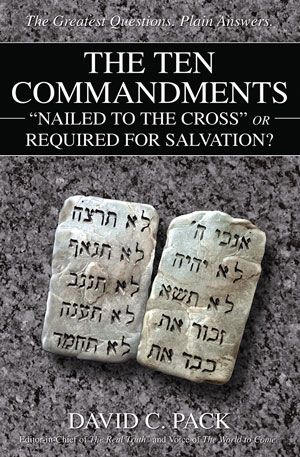
Yet the subject of the Law of God is huge in God’s Word. There is more to study. To fully grasp and appreciate the many elements of this crucial topic, read our book The Ten Commandments – “Nailed to the Cross” or Required for Salvation?
There is no hint that God ever did away with, suspended—or replaced—His Law with “love” or any other religious-sounding phrase. The book makes crystal clear that God’s Law existed long before Moses, from the time of Creation. All Ten Commandments were taught throughout the New Testament and are in effect today.