
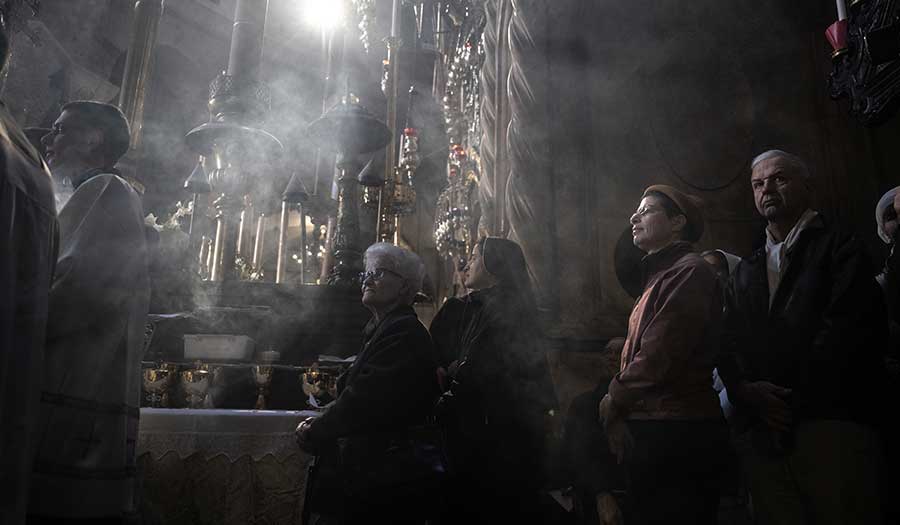
 MOSTAFA ALKHAROUF/ANADOLU VIA GETTY IMAGES
Article
Christians should sincerely ask whether this tradition truly reflects God’s will.
Learn the why behind the headlines.
Subscribe to the Real Truth for FREE news and analysis.
Subscribe NowEaster is a time when believers across traditions honor the resurrection of Jesus Christ. Roman Catholics hold the late‑night Easter Vigil, looking ahead to the account of Jesus’ empty tomb. Protestant congregations often gather for sunrise services, recalling the early morning discovery that Christ had risen.
Lifeway Research, an organization that monitors religious trends, notes that pastors consistently report Easter as drawing some of their largest crowds of the entire year. This single day often surpasses attendance even on Christmas.
Easter’s influence reaches beyond churches. School calendars schedule spring break around the same period, showing how deeply the observance is embedded in public life.
Yet careful readers of the Bible notice three striking realities that conflict with the popular Easter tradition.
First, the Bible never commands an Easter celebration. Nowhere—from Genesis to Revelation—does God establish such a day or instruct His people to observe it.
Second, Jesus never taught His disciples to institute a yearly resurrection festival.
Third, the apostles never practiced it. The single appearance of the word “Easter” in the King James Version in Acts 12:4 is recognized by scholars as a mistranslation of the Greek term pascha, which everywhere else refers to Passover.
These facts raise a necessary question for anyone who seeks to follow Scripture faithfully: If Jesus never commanded Easter, never taught the apostles to keep it, and they never observed it, why would Christians keep it today while overlooking the memorial God Himself appointed?
Foreshadowing Christ
Long before the New Testament era, God established Passover as a sacred memorial. After bringing nine devastating plagues upon Egypt, He declared, “This day shall be unto you for a memorial; and you shall keep it a feast to the Lord throughout your generations; you shall keep it a feast by an ordinance forever” (Ex. 12:14).
Passover was permanently fixed into Israel’s yearly cycle—a lasting memorial of the night God delivered them from bondage.
Within this memorial, every household killed a lamb and shared a meal according to God’s precise instructions.
It memorialized the time God literally passed over their blood‑marked houses, sparing their firstborn while Egypt’s firstborn were killed during the 10th plague, and setting in motion Israel’s release from slavery into freedom.
Leviticus 23 further confirms Passover’s significance by listing it among God’s appointed times. These annual observances were not human inventions. God Himself sanctified them, calling them “My feasts” (vs. 2). These are holy convocations set apart for His own purpose.
This foreshadowed something far greater than the Israelites could yet grasp. The ritual pointed forward to the ultimate sacrifice God would later provide through the true Passover Lamb: Jesus Christ. The New Testament identifies Him plainly. John the Baptist proclaimed Jesus as “the Lamb of God” in John 1:29, and the apostle Paul wrote, “Christ our Passover is sacrificed for us” (I Cor. 5:7).
By observing Passover year after year, Israel rehearsed the need for a Savior who would provide deliverance not merely from physical captivity, but from the spiritual slavery of sin. His death made it possible for people to have salvation.
From the beginning, Passover was designed to be a memorial for the sacrifice of Jesus Christ, the “Lamb slain from the foundation of the world” (Rev. 13:8).
Jesus Kept Passover
When Jesus gathered with His disciples on the night before His crucifixion, He was keeping the same Passover God had commanded Israel to observe since their deliverance from Egypt—not establishing a new holy day.
Knowing He would be killed before the national observance the next day, Christ held the meal early and used the occasion to reveal the deeper spiritual meaning within the Passover ceremony.
During this service, Jesus introduced the foot washing ordinance as an example of the attitude His followers must cultivate—ongoing humility as a way of life, pictured through a willingness to “wash one another’s feet” (John 13:14).
He then expanded the meaning of the symbols they had always used. The unleavened bread represented His sinless body. The wine symbolized His shed blood, poured out for the forgiveness of sin.
In doing this, Jesus honored the memorial His Father had instituted and made clear that His disciples were to continue observing it.
Just as important is what Christ did not do. In all the gospel accounts of His final instructions, there is no reference whatsoever to an annual resurrection celebration. He issued no command, hint or teaching that would support the creation of Easter or anything resembling it. At no point did He authorize replacing Passover with a different spring festival.
What the Early Church Observed
The New Testament Church continued to keep this memorial annually in the spring, following the same pattern Christ Himself had established. In I Corinthians 11, Paul provided plain instruction on how the Church was to observe the yearly Passover service. The entire chapter is worth studying. In verse 26, he wrote: “For as often as you eat this bread, and drink this cup, you do show the Lord’s death till He come.”
That phrase, “till He come,” is a powerful New Testament affirmation that the observance of these symbols, taken on Passover night, is to continue uninterrupted until Christ returns to establish the Kingdom of God.
If ever there was a moment for Paul to introduce a resurrection festival—to pivot the Church toward Easter—this would have been the perfect place. Yet he does nothing of the sort. Instead, he affirms the importance of keeping Passover exactly as Christ taught it.
In verse 27, Paul issues a sobering warning: “Whosoever shall eat this bread, and drink this cup of the Lord, unworthily, shall be guilty of the body and blood of the Lord.”
The implications of mishandling this observance, taken only after careful self‑examination (vs. 28-29), are described as serious and potentially eternal.
To learn more about Passover, read our free booklet God’s Holy Days or Pagan Holidays?
Paul offered zero instructions about shifting the focus to another celebration. Everything in this passage underscores that Passover was to be treated with the utmost gravity, preserved and guarded by the Church exactly as Christ delivered it.
A Gradual Shift
The transition from the biblical Passover to what later became Easter originated not within the Church Jesus built, but within a counterfeit movement that had already begun infiltrating congregations in the first century.
The apostles repeatedly warned that this corrupting influence would grow after their departure. Paul told the Ephesian elders that “grievous wolves” would enter the flock, and that even some from within the congregations he served would rise up and “draw away disciples after them” (Acts 20:29-30). He also explained that a “mystery of iniquity” was already working in his time (II Thes. 2:3, 7).
The apostle John likewise cautioned that “many false prophets” and “many deceivers” had entered the world (I John 4:1; II John 7), and Jude noted that “certain men crept in unawares” (Jude 4).
These warnings reveal an organized counterfeit influence operating alongside the true Church from the very beginning.
As the decades passed, two very different paths emerged. The true Church remained a “little flock” (Luke 12:32), scattered and persecuted, holding firmly to the doctrines delivered by Christ and the apostles. In contrast, a larger, more visible, politically connected religious structure developed—one that gradually adopted customs and doctrinal changes that aligned more comfortably with the surrounding Roman world.
Within this post-apostolic environment, influential leaders began distancing themselves from anything associated with Judaism—including the biblical calendar God had established. Sunday observance gained influence, and a yearly resurrection celebration grew in popularity.
This widening divide became unmistakable in the Quartodeciman controversy, recorded by historian Eusebius in Ecclesiastical History. Congregations in Asia Minor continued keeping the Passover on the 14th day of Nisan, while Rome favored a Sunday observance instead.
In the mid-second century, this dispute became personal when Polycarp of Smyrna—a disciple of the apostle John—traveled to Rome to meet Bishop Anicetus. According to Eusebius, Polycarp explained that he had always kept the Passover on the 14th day, as he had received from John and the other apostles.
Neither man altered his position, and the matter was left unsettled.
A decisive moment came in AD 325 at the Council of Nicaea, where church leaders standardized a universal Sunday observance rather than keeping it tied to the Passover date. From that point, those who continued holding to the 14th day increasingly found themselves marginalized by the growing institutional system.
Throughout this period, the true Church did not compromise. Though small and often forced to scatter, it continued faithfully observing the original Passover exactly as Christ and the apostles had taught.
The shift to Easter did not arise from Scripture. It gradually developed as a tradition.
Who Decides What Is Holy?
God alone determines what is holy. From the beginning, He established Passover as the memorial of Christ’s sacrifice. It was not left to human interpretation or cultural preference.
No council, no tradition and no popular custom can alter what God Himself has declared sacred.
Throughout history, religious leaders have introduced customs that seemed attractive, unifying or easier to accept within the culture around them. Yet none of these innovations carry divine authority simply because they become popular. What God did not sanctify cannot somehow be made holy simply because people decide it is.
Christ warned plainly against elevating human tradition above the commandments of God. He rebuked those who replaced God’s instructions with their own traditions, saying, “In vain do they worship Me, teaching for doctrines the commandments of men…Full well you reject the commandment of God, that you may keep your own tradition” (Mark 7:7, 9).
Millions find Easter inspiring and spiritually rejuvenating. Many observe it with sincere devotion. But inspiring does not equal holy. A practice becomes holy only when God designates it as such.
Passover carries God’s authority because He instituted it. In Exodus 12:11, He calls it “the Lord’s Passover.”
Easter, however, arose centuries later through human decisions—decisions shaped by culture, politics and tradition rather than Scripture.
Christ’s Only Sign
The Easter timeline is well-known: Jesus died on Good Friday and arose Sunday morning.
Yet Christ’s own words contradict this. When challenged to prove His identity, He offered one unmistakable sign.
He declared, “As Jonah was three days and three nights in the whale’s belly; so shall the Son of man be three days and three nights in the heart of the earth” (Matt. 12:40).
This was a precise prophetic timetable. If it failed, His entire claim to being the Christ would collapse.
The popular Friday‑to‑Sunday tradition, however, cannot contain three days and three nights. At most, it produces a day and a half. No symbolic interpretation or compressed counting can reconcile that timeline with Jesus’ own words.
To understand this sign, the correct chronology is essential.
Jesus and His disciples kept the Passover on Tuesday night, or more accurately the start of Wednesday, since God counts days from sunset to sunset (see Genesis 1). That evening was the beginning of the 14th day of the month, exactly as God had appointed.
Later that same day—Wednesday afternoon—Christ died at the very hour the Passover lambs were being killed throughout Judea. He was placed in the tomb just before sunset, as the First Day of Unleavened Bread, an annual Sabbath, was about to begin. This moment marked the start of the first of three nights and three days.
Counting forward exactly 72 hours brings His resurrection to the end of the weekly Sabbath, completing the only sign He gave. This is why the tomb was already empty early Sunday morning—He had risen the previous evening, Saturday, precisely on schedule.
Only the Passover‑based chronology—Tuesday Passover, Wednesday crucifixion, Saturday resurrection—matches the sign of Jonah exactly as Christ stated it!
Ironically, Easter observance emphasizes a Sunday morning resurrection while overlooking the very proof Christ said would confirm who He is. A tradition meant to honor His resurrection ends up obscuring the central evidence He gave us.
For more details about this timing, read our booklet Christ’s Resurrection Was Not on Sunday.
This should prompt a sincere question: If Christ declared that this was the only sign verifying His Messiahship, why would any Christian ignore it—or embrace a tradition that contradicts it?
Scripture Before Tradition
The biblical record is consistent: God appointed Passover, Jesus kept it, the apostles taught it, and the early Church observed it exactly as they had received it. Each generation of the true Church continued the same practice because it was commanded.
In contrast, Easter does not originate from the Bible.
Sadly, millions are unaware or unsure of Easter’s history and its absence in Scripture and keep it anyway.
God calls people to “Prove all things; hold fast that which is good.” (I Thes. 5:21). This includes honestly examining whether long‑held observances carry God’s authority.
Christ did not authorize a resurrection festival. Nor did He replace Passover. He was faithful to what His Father appointed and set an example for His followers.
That is the biblical pattern. Regardless of what popular churches may promote, Scripture overrules tradition. The question for every sincere Christian is whether they will follow the Word of God or a counterfeit substitute.
Paul summed up the entire matter: “Christ our Passover is sacrificed for us: therefore let us keep the feast” (I Cor. 5:7-8).
Other Related Items:
More on Related Topics:
Latest News
-
October 9, 2026
- What Will the Next Leader of the UN Need to Get the Job Done in an Increasingly Complex World? October 8, 2026
- UN Health Agency Wants More Details from Russia on Suspected Pneumonic Plague Case
- Ukraine Claims to Have Taken Out More Than Half of Russia’s Oil Refining Capacity
- Violence Has Displaced Members of More Than Half a Million Mexican Households in Past 5 Years
- As Iran War Smolders, Shunned Eritrea Looks to Come in from the Cold September 15, 2026
- U.S. Acknowledges for the First Time that It Has Deployed Weapons in Space
- Some Russians Are Fleeing Abroad, Citing Draft Fears and a Loss of Freedom September 11, 2026
- Americans Mark 25 Years Since September 11 Attacks amid Enduring Grief, Reflection
- Yemen’s Iranian-Backed Houthis Seize an Island in a Key Strait, Opening a New Front in the Iran War September 10, 2026
- The Push to Remove Lead Pipes Is On. Thousands of Water Systems Still Don’t Know Where Theirs Are September 9, 2026
- Family Interest in Education Falls as Test Scores Drop
- The Poorest in the U.S. Can’t Find Housing Even as Low-Income Units Sit Empty September 1, 2026
- In U.S. West, Drought Pits Farms Against Industry
- Why Christians Must Watch the News
- Teach Your Children to Be Active
- What Comes After America 250? August 31, 2026
- How Brexit Broke British Politics
- How to Keep the Sabbath
- Aliens and the Bible?
- Building Character in a Crooked World