
 BASHAR TALEB/AFP VIA GETTY IMAGES
Article
An overlooked moment at the Winter Olympics revealed a fundamental truth about people.
Learn the why behind the headlines.
Subscribe to the Real Truth for FREE news and analysis.
Subscribe NowAt the opening ceremony of the 2026 Winter Olympics, Italy introduced itself to the world the way only Italy could. Opera swelled through the night air, with Verdi and Puccini woven into the program. The unmistakable strains of Rossini’s William Tell Overture stirred the crowd.
Giant suspended paint tubes hung from the stadium ceiling, bursting with color as if the Renaissance itself were being poured out over the modern age. The ceremony nodded to Leonardo da Vinci’s artistic genius, to Federico Fellini’s cinematic imagination, to Giorgio Armani and the runways of Italian fashion. Espresso makers, mythological figures and contemporary choreography blended into one confident declaration: This is who we are.
For a few hours, the host nation presented the finest version of itself—culture, beauty, creativity, refinement. A vision of what humanity can create at its best.
Then, amid the spectacle, the tempo slowed.
Italian rapper Ghali stepped forward surrounded by dancers. Rather than deliver a hip-hop performance, he chose to recite a poem. In Italian, then in French and English, he spoke the words of children’s author Gianni Rodari: “There are things never to be done…one, for example, is war.”
This statement, from the poem Memorandum, comes after listing things children must do every day: bathe, study, play, help their parents, sleep and dream.
At the end, dancers lowered themselves to the floor, forming the shape of a dove, the universal symbol of peace.
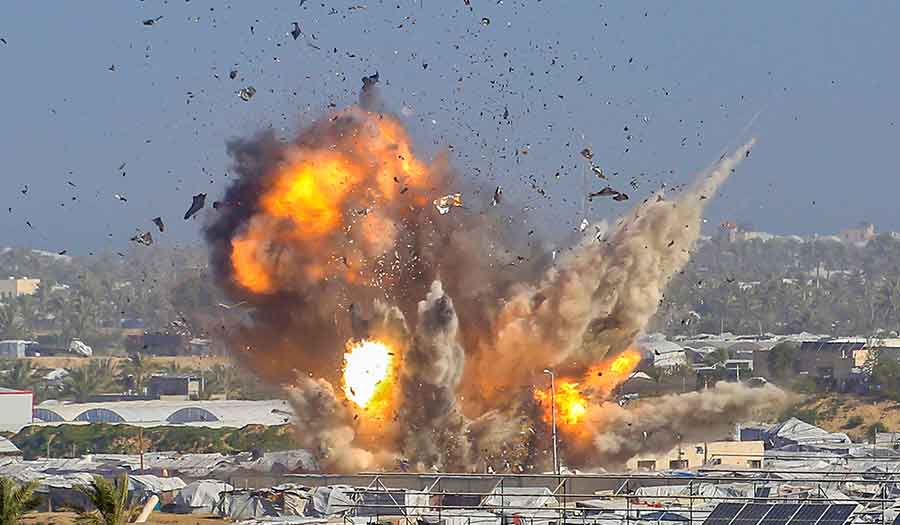
Yet outside the stadium, peace was still missing.
In Sudan’s Kordofan region, UN rights officials said drone strikes killed at least 57 civilians over two days in February—including at least 15 children—as warring parties targeted markets and shelters in the long-running civil war.
In Ukraine, Action on Armed Violence research shows civilian casualties surged in 2025, with dozens killed and hundreds injured by Russian strikes on cities and infrastructure.
And in Gaza, UNICEF reports that tens of thousands of children have been killed or injured since October 2023.
Why do we know to teach our children war is wrong, yet utterly fail to put a stop to it as adults?
Beyond Rodari, politicians, philosophers and thinkers throughout the centuries have written unending words about an end to war.
Why can humanity never seem to turn those dreams and ideals into reality?
Global Ideal
The official theme of the Games was armonia, the Italian word for harmony. The message was reinforced visually and verbally: “Peace” glowed in giant letters on the side of the stadium, formed from the lights of the audience’s wristbands. Speeches emphasized unity over conflict and division.
International Olympic Committee President Kirsty Coventry stated: “Here, athletes from every corner of our world compete fiercely—but also respect, support and inspire one another. They remind us that we are all connected, that our strength comes from how we treat each other, and that the best of humanity is found in courage, compassion and kindness.”
South African actress and United Nations peace ambassador Charlize Theron quoted Nelson Mandela: “Peace is not just the absence of conflict. Peace is the creation of an environment where all can flourish, regardless of race, color, creed, religion, gender, class, caste, or any other social markers of difference.”
Such words and displays are not unique to the Olympics.
After wars, leaders vow, “Never again.” Candlelight vigils follow tragedy, memorials are raised to honor the fallen, and treaties and ceasefires are negotiated—all sincere attempts to secure peace after bloodshed.
Spilling Ink
For centuries, thinkers have wrestled with the deeper question beneath Rodari’s simple line: If war is something that should never be done, how do you stop nations from doing it anyway?
In ancient China, during the Warring States period (475-221 BC), the philosopher Mozi condemned aggressive war by pointing out a moral contradiction: Killing one man was treated as a crime, yet invading a rival state and killing thousands was often praised. Mozi argued that war endures because people instinctively protect their own side and treat outsiders as less valuable. If human beings could learn to weigh other lives as heavily as their own, he believed, war would more naturally be avoided.
More than two millennia later, Europe was still wrestling with the same question. In 1795, philosopher Immanuel Kant published the essay Toward Perpetual Peace. His aim was to build a rational plan for peace in a world of self-interested nations.
His starting premise: A peace treaty is not peace if it is signed with “mental reservations”—if leaders agree publicly while privately leaving room to resume the fight. From there, he argued that peace would require restraints: governments accountable to their people and international law to prevent disputes from escalating into war.
These ideas did not remain trapped in philosophy.
After World War I, leaders and legal theorists reached for Kant’s ideas when trying to build institutions designed to prevent another catastrophe. Germany’s foreign minister invoked the philosopher while making the case for the League of Nations, which later folded into the UN.
Humanity has not ignored the problem of war. It has studied it relentlessly. It has tried to write peace into philosophy, treaties, institutions and international law.
One might argue that the world we see today is humanity’s best attempt to institutionalize peace. It has built mechanisms that have deterred some conflict, isolated some aggressors, and sometimes kept violence from spreading.
Yet war remains.
Why Words Fail
When Ghali’s dancers formed a dove across the stadium floor, they were invoking a symbol nearly everyone recognizes. That dove with an olive branch has roots in the Bible: After the Flood, Noah sent out a dove, and it returned with an olive leaf as proof that destruction had passed and restoration could begin (Gen. 8:8-11).
That origin is fitting. The Bible has much to say about war and peace.
God is clear how He feels about violence. The Ten Commandments state it plainly: “You shall not kill” (Ex. 20:13). Innocent life is not to be taken.
Yet people do not need to know the Bible to understand war is wrong. They may argue about when it is “necessary,” but few praise bloodshed as pure good. They justify it because they feel the need to.
This is what the apostle Paul explains in Romans 2: “The Gentiles, which have not the law, do by nature the things contained in the law…their conscience also bearing witness…” (Rom. 2:14-15).
By “the law,” Paul is referring to God’s Law, which is summed up in the Ten Commandments. Paul’s point is not that human beings naturally obey it, but that their consciences still recognize basic moral principles.
And yet, knowing what is right is not the same thing as doing it. Knowing how to bring peace escapes even the most celebrated minds of history.
In 1932, Albert Einstein wrote to Sigmund Freud with a question that still haunts the modern world: “Is there any way of delivering mankind from the menace of war?”
Einstein was agnostic and Freud was an atheist. They did not follow the Bible but still treated war as a problem to be solved.
Einstein admitted something sobering about humanity’s peace efforts: “for all the zeal displayed, every attempt at its solution has ended in a lamentable breakdown.”
Freud, for his part, could only speculate that growing civilization—and dread of the next war’s destruction—might restrain mankind someday. But he conceded: “By what ways or by-ways this will come about, we cannot guess.”
Two of the 20th century’s greatest secular minds could see the moral problem. But they could not show how society would actually arrive at lasting peace.
God’s Word puts that verdict in a single line: “The way of peace they know not” (Isa. 59:8).
Humanity knows enough to condemn war. But without fully following God’s Law, it does not know the way to make peace permanent.
Words with Authority
It is fitting that some of the most impactful words of the Olympics opening ceremony came from a children’s author. Children represent the future. When we see them suffering—displaced by war, injured in bombings, growing up fatherless—the brokenness of the present world becomes unmistakable. Their vulnerability sharpens our longing for something better.
The Bible does not merely echo that longing. It describes a future in which it is fulfilled: “Thus says the Lord of hosts; There shall yet old men and old women dwell in the streets of Jerusalem…And the streets of the city shall be full of boys and girls playing in the streets thereof” (Zech. 8:4-5).
This promise is rooted in Jerusalem, but its scope is far larger. It portrays a world where the most vulnerable—the elderly and the young—move about without fear. Streets are not emptied by air-raid sirens or scarred by rubble. They are filled with life. In a world where images of bomb shelters and refugee camps are common, such a scene feels implausible.
Isaiah expands the vision even further: “The wolf also shall dwell with the lamb…and a little child shall lead them…They shall not hurt nor destroy in all My holy mountain” (11:6, 9).
This represents a total transformation from the world of today. Violence is not just restrained, it is removed entirely.
Today, children are often the first to suffer in conflict. In the world God describes, they become symbols of safety and trust.
And this coming peace will endure. It will be sustained by God’s instruction and guidance: “And all your children shall be taught of the Lord; and great shall be the peace of your children” (Isa. 54:13).
True peace lasts because it is taught. It must be anchored in God’s Law and upheld by His authority.
On its face, such a future sounds too hopeful—too distant from present reality. The gap between prophecy and headlines is wide.
The difference between man’s peace plans and God’s peace promises is authority. Human beings can write beautiful words and even build institutions, but they cannot guarantee results.
God can.
He describes Himself as the One “Declaring the end from the beginning, and from ancient times the things that are not yet done, saying, My counsel shall stand, and I will do all My pleasure” (Isa. 46:10). And He states it even more simply: “I the Lord have spoken it, and I will do it” (Ezek. 36:36).
In other words, God does not publish peace as an aspiration. He preserves it in His Word as a promise—and will bring it to pass.
The Gospel of Peace
A peaceful future is the very message Jesus Christ brought, and what the apostle Paul called “the gospel of peace.”
During His earthly ministry, Christ preached: “The Kingdom of God is at hand: repent you, and believe the gospel” (Mark 1:15).
Paul wrote, “How beautiful are the feet of them that preach the gospel of peace, and bring glad tidings of good things!” (Rom. 10:15). He also said that Christians are to stand with their “feet shod with the preparation of the gospel of peace” (Eph. 6:15).
The word gospel means good news. It is the announcement of a coming Kingdom—the rule of God over the Earth.
Isaiah described what that rule will accomplish: “And He shall judge among the nations…and they shall beat their swords into plowshares, and their spears into pruninghooks: nation shall not lift up sword against nation, neither shall they learn war any more” (2:4).
Notice the structure of that promise. Peace comes after judgment—after authority is exercised. Nations will not simply agree to disarm, rather they will be taught a different way. War is unlearned.
Peace is connected directly to government: “Of the increase of [God’s] government and peace there shall be no end…” (9:7).
Even mankind knows government and peace are tied together. Just look at the UN. Yet peace from God does not depend on fragile consensus or temporary restraint. It will endure because it is upheld by righteous authority.
This is why the gospel is good news. It does not ask humanity to generate a peace it has repeatedly failed to sustain. It announces that peace will be established by the One who can remove the causes of conflict altogether.
God’s Peace Now
God is not only planning to bring peace in the future.
Jesus said: “Peace I leave with you, my peace I give unto you: not as the world gives, give I unto you. Let not your heart be troubled, neither let it be afraid” (John 14:27).
The world offers fleeting peace through treaties, deterrence and negotiation. God offers peace through transformation of the human heart.
Colossians 3:15 says, “Let the peace of God rule in your hearts.”
Peace now comes from living under God’s government. The same Law that will one day guide nations can guide individuals today. Where God’s rule is accepted, conflict gives way to restraint. Pride yields to humility. Fear yields to trust.
Part of that peace comes from understanding the world as it truly is. Knowing that the “way of peace they know not” (Isa. 59:8) can help you make sense of the events going on in the world. It explains why the best human efforts to end war collapse. It confirms that lasting peace cannot emerge from human will alone.
And it anchors hope.
Because the God who gives peace to individuals today has promised to give peace to the world tomorrow. He has declared a future in which swords become plowshares, in which children play safely in the streets, in which war is not merely paused, but unlearned.
“There are things never to be done…one, for example, is war.”
Humanity can write those words. Only God can make them permanent.
More on Related Topics:
- After Killing Hundreds in Boat Strikes, U.S. Military Expands Campaign on Land in Latin America
- Analysis: How Iran Is Widening Its Pressure Campaign to Force U.S. Concessions
- Analysis: Russia Pounds on the Gates of Ukraine’s ‘Fortress Belt’
- Iran Fallout: A Global Hunger Crisis?
- Analysis: ‘Breakneck’ Ebola Epidemic in Congo Outpaces World’s Response
Suggested Reading
More on Related Topics
Latest News
-
October 9, 2026
- What Will the Next Leader of the UN Need to Get the Job Done in an Increasingly Complex World? October 8, 2026
- UN Health Agency Wants More Details from Russia on Suspected Pneumonic Plague Case
- Ukraine Claims to Have Taken Out More Than Half of Russia’s Oil Refining Capacity
- Violence Has Displaced Members of More Than Half a Million Mexican Households in Past 5 Years
- As Iran War Smolders, Shunned Eritrea Looks to Come in from the Cold September 15, 2026
- U.S. Acknowledges for the First Time that It Has Deployed Weapons in Space
- Some Russians Are Fleeing Abroad, Citing Draft Fears and a Loss of Freedom September 11, 2026
- Americans Mark 25 Years Since September 11 Attacks amid Enduring Grief, Reflection
- Yemen’s Iranian-Backed Houthis Seize an Island in a Key Strait, Opening a New Front in the Iran War September 10, 2026
- The Push to Remove Lead Pipes Is On. Thousands of Water Systems Still Don’t Know Where Theirs Are September 9, 2026
- Family Interest in Education Falls as Test Scores Drop
- The Poorest in the U.S. Can’t Find Housing Even as Low-Income Units Sit Empty September 1, 2026
- In U.S. West, Drought Pits Farms Against Industry
- Why Christians Must Watch the News
- Teach Your Children to Be Active
- What Comes After America 250? August 31, 2026
- How Brexit Broke British Politics
- How to Keep the Sabbath
- Aliens and the Bible?
- Building Character in a Crooked World