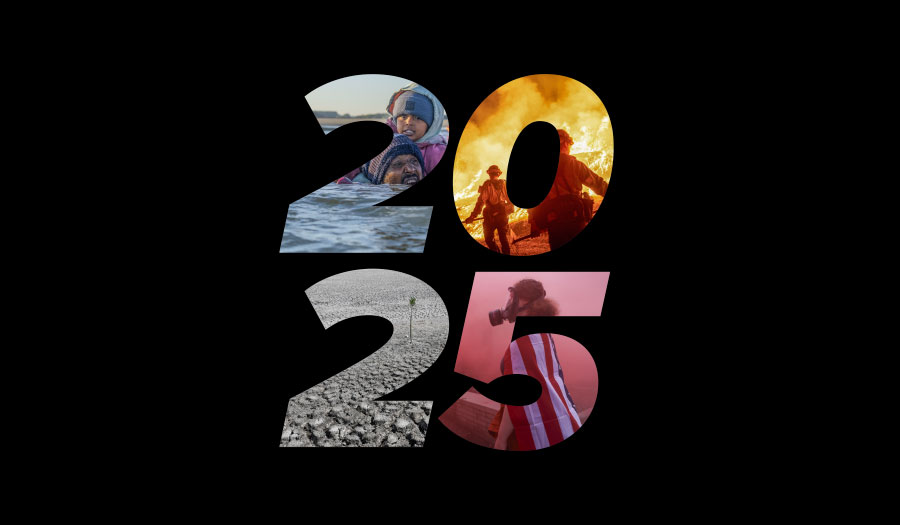
 TOP LEFT, CARL COURT/GETTY IMAGES; TOP RIGHT, BRANDON BELL/GETTY IMAGES; BOTTOM LEFT, JOE RAEDLE/GETTY IMAGES; BOTTOM RIGHT, SPENCER PLATT/GETTY IMAGES
Article
A year of war, disaster, division and unrest tested the foundations of modern life. What stood—and what failed—revealed far more than headlines ever could.
Learn the why behind the headlines.
Subscribe to the Real Truth for FREE news and analysis.
Subscribe Now“In a time of crisis, it’s so funny what you learn about yourself, in terms of what to save,” a Los Angeles resident told People after being forced to flee as wildfires tore through Southern California in the first days of 2025.
Evacuation orders came with little warning as the fires rapidly spread through dry hillsides and neighborhoods. There was no time for careful decisions. People left with whatever they could carry. Many reached instinctively for family photographs, children’s artwork and handwritten letters—things that could not be replaced.
Others left with nothing at all, focused only on getting loved ones to safety.
In the heat and confusion, something else surfaced: character. Neighbors knocked on doors to warn those who had not seen alerts. Some stayed longer than advised to help the elderly or guide strangers through smoke-filled streets. Firefighters pushed past exhaustion.
The fires caused real loss and hardship—the estimated cost of the damage is $250 billion—but they also revealed a deeper truth about life. Trials and tragedy have a way of exposing what we are really made of and what truly matters.
The Bible explains how hardship works. The apostle Paul wrote that human lives and efforts are like materials used in construction—“gold, silver, precious stones, wood, hay, stubble” (I Cor. 3:12).When testing comes, it burns away what is temporary and leaves what endures. “Every man’s work shall be made manifest…because it shall be revealed by fire; and the fire shall try every man’s work of what sort it is” (vs. 13).
In moments of trial, the reality beneath the surface is laid bare. The heat of life reveals the truth.
And 2025 sure did have a lot of heat. Wars in Ukraine and Gaza pressed on into yet another year, leaving cities in ruins and tens of thousands dead. In Sudan, millions were driven from their homes as fighting deepened one of the world’s worst humanitarian crises. By summer, tensions in the Middle East flared sharply, with U.S. strikes on Iranian nuclear sites raising fears of wider war. Protests toppled governments in Nepal and Bulgaria. Record heatwaves scorched Europe. Monsoon floods across Asia swallowed villages and displaced millions.
The pace did not ease as the year closed. In Australia, a mass shooting at a crowded beach during Hanukkah celebrations left many dead. In Syria, U.S. service members were killed amid renewed violence and extremist attacks. In Rhode Island, a shooting at Brown University devastated yet another school campus.
The last 12 months felt compressed, with events stacked tightly together applying pressure again and again. And as with the fires that opened the year, those events revealed lessons that are easy to miss in calmer times—truths about human nature, about the limits of institutions, about the world as it actually is.
Here is what 2025 revealed…
A Fractured Republic
The California wildfires revealed more than the character or priorities of individuals—they exposed just how deeply divided the United States has become.
As flames spread, the White House publicly faulted state leadership, pointing to water management and land-use policies as failures that had worsened the disaster. California’s governor, a Democrat, rejected that account. He warned that the public was being battered by “hurricane-force winds of mis- and disinformation” about the fires and launched a state website to counter what his office described as false narratives.
The exchange put Americans in a familiar position: Watching politicians and pundits describe the same event in fundamentally different ways, each insisting the other was misleading the public. For the fires, the issue moved from how the blazes started to who could be trusted to tell the truth about them.
The prophet Isaiah’s words perfectly describe such conditions: “Judgment is turned away backward, and justice stands afar off: for truth is fallen in the street, and equity cannot enter…yes, truth fails” (59:14-15).
While Americans could agree on little else in 2025, most shared the same uneasy conclusion: Judgment, justice and truth all felt increasingly fragile.
As the year progressed, that fragility became more visible—especially surrounding major decisions by a newly re-elected President Donald Trump. Event after event seemed to unfold in parallel realities:
Tariff policies were framed either as a long-overdue correction to decades of trade imbalance—or as a risky gambit that left American consumers paying more.
Immigration enforcement was described either as a necessary effort to restore control at the border—or as a heavy-handed crackdown that punished the desperate.
Missile strikes against Venezuelan boats were portrayed either as a decisive move to disrupt drug trafficking and smuggling networks—or as a dangerous escalation that could constitute war crimes.
In September, the assassination of political activist Charlie Kirk shocked the nation, with partisan finger pointing quickly following. Each side accused the other of inflaming political rhetoric and creating a climate that made violence more likely. The event warped reality further, with conspiracy theories casting doubt on the official account and further eroding trust in law enforcement and the media.
Soon after, the federal government reached gridlock with a prolonged shutdown. Each side blamed the other. Responsibility, like so much else in 2025, depended on who was telling the story.
After a year of rampant division, Jesus Christ’s words should serve as a harsh warning to the nation: “Every kingdom divided against itself is brought to desolation; and every city or house divided against itself shall not stand” (Matt. 12:25).
Wars That Refused to End
As wars drag on, some people lose hope while others continue to yearn for peace. When 2025 began, the world wondered if this would be the year that conflicts in Ukraine, Gaza and other places would finally be resolved. But as the months passed, optimism collided with reality. While some wars did slow down or reach shaky ceasefires, lasting peace remained elusive.
Proverbs 13:12 says, “Hope deferred makes the heart sick.” Seeing people hurt, killed and displaced in Sudan, Cambodia, Thailand, Myanmar and other places, and small children malnourished in Gaza, is indeed sickening. The hope for peace has been deferred yet again, to 2026 or some indefinite point in the future.
Ukraine entered its fourth year of grinding war with Russia. During the U.S. presidential campaign, Donald Trump said the conflict could be ended swiftly through negotiation. While various high-profile meetings took place, such as the Oval Office meeting in late February between Mr. Trump and Ukrainian President Volodymyr Zelenskyy that ended in an explosive argument, and the August 15 meeting in Alaska with Mr. Trump and Russian President Vladimir Putin, these talks did not produce peace.
Front lines moved little, while missile and drone attacks continued to strike cities and infrastructure. Ukraine refused to surrender territory, and Russia showed no willingness to withdraw. As Scripture warns, “They shall seek peace, and there shall be none” (Ezek. 7:25).
In Gaza, the year exposed a different weakness: How easily ceasefires unravel. A temporary halt in fighting early in the year raised cautious hopes that devastation might ease. Those hopes faded as major Israeli operations resumed in the spring, plunging the territory back into violence and humanitarian crisis. By December, another ceasefire was in place, yet there have still been numerous attacks and military activities. The pattern repeated: Truces form under pressure, then erode by unresolved grievances.
Tensions between Israel and Iran simmered throughout the year, culminating in unprecedented direct strikes between the two countries, with the U.S. getting involved to attack Iran’s nuclear facilities. Wider war was avoided, but only narrowly, showing how close the Middle East remains to broader escalation.
These conflicts reveal a sobering truth. Wars persist not merely because of weapons or alliances, but because of human nature. James 4:1 says directly that wars and conflicts come from “evil desires at war within you” (New Living Translation). Ambition, fear and pride are rooted deeply within the hearts of men. Leaders can negotiate and institutions can intervene, but no one can remove the evil within the human heart that provokes people to fight and kill.
Psalm 46:9 reveals the only Being who can end conflict: “He [God] makes wars to cease unto the end of the earth.” Peace remains elusive because humanity continues to look inward for answers.
Shifting World Order
For decades, global stability rested on a familiar idea: Major powers would cooperate to manage crises and preserve order. In 2025, that belief weakened under pressure, revealing a world less coordinated—and more divided—than many assumed.
The strain was evident at the G20 summit in Johannesburg, South Africa. Intended to display unity, the meeting instead highlighted fragmentation. The United States did not send a representative. “No U.S. Government Official will attend as long as [South Africa’s] Human Rights abuses continue,” the president said.
Other nations arrived with competing priorities, and meaningful consensus proved difficult. The prophet Amos observed, “Can two walk together, except they be agreed?” (3:3). The clear answer to this rhetorical question is no.
China’s posture reinforced that fragmentation. Beijing continued to assert itself as a parallel center of power, engaging selectively with Western-led institutions while expanding bilateral influence and alternative alliances.
Economic policy added further strain. America’s renewed emphasis on tariffs and trade pressure brought uncertainty to traditional relations with the nation’s allies. Supporters viewed the strategy as corrective, while critics warned of retaliation and instability.
Some citizens want America to show leadership in the world at large, while others want the U.S. to focus more exclusively on its own people and problems.
Across Europe, political realignment accelerated. Far-right and populist parties gained ground. France experienced repeated government upheaval, with prime ministers removed in rapid succession. In the United Kingdom, the rise of Reform UK reflected growing rejection of traditional parties.
Rivalry extended beyond politics into technology. Artificial intelligence became another arena of competition, with nations racing to secure advantages in development, regulation and military use. AI innovation was treated less as a shared advance and more like a strategic asset.
Global shifts like these reveal a greater purpose at work. The prophet Daniel recorded that God “removes kings, and sets up kings” (2:21). Psalm 33:10 adds, “The Lord foils the plans of the nations; He thwarts the purposes of the peoples” (New International Version).
God allows the countries of Earth to pursue certain plans of their own. Yet He also guides events to make sure that His overall plan for mankind stays on track. When nations’ plans become at odds with God’s purpose, He overthrows those plans. While we cannot always tell which is the case, seeing shifts like those in 2025 reminds us that God is at work.
Taking to the Streets
This year, public frustration boiled over in the form of widespread protests. Across continents, people moved into streets and campuses to express their frustration with the status quo.
Gen Z played a central role in this unrest. Organizing quickly through social media, protesters challenged political systems they believed no longer represented them. These protests were sparked by specific grievances but were also driven by long-simmering issues like widening inequality, economic uncertainty, corruption, and nepotism of leaders.
A deadly uprising in Nepal culminated with the resignation of the prime minister in September. Protesters drew inspiration from successful anti-government movements elsewhere in South Asia—Sri Lanka in 2022 and Bangladesh in 2024—which led to the ouster of incumbent regimes.
In mid-October, Madagascar’s president was forced out of power and out of the country after a military mutiny, the culmination of weeks of demonstrations led by “Gen Z Madagascar.”
Other protests across the world took place in countries including the Philippines, Indonesia, Kenya, Peru and Morocco. Near the year’s end, sustained protests in Bulgaria again contributed to government collapse.
In the U.S., protests branded under the slogan “No Kings” reflected similar frustration with political authority and institutions.
What these protests revealed is a lack of trust that cannot be easily restored. Officials resigned, governments reshuffled and reforms were promised. Yet citizens do not trust their governments to make good on their promises. Leaders cannot trust their citizens to support their decisions, as an uprising could remove them from office at any moment.
The book of Ecclesiastes shows that God is watching these events: “If you see the oppression of the poor, and violent perverting of judgment and justice in a province, marvel not at the matter: for He that is higher than the highest regards” (5:8).
Throughout Scripture, God makes clear that He hates oppression and inequality. Proverbs 14:31 says, “He that oppresses the poor reproaches his Maker.” Yet God also shows that protesting is not the solution: “You shall not follow a multitude to do evil” (Ex. 23:2).
Proverbs 29:2 reveals what will solve the problem: “When the righteous are in authority, the people rejoice: but when the wicked bear rule, the people mourn.” One way to think of being “righteous” in modern language is having character. That is what makes the difference. When leaders possess good character, people can rely on them. And God would expect the same thing from citizens. He would not require righteousness from leaders while allowing unrighteousness from everyone else.
Until leaders and citizens can trust one another, the cycle of protesting is doomed to continue.
Against the Elements
Not every force that shaped 2025 carried a human fingerprint. While politics and war dominated headlines, the weather delivered its own reminder of humanity’s limits.
In Texas, catastrophic flooding in July followed record rainfall along the Guadalupe River, claiming lives and devastating communities. Familiar places became dangerous in a matter of hours. Just at Camp Mystic, a girls’ summer camp in the area, 27 children were tragically killed.
One of the parents who lost a child in the disaster told ABC News that waiting for her daughter’s body to be recovered felt like a “torture chamber of uncertainty.”
Across Europe, prolonged heat waves strained power grids and overwhelmed health systems. Cities built for milder summers struggled as temperatures remained dangerously high. Wildfires spread across southern Europe—especially in Greece, Italy and Portugal—forcing evacuations and leaving scorched landscapes behind.
Elsewhere, powerful cyclones and typhoons struck the Philippines and Bangladesh, displacing communities and destroying crops. For poorer nations, recovery proved especially difficult.
Risks were known. Warnings were issued. Yet conditions exceeded what planning could handle. No matter how far society advances, the weather remains an untamable force. People feel powerless against it.
Prolonged drought also took a heavy toll in parts of Africa, the Middle East and southern Europe, shrinking reservoirs and damaging crops. In many regions, the slow crisis of water scarcity proved just as destructive as more sudden disasters. Even America’s Rio Grande-Bravo water basin is in crisis.
Romans 8 speaks of how “the whole creation groans and travails in pain together until now” (vs. 22). Verse 21 poetically speaks of the planet being “delivered from the bondage of corruption into…glorious liberty.” The context makes clear that this will only happen after God establishes His Kingdom on Earth. Nature will not be in harmony until God brings it glorious liberty.
Violent weather ignores borders, wealth and ideology. Technology helps—but only to a point. Jesus Christ warned that storms test every foundation (Matt. 7:24-27). In 2025, nature once again revealed a familiar truth the world prefers to forget: Some forces remain beyond human control.
What Cannot Be Shaken
From fires and floods to wars, protests and political collapse, the events of 2025 applied relentless pressure. They exposed fragile institutions and divided nations. They stripped away the illusion that human effort alone can solve this world’s problems.
The last 365 days—and the lessons revealed through its events—offer a small preview of what lies ahead.
The prophet Haggai recorded God’s declaration of a time yet to come: “Yet once, it is a little while, and I will shake the heavens, and the earth, and the sea, and the dry land…and I will shake all nations” (2:6-7).
Paul later explained why such shaking is necessary. Quoting Haggai, he wrote that God will shake “not the earth only, but also heaven,” so that “those things which cannot be shaken may remain” (Heb. 12:26-27).
God will shake the entire world to expose what is built on human reasoning—and what is built on His Way.
At that time, God will establish a Kingdom that replaces what cannot endure. Paul calls it “a Kingdom which cannot be moved” (vs. 28). This government of God will finally bring what the world has never been able to produce: A society free from corruption, fear and selfish leadership.
Until that time comes, periods of shaking will continue. We at The Real Truth will be here pointing readers to the biblical meaning behind world events—not merely what is happening, but what those events reveal.
With each passing year, the contrast grows clearer between what mankind builds and what God is bringing—between this “present evil world” (Gal. 1:4) and the wonderful “world to come” (Luke 18:30).
The events of 2025 revealed how fragile this present world truly is. But we can look forward to something unshakable: His Kingdom to come. When everything else is shaken, only what God builds will stand.
More on Related Topics:
- After Killing Hundreds in Boat Strikes, U.S. Military Expands Campaign on Land in Latin America
- Analysis: How Iran Is Widening Its Pressure Campaign to Force U.S. Concessions
- Analysis: Russia Pounds on the Gates of Ukraine’s ‘Fortress Belt’
- Iran Fallout: A Global Hunger Crisis?
- Analysis: ‘Breakneck’ Ebola Epidemic in Congo Outpaces World’s Response
Suggested Reading
More on Related Topics
Latest News
-
October 9, 2026
- What Will the Next Leader of the UN Need to Get the Job Done in an Increasingly Complex World? October 8, 2026
- UN Health Agency Wants More Details from Russia on Suspected Pneumonic Plague Case
- Ukraine Claims to Have Taken Out More Than Half of Russia’s Oil Refining Capacity
- Violence Has Displaced Members of More Than Half a Million Mexican Households in Past 5 Years
- As Iran War Smolders, Shunned Eritrea Looks to Come in from the Cold September 15, 2026
- U.S. Acknowledges for the First Time that It Has Deployed Weapons in Space
- Some Russians Are Fleeing Abroad, Citing Draft Fears and a Loss of Freedom September 11, 2026
- Americans Mark 25 Years Since September 11 Attacks amid Enduring Grief, Reflection
- Yemen’s Iranian-Backed Houthis Seize an Island in a Key Strait, Opening a New Front in the Iran War September 10, 2026
- The Push to Remove Lead Pipes Is On. Thousands of Water Systems Still Don’t Know Where Theirs Are September 9, 2026
- Family Interest in Education Falls as Test Scores Drop
- The Poorest in the U.S. Can’t Find Housing Even as Low-Income Units Sit Empty September 1, 2026
- In U.S. West, Drought Pits Farms Against Industry
- Why Christians Must Watch the News
- Teach Your Children to Be Active
- What Comes After America 250? August 31, 2026
- How Brexit Broke British Politics
- How to Keep the Sabbath
- Aliens and the Bible?
- Building Character in a Crooked World