Tomatoes, potatoes, blueberries, eggplants and cranberries need help. For them to pollinate and create fruit requires a specialized skill that most other plants do not need. Honeybees do not cut it. Neither do hummingbirds or butterflies.
The blue-banded bee comes to the rescue! These Australian natives use buzz pollination, a skill that only a few insects possess and that key food-bearing plants need in order to reproduce. These plants, like the ones mentioned above, would cease to exist were it not for these insects’ unique abilities.
Pollination can seem like a basic process: a flower with male anthers produces pollen (sperm) that needs to get to the female stigma so the plant can produce fruit. Typically, anthers are covered with pollen—flowers of the lily family are a good example of this. These pollen grains are then picked up by the wind or a visiting pollinator and some make it to another plant of the same species. Pollen tends to be sticky and so it attaches to any pollinator that visits the plant.
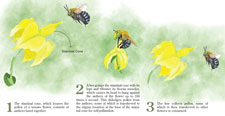
Yet creating pollen takes a lot of energy, so some plants use a different tactic to conserve. Instead of pollen being on the outside of the anther, flowers hide it within a tube that is only accessible to creatures that can make a “secret knock.”
This is where the blue-banded bee comes into the picture. It grabs the anther with its legs and vibrates its flight muscles to loosen the pollen inside and shake it out. The bee then catches this pollen with hairs on its legs and belly before flying off to the next plant.
Though unique, this kind of pollination is not rare among bees. For example, bumblebees also exhibit this behavior. An article in the February 2018 edition of the journal Evolution found that over half of all bee species use buzz pollination. The article’s authors surmised that buzz pollination gives the bees a more diverse food source and thus gives them an evolutionary advantage.
But does buzz pollination really prove evolution? According to evolutionary theory, every living creature that is successful or takes the path of least resistance will spread its genes more quickly than others. This is particularly the case for two organisms that are symbiotic, meaning they are two separate species that help each other. In this case, so-called natural selection allows both to pass on their genes because they are both beneficial to each other.
As time passes, the theory goes, the plant creates strategies that only its chosen pollinator can access and the pollinator creates strategies that are specific to the plant’s flowers.
There is a danger to this strategy, though. The more tightly bound two species are, the greater the chances that environmental pressures will cause both to die out. Because of this, in reality, 92-94 percent of the roughly 352,000 known species of flowering plants do not require buzz pollination. Only 22,000 of all flowering plant species require it. Obviously buzz pollination is not better for plants, else they would make up the majority.
Evolutionists can see that these two groups of species rely on each other. They surmise that through a series of unobservable and untestable genetic mutations they must have evolved to be interdependent. But think: how would this be possible if they developed independent from each other?
Let’s say bees and flowers had been coexisting before buzz pollination came about. One day a struggling flower decides to hide its pollen because it wants to save energy to survive. Bees—used to traditional pollination—would not immediately figure out how to access this pollen because it has not developed the trait, so it moves on to other flowers that are easier to access. Natural selection takes place, and the flower dies without kin!
In order for this to work, even over tens of thousands of years, both flower and bee would have to make an agreement to adapt to another lifestyle that is not even necessary for survival.
If the main goal of a plant is to spread its genes through pollination most effectively, what benefit is there to making it harder for other animals to help spread the plant’s genes?
All About the Bee
The lives of blue-banded bees are markedly different from most bees. Of course, their most notable feature is the metallic blue bands across the insects’ abdomens, for which they are named. Males have five of these beautiful stripes while the females have four, making it easy to identify gender.
Blue-banded bees do not form hives, but they nest near each other. Females nest by building tunnels in soft sandstone, dry riverbanks, the mortar of old buildings, or even in the clay bricks of older homes. Around Australia, sandstone outcroppings can become honeycombed with blue-banded bee burrows. The female lays a single egg at the end of each inhabited tunnel with a collection of pollen and nectar for larvae to feed on when they hatch. The bees do not create honey.
Males, on the other hand, do not burrow. They sleep in groups grasping twigs or stems with their mouths while their bodies hang in the air. If a male bee is already attached to a twig and another male comes too near, the first bee will push the second away with his back four legs without letting go of his own roost. Twigs are studded with males throughout the night and then they all go off on solo flights throughout the day.
The bees show a preference for blue and purple flowers, but they have been known to drink from and pollinate red, yellow and even gray flowers. They have a long proboscis, or snout-like appendage, which they use to drink nectar from the flowers they visit.
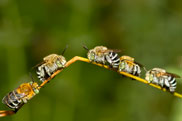
Photo: Getty Images
To summarize the problem, a Dutch botanist wrote, “Natural selection may explain the survival of the fittest, but it cannot explain the arrival of the fittest” (Hugo de Vries, Species and Varieties: Their Origin by Mutation). This was quoted in our seven-part article series “Evolution Exposed: Deconstructing False Science.” Read it for more information on the fallacies of scientific theories.
The Creator’s Handiwork
When God recreated the planet in Genesis 1, He used the third, fifth and sixth days to bring life back to the world. He made all the plants on the third day of the week (vs. 11-13). The fifth day saw the return of fish and everything that lives in the water and the birds (vs. 20-23). On the sixth day, before He created man, “God said, Let the earth bring forth the living creature after his kind, cattle, and creeping thing, and beast of the earth after his kind…and God saw that it was good” (vs. 24-25).
The Creator formed buzz-pollinating bees and the flowers they feed on. He created the plants first so that the animals would have something to eat. If the blue-banded bee and other buzz pollinators had not been created, then the 22,000-plus species of plants that need buzz pollination would have died out.
No hash browns. No eggplant parmesan. No cranberry pudding cake with butter sauce.
If God had created the animals before He had created the plants, many animals, especially smaller ones, would have starved before their food sources would be available.
Furthermore, there is no transitional state between a plant that spreads its pollen widely and one that has poricidal anthers (that require buzz pollination) that would encourage the evolution of one to the other. Buzz pollination is not a learned skill, and it could not just randomly appear. Most buzz pollinators are solitary bees that would never have had the opportunity to teach another bee how to do it!
Evolutionists can see that these two groups are tightly bound together and some plants would not be able to survive without buzz pollinators. This would require an impossible process of random mutations to come to a solution.
Much more simple and believable is that the Creator’s great mind built these symbiotic relationships from the beginning. The Creator designed certain species to need each other to survive. He created specialized pollinators to ensure they were fed by the plants that required them for pollination.
The blue-banded bee proves that it takes more faith to believe in evolution than it takes to believe in a Creator.