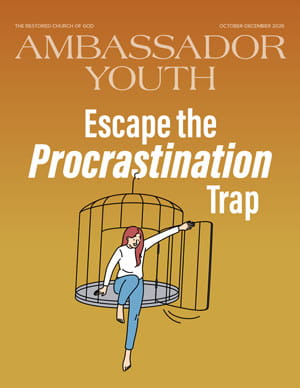
You sit down to do your homework, and an argument starts in your head: “I don’t want to do this…But I have to do it.” “I can do it later…But later will be worse.” “It’s so boring…But I’ll fail if I don’t do it.”
Sound familiar? Part of you wants to do the right thing and finish your homework, while the rest of you wants to do absolutely anything else. Suddenly, even organizing your sock drawer sounds like a great idea.
That tug-of-war is normal. But when the wrong side wins, it has a name: procrastination. Procrastination is putting off something you know you need to do, even when you know it will cost you later. It is a trap where you trade a little relief now for bigger problems down the road.
In the moment, that can seem like a good deal. It never is.
King Solomon described someone who made this kind of bad deal. “The sluggard will not plow by reason of the cold; therefore shall he beg in harvest, and have nothing” (Prov. 20:4).
The sluggard skips plowing because the weather is cold and uncomfortable. Staying inside feels easier now, but when harvest comes, he has nothing to gather. The principle is that avoiding necessary work just because it feels unpleasant can lead to much bigger problems later. The same is true with homework. Put off one assignment, and you might end up with a bad grade. Make it a habit, and you could miss out on opportunities in the future.
You know the assignment will not go away. You know the deadline is coming. So why do you keep walking into the trap?
Just about everyone struggles with procrastination, but not everyone is controlled by it. The good news is that you can learn practical ways to deal with it. It starts with figuring out why you put things off. Then you can choose a strategy that fits the problem and build habits that make starting easier next time. This article uses homework as its main example, but the same steps work for chores, music practice, a job or anything else you are tempted to delay.
Why Are You Putting This Off?
People tend to equate procrastination with laziness. They hear your reasons and call them excuses. But procrastination is not always laziness. It often involves avoiding discomfort.
Sometimes the mere thought of doing something is worse than doing it, yet we keep putting it off. When we delay homework or any unpleasant task and do something more enjoyable instead, we feel relief right away. You make getting started a problem for “future you.” That relief feels so good that it becomes tempting to avoid the task again next time, even though the work and the stress are still waiting for you, and the dread only grows.
This plays out in many ways. Perhaps it has been a long day of school and extracurricular activities. Your brain feels fried, so you tell yourself you will get up at 5:00 a.m. to do the assignment when your head is clear—even though you never get up that early.
Maybe you say you are ready to start on that paper, but first you have to find a music playlist, set up your desk, get a glass of water and download a new productivity app. Half an hour later, you still have not written a word.
Perhaps you make a false start. You write the first sentence, only to say it sounds stupid and delete it. Now you are back to staring at a blank page and still do not know where to begin.
Each of these can seem sensible in the moment, but each one hides a different reason. The early-morning plan sounds responsible, but it really just means you do not feel like starting tonight. The perfect playlist is a way to get ready without actually getting started. Deleting the first sentence comes from fear that your work will not be good enough.
Whenever you catch yourself delaying, stop and ask: Why am I really avoiding this? Be honest. Sometimes the answer is simply that you do not want to work.
Our excuses can get pretty silly, too. Proverbs 22:13 says, “The slothful man says, There is a lion without, I shall be slain in the streets.” Picture it: this man will not go out to work because he thinks a lion might be waiting in the street to gobble him up.
Lions were a real danger in ancient Israel, but finding one prowling the city streets would have been highly unusual. The slothful man takes a remote possibility and turns it into a reason not to leave the house. We can do the same thing by blowing an unlikely problem out of proportion until it becomes a reason not to start.
Whenever you hear yourself making an excuse, ask: Is this really as big a problem as it seems, or is it a lion in the street?
Then use honest answers to identify what is holding you back. Is the assignment overwhelming? Are you distracted? Do you simply not feel like starting? Are the instructions unclear? Or are you afraid your work will not be good enough? Once you know why you are not starting, you have spotted the trap, and you can more easily avoid it.
What to Do About It
Often, the hardest part of any task is getting started. Once you get moving, it is easier to keep the momentum going. People often wait for conditions to be right before they even prepare to start.
Ecclesiastes 11:4 says, “He that observes the wind shall not sow; and he that regards the clouds shall not reap.” In other words, a farmer who keeps watching the wind and clouds for perfect weather never gets his seed planted. If you wait until you feel rested, motivated or completely ready, you may never start either.
Let’s look at a few common reasons you might delay starting your homework.
Overwhelmed? Some assignments feel enormous. Maybe you have to do weeks of research, write a paper and present it to your class. When a project is that big and complicated, it can be hard to know where to start. It is like being asked to eat a giraffe.
So what is the best way to eat a towering one-ton animal? One bite at a time.
Treat a big assignment the same way. Break it into bite-sized tasks and make a list. Instead of thinking, “I have to write this whole research paper,” ask yourself, “What is the next small piece I can do?” That might be choosing a topic, finding your first source, or writing the first paragraph.
As you work, focus on the task at hand. For now, give yourself permission to stop thinking about the rest of the project. It is on your list, and you will get to it. This way, you set aside everything except one small piece, and that piece gets done.
Distracted? Phones, conversations, TV, notifications and other distractions make it tempting to avoid your work. But eventually, you still have to do it.
Solve distractions by removing what you can and blocking out what you cannot. For example, you can move your phone to another room or turn off the TV. If you are working on a computer, close extra tabs and turn off notifications. If you cannot remove the distractions, remove yourself from them. Find somewhere quiet and comfortable where you can focus on your assignment.
If you must stay where the distractions are, find ways to minimize their impact. Earplugs or noise-canceling headphones can reduce room noise.
Unmotivated? Do not wait until you feel motivated. Motivation tends to grow after you begin. A simple way to get going is to shrink the commitment. Make the first step easy, and the next step will often follow.
Look at your homework and figure out a way to do something small. If you have 14 math problems, tell yourself you are just going to do the first one. If you need to read three chapters in a textbook, start by reading three paragraphs. If it is something else, agree to work on it for just five minutes.
Another option is to turn the work into a game. Think of the games you like to play and add some of those mechanics to the task at hand. For example, set a timer to see how many math problems you can solve in five minutes, or check off each problem as you finish it.
Once you are moving, you will find it is easier to keep moving. You might even discover that the motivation you were missing turns into a solid desire to finish.
Confused? Some homework assignments are unclear. You can read the instructions, but you have no idea what your teacher wants you to do.
First, reread the instructions and check your notes. If you are still stuck, find one clarifying question. Do not just sit in silence hoping that the answer will come to you. Define the exact point of confusion, such as “I do not understand the difference between question 3 and question 4,” or “I am not sure how this question connects to what we studied.”
The clearer you are about what confuses you, the easier it is for your teacher, parent or classmate to help you understand what you are being asked. If you cannot reach anyone immediately, write your question down and work on the parts you do understand.
Afraid of Mistakes? Sometimes, the fear of a bad first attempt keeps us from getting started. If you want to begin but worry your work will not be good enough, let your first try be rough.
Give yourself permission to write a messy first draft. You can use notes or markers to remind yourself what to revisit later. Mistakes are no big deal when your goal is simply to get your thoughts onto the page. You can polish a rough draft, but you cannot fix what you never started.
These are five common reasons for procrastination, but they are not the only ones. You may find other ways to make it easier to start. You may also want to ask a friend or someone else you know is good at following through with their commitments how they get themselves started. Try one of their ideas, and if it does not work, then try another. What matters most is getting yourself moving.
How to Make Next Time Easier
Beating procrastination once makes it easier to beat it again, but it does not mean it will be easy. A few simple habits can help you stay out of the trap next time.
A schedule and routine can go a long way toward preventing procrastination. When you set specific times for homework, chores and other responsibilities, you do not have to decide whether to start now or later—you already decided. Starting becomes a normal part of your day instead of something you have to talk yourself into every time. Just be sure to leave room for surprises, like a last-minute chore.
Watch out for familiar excuses, such as “I can do that tomorrow” or “I work better under pressure.” Solomon saw it differently: “The thoughts of the diligent tend only to plenteousness; but of every one that is hasty only to want” (Prov. 21:5).
The verse contrasts diligent planning with haste. A diligent person thinks ahead and works steadily, and that effort tends to lead to plenty. A hasty person rushes. It is easy to make mistakes when you are rushing.
Putting off homework sets you up to rush, and the stress of a looming deadline makes it harder to focus and do your best work. If one unpleasant task hangs over you all evening, try doing it first to get it out of the way.
Ask God for help. It may seem strange to pray about homework, but God cares about the habits you are building. Proverbs 16:3 says, “Commit your works unto the Lord, and your thoughts shall be established.”
Finally, if you do fall into the procrastination trap, remember that everyone slips occasionally. One unproductive evening with your homework does not mean you have lost the battle for good. Figure out what got in the way and try again. If you keep getting stuck night after night, talk to a parent or teacher. They may be able to help you see what is really going on.
Breaking Free
The procrastination trap is baited with short-term relief. The temporary comfort of scrolling on your phone or stepping away from your desk feels good for a little while. But like any trap, getting caught costs far more than the bait was worth. Your assignment’s due date keeps getting closer whether you are working or not.
The desire to procrastinate is so common it can feel automatic, but overcoming it is not about massive willpower or waiting until you are ready. It is about learning to recognize the bait before you take it. Every time you catch yourself starting to delay, pause to figure out why. Once you know why, you can step around the trap instead of into it.
Best of all, consistently taking those small actions to get started does more than help you finish your homework. Each time you choose to begin instead of delaying, you practice diligence and self-control, which are two character traits that will serve you well for the rest of your life.
The psalmist wrote, “I made haste, and delayed not to keep Your commandments” (Psa. 119:60). He was talking about obeying God, not about schoolwork. But learning not to delay with small things like homework can help you respond quickly when you know what God wants you to do.
The next time that familiar argument starts in your head—“I don’t want to do this…But I have to do it”—you do not have to keep arguing. The way out is to start. Pick something you have been putting off, whether it is an assignment due next week, cleaning your room, exercising or something else. Figure out what is holding you back, shrink that first step, and give it five minutes—starting now.
Future you will thank you.