As darkness fell, the lions slowly paced the dank enclosure that also held the prophet Daniel. Leaning against a wall, Daniel could hear the beasts’ heavy breathing as they studied him. The only exit to the den had been sealed shut by a heavy stone. It was going to be a long night.
Daniel’s enemies thought he would be eaten by morning. Yet when King Darius came to check on him the next day, Daniel was safe and unharmed. He said: “My God has sent His angel, and has shut the lions’ mouths, that they have not hurt me” (6:22).
The story of Daniel in the lions’ den is what we usually picture when this Old Testament prophet comes to mind, and for good reason. It is one of the most dramatic deliverances in the Bible.
Yet what made Daniel special goes far beyond this one night. Over the course of his life, Daniel faced challenges to his faith time and again.
From his early teenage years in Babylon to later years as an influential prophet with authority over the nation, Daniel’s story is about holding to God’s Way under pressure.
Today, you also face trials and challenges to your beliefs. At times, depending on what you are facing, your classroom, workplace or even your home can feel like a “lions’ den.”
For you, this could involve classmates at school challenging you about something the Bible teaches, a boss expecting you to fill a shift during the Sabbath, or friends pressuring you to go along with something you know to be wrong. While these may seem less dramatic than what Daniel went through, they are real tests.
Daniel’s example shows how to stand firm, respond wisely to pressure and trust God with the consequences of obedience.
Purpose in Your Heart
Daniel’s record of setting the right example started early in life. Chapter 1 of his book describes a group of “children in whom was no blemish” (vs. 4) who were being gathered to serve in King Nebuchadnezzar’s palace. This included Daniel as well as his friends Shadrach, Meshach and Abednego.
At this point, Daniel was likely about your age. Yet he and his friends were known for being “well favored, and skillful in all wisdom, and cunning in knowledge, and understanding science” (vs. 4). Do not underestimate the example you can set, even as a teen.
As the chapter continues, the first recorded test of Daniel’s convictions emerges. Verse 5 says, “the king appointed them a daily provision of the king’s meat, and of the wine which he drank.”
At first glance, free food may not seem like much of a trial. But Daniel knew there was something wrong.
Daniel had been taken from his homeland and placed in a program to prepare him for service in a foreign royal court, surrounded by different beliefs, customs and expectations. There was a lot at stake here. It would have been much easier to just go with the flow. But in verse 8, Daniel “purposed in his heart that he would not defile himself with the portion of the king’s meat, nor with the wine which he drank.”
We do not know exactly what the problem was with this cuisine. Some have speculated that the meat came from unclean animals, that it may have contained blood because the animal was improperly slaughtered, or that it had been offered to Babylonian gods. Regardless of the specific reason, Daniel knew God did not want him consuming it.
You may face similar situations today. Imagine it is your first week at a new job, and your manager takes the new hires out for sushi. You cannot tell what kind of fish is in the rolls he ordered, and you want to make a good impression. God considers some fish clean to eat and others unclean. Like Daniel, you are new, someone over you chose the food, and going along is easiest. It is your choice whether to speak up, ask what is in the rolls and decline what is unclean or stay quiet.
Your choices in situations like this help build habits to carry you through bigger challenges.
Other tests have nothing to do with food. Say a friend invites you to a “winter party.” You are told it is simply about winter, but you are not sure whether Christmas will be part of it, and it does not quite feel right.
Start by politely asking what the party includes. If it is just sledding and hot chocolate, go and enjoy it. But if there will be a tree, gift exchange or carols, it is a Christmas party by another name. Thank your friend, politely decline and suggest another time to get together. If in doubt, ask your parents.
Situations like these require discernment, whether people simply do not know your beliefs or are testing whether you will compromise. They require learning when to speak up and stand firm, and when something is fine.
Notice that it said in verse 8 that Daniel “purposed in his heart.” This is a powerful key. Daniel did not wait until pressure was unbearable to form his convictions. If you purpose in your heart to stick to your beliefs, doing the right thing becomes easier.
God had given Daniel favor with the official in charge, but the man worried that if Daniel looked worse than the others after not eating the meat and drinking the wine, the king would have his head (vs. 9-10). So Daniel went to the steward placed over him and offered an alternative: “Prove your servants, I beseech you, ten days; and let them give us pulse [vegetables] to eat, and water to drink” (1:12).
Notice how Daniel handled this. He had decided ahead of time what he would not do, and it took courage for a young captive to speak up at all. But he also took the official’s concern seriously and found a solution that worked for both of them. Having firm convictions does not mean being inflexible in how you deal with people. At school, at work or with friends, that might mean quietly ordering something else instead of making a scene, or saying no without lecturing everyone else. Remember, “a soft answer turns away wrath: but grievous words stir up anger” (Prov. 15:1).
As you navigate tough situations, people may have questions about why you did or did not do something. Purposing in your heart goes hand in hand with a principle found in I Peter 3:15: “Be ready always to give an answer to every man that asks you a reason of the hope that is in you.” Thinking through likely questions ahead of time helps you to “be ready.”
The steward agreed to Daniel’s request. The result? “At the end of the ten days, Daniel and his three friends looked healthier and better nourished than the young men who had been eating the food assigned by the king” (1:15, New Living Translation).
People could see that what Daniel did worked. For you, there may or may not be visible proof that your choice paid off. But you will know you did the right thing, and so will God.
Keep Doing Right Under Pressure
Daniel’s decision about the king’s food began a lifelong pattern. Later, when Nebuchadnezzar ordered the execution of Babylon’s wise men after they could not tell him his dream and its interpretation, Daniel again responded calmly. God revealed the king’s dream and its interpretation to Daniel, and his life was preserved.
Daniel made such an impression that King Nebuchadnezzar “fell upon his face” before him (2:46). But the king gave all the credit to Daniel’s God (vs. 47). Then he “made Daniel a great man, and gave him many great gifts, and made him ruler over the whole province of Babylon” (vs. 48).
As Daniel gained influence and responsibility, he continued following God.
Decades later, after the Babylonian kingdom fell, Daniel continued serving under its new ruler, Darius. Chapter 6 records that “the king thought to set him over the whole realm” (vs. 3). But another test was on the way.
Verse 4 describes a group of “presidents and princes” who were looking for something to accuse Daniel of before the king. But “they could find none occasion nor fault; forasmuch as he was faithful, neither was there any error or fault found in him.”
Daniel was not known for simply saying no to bad things. This verse suggests he was an exceptionally capable, trustworthy and effective person.
His record was so spotless, they admitted in verse 5: “We shall not find any occasion against this Daniel, except we find it against him concerning the law of his God.”
We know Daniel was not perfect. He was human, just like us. But these highly motivated and intelligent men could not find anything Daniel was doing wrong except obeying God. They opposed him anyway.
In verse 7, this group persuaded the king “to make a firm decree, that whosoever shall ask a petition of any God or man for thirty days, save of you, O king, he shall be cast into the den of lions.”
In other words, for those thirty days, praying to God was illegal. This was much harder than turning down food and drink in chapter 1. Daniel had a clear choice: obey the decree or obey God.
Most people today are content to mind their own business, to live and let live. But you may face times when you need to take a stand like Daniel did.
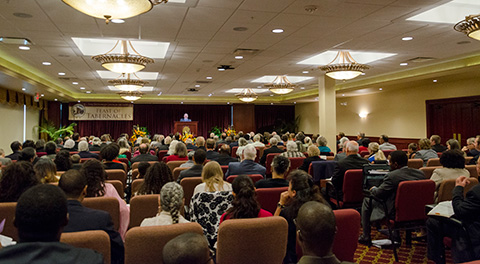
For example, you might respectfully explain to a teacher that you will miss a major class presentation during the Feast of Tabernacles. You work ahead and arrange to make up what you miss, but he remains frustrated and seems to think you just did not want to do the work. You go to the Feast anyway. Later in the year, when an opportunity comes up to lead a special project in the class, he passes you over. Doing what is right can bring consequences even when you have handled everything responsibly.
Here is what Daniel did: “Now when Daniel knew that the writing was signed, he went into his house; and his windows being open in his chamber toward Jerusalem, he kneeled upon his knees three times a day, and prayed, and gave thanks before his God, as he did aforetime” (vs. 10).
Daniel did not waver. He did not change his routine to avoid trouble, and he did not change it to make a statement. He simply kept praying the way he always had, and he was willing to live with the consequences.
The same can be true of us: we do not need to push our beliefs on others, and we do not need to hide them either. Daniel lived out a principle the apostles would later state plainly: “We ought to obey God rather than men” (Acts 5:29).
Trust God with the Outcome
Daniel’s continued prayers are what got him thrown into the lions’ den (6:16). But by this point in life, Daniel had been building a track record of obedience under pressure. His night with the lions was a major test, but he had been prepared for it over many years of faithfulness.
After that long night, “no manner of hurt was found upon him, because he believed in his God” (6:23).
As you go through life, you will not know the outcome of every situation in advance. The Bible also records examples of God’s servants who were not always delivered from harm. But you can work to develop a strong, unshakable trust in God.
Proverbs 3 says, “Trust in the Lord with all your heart; and lean not unto your own understanding. In all your ways acknowledge Him, and He shall direct your paths” (vs. 5-6).
Sometimes you may make it through difficulties largely unscathed. Other times, doing right may mean being left out, made fun of, or missing out on opportunities. But consequences do not mean obedience was a mistake.
Daniel’s trust in God set a powerful example. King Darius was so moved by what he saw, he issued a decree that “in every dominion of my kingdom men tremble and fear before the God of Daniel: for He is the living God, and steadfast forever, and His Kingdom that which shall not be destroyed, and His dominion shall be even unto the end” (6:26).
How you handle challenges to your beliefs is a way to let your light shine. It shows other people and God Himself that you are serious about this way of life.
God used Daniel to record many prophecies, including ones about the Kingdom of God. In the final verse of his book, Daniel was promised that he would rest and one day stand to receive his inheritance in that coming Kingdom (12:13).
The young man who purposed in his heart to obey God became the older man who remained faithful among the lions. The choices you make now establish a pattern of trusting God throughout life.