The Bible has long been the world’s best-selling book. More than 100 million copies are printed each year. Choosing the right Bible can feel overwhelming. Think of all the translations available—KJV, NKJV, NIV, Amplified, Moffatt and so many more.
Even more intimidating is understanding the text itself. The Bible’s nearly 750,000 words are packed with depth and meaning but are written “precept upon precept…line upon line…here a little, and there a little” (Isa. 28:13). Knowing where to start and what topics to study is challenging, especially for a beginning Bible student.
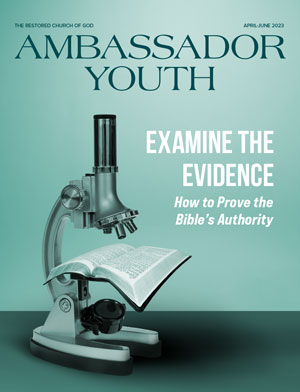
But it does not have to be difficult. The place to begin is simple: proving whether the Bible is God’s authentic Word. Knowing beyond a shadow of doubt that it contains truths that will directly impact your life.
Ask: Why should you base your entire life around a book if you cannot know for certain that it was inspired by the all-powerful, all-knowing Creator of the Universe? The answer is you should not! That would be silly.
Proving God’s Word brings a tremendous peace of mind and sense of purpose. It can impact every part of your life: “All scripture is given by inspiration of God, and is profitable for doctrine, for reproof, for correction, for instruction in righteousness: that the man of God may be perfect, thoroughly furnished unto all good works” (II Tim. 3:16-17).
The belief that the Bible is God’s inspired Word is so important that it is one of the requirements for becoming a member of the Church (Acts 2:38). If someone disagrees with the divine origin of Scripture, there is no point in baptizing them.
Whether you are an older teen approaching baptism age, a younger teen preparing for your first Ambassador Youth Camp, or anywhere in between, recognizing the authority of the Bible is vital. This step is paramount for anyone seeking a genuine relationship with God.
Jesus Christ taught that “man should not live by bread alone, but by every word that proceeds out of the mouth of God” (Matt. 4:4). The Bible’s spiritual instruction and life advice will help those of any age.
Yet God does not expect you to blindly believe He inspired Scripture. He provides several clear-cut ways to prove the Bible’s absolute authority.
Proof 1: Disproving Evolution
The Bible opens by explaining how God created all things, including humanity and all other forms of life. This account directly opposes the belief that evolution is the origin of life. Disproving this popular scientific theory is an essential step to proving the entirety of Scripture.
You have probably heard about evolution in school. Merriam-Webster defines evolution as the process by which new species or populations of living things develop from preexisting forms through successive generations. In plain English, evolution says new types of animals or plants came from simple organisms that gradually changed over millions and millions of years.
The Bible, on the contrary, says that God created the fish, birds and land animals in their current, complex forms (Gen. 1:1, 21, 25, 29).
Refuting evolution reinforces the Bible’s authority. Several scientific principles and observations help do this.
The law of biogenesis, first formulated by Italian biologist Francesco Redi in the 17th century and later confirmed by Louis Pasteur in the 19th century, is an established biological principle. The law states that living organisms can only arise from pre-existing living organisms. In other words, life cannot spontaneously arise from non-living matter.
A major problem with believing people and animals came from evolution is that it fails to explain the source of life. Instead, it generally focuses on how life on Earth has changed and diversified over time.
Irreducible complexity in DNA and cells is another issue that evolution cannot explain. Popularized by biochemist Michael Behe in his book Darwin’s Black Box, irreducible complexity argues that some biological systems are too complex to have evolved gradually.
One example of this concept is the human eye, which is so incredibly complicated that it could have never evolved. (To learn much more about this, read our Real Truth article “Seeing Clearly – The Story of the Human Eye.”)
Another challenge with the evolutionary theory is its claim that land mammals, including humans, evolved from fish. How these creatures could have survived in a partially evolved state is unclear. At what point, for instance, did fish develop the ability to live outside of water? The only explanation from evolutionists is that it took billions of years.
In contrast, creation of the Earth and all its inhabitants by an all-powerful God is easy to explain. It is not difficult to grasp the concept of making something. It means to create, produce or construct something—a process of planning and designing leads to execution.
God made the heavens, the Earth and its inhabitants with all their wonderment and complexity. He planned, designed and created plants and animals to function in complete harmony. Everything was made with a specific purpose and fit together like a well-designed machine.
Yes, it takes faith to believe that God created everything around you: “Through faith we understand that the worlds were framed by the word of God, so that things which are seen were not made of things which do appear” (Heb. 11:3). Yet your faith is not without evidence.
The flawed theory of evolution juxtaposed with the clarity of Scripture is instructive. The Bible does not equivocate as evolutionary scientists and other so-called experts do. The scriptures do not use terms like “we suspect,” “we have come to believe,” “we theorize,” or “what probably occurred.” The Bible speaks with an authority that can be trusted and relied upon for truth.
Further, unlike evolution, the Bible adds a purpose to our existence. With no purpose, the explanation of evolution misses the big picture. Without God, we cannot truly understand where we came from and why.
Much more could be covered about disproving evolution, and there is some nuance within the subject that must also be understood. Take time to read our Real Truth article series “Evolution Exposed: Deconstructing False Science” and our Pillar article “Is Evolution Real?” to gain a more complete understanding.
Proof 2: Historical Preservation
The Bible’s authority relies on its authenticity. We must be able to trust that what we read today is what was originally written—that it was preserved by God. To that end, one of the most important archeological finds of the 20th century was the Dead Sea Scrolls.
Discovered in the 1940s by a Bedouin shepherd, the Dead Sea Scrolls date back to 300 years before Jesus Christ walked the Earth. They contained fragments from every book of the Hebrew Bible except for Esther. These manuscripts were more than 1,200 years older than the previous oldest copies of the Old Testament.
The Dead Sea Scrolls text matched the writings in the modern Old Testament, confirming that the words had been accurately copied over the centuries. This points to the certainty of the Bible being carefully kept intact and properly transmitted, meaning it can be trusted. Details preserved in the scrolls also put the development of Judaism and Christianity into proper historical context, further adding to the Bible’s credibility.
More than 5,800 manuscripts of the Greek New Testament, some dating back to the 2nd century AD, also help prove the accuracy of the New Testament. These old manuscripts were copied close to the time of the original writings.
Not only are the Bible’s manuscripts accurate and very old, they are also plenteous compared to other well-respected historical writings. Manuscripts for the Bible far exceed the number of manuscripts for other trusted texts, such as Aristotle’s Poetics, of which we have less than a dozen manuscripts, Julius Caesar’s Gallic, which has less than 250 manuscripts and goes back only about 800 years, or Homer’s Iliad, which has around 1800 manuscripts with the earliest copied about 600 years after the original.
Early Christian writers also reveal the authenticity and reliability of the Bible. For example, texts from Clement of Rome (AD 35-99) and Polycarp (AD 69-155) provide evidence for the spread and acceptance of biblical writings.
There is overwhelming evidence that the Bible has been accurately preserved throughout history.
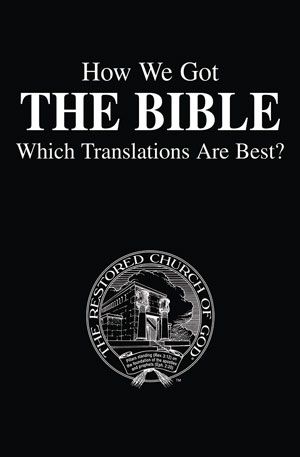
There is much more to the story about how God preserved His Word. Read our booklet How We Got the Bible – Which Translations Are Best?
Proof 3: Fulfilled Prophecy
Prophecy can seem like a vague religious term. Yet the simple definition is that it is history written in advance. Examining how the events foretold in the Bible actually came to pass becomes a powerful proof of its authority.
God declares this in Isaiah 42: “I am the Lord: that is My name: and My glory will I not give to another, neither My praise to graven images. Behold, the former things are come to pass, and new things do I declare: before they spring forth I tell you of them” (vs. 8-9).
The Bible is filled with prophecies that range from specific predictions to broader forecasts about the future. These events have come to pass exactly as written, hundreds or even thousands of years after their recording.
Amazingly, God’s Word predicted the rise and fall of various world empires and kingdoms.
In the book of Daniel, notice the interpretation of King Nebuchadnezzar’s dream about a metal man of gold, silver, bronze and iron: “You, O king [Nebuchadnezzar], are a king of kings: for the God of heaven has given you a kingdom, power, and strength, and glory” (2:37). Verse 38 adds, “You are this head of gold.”
In other words, Nebuchadnezzar and ancient Babylon represent the first kingdom in this metal man. Verses 39-40 then go on to describe three successive kingdoms that would follow. Here is how they are described: “And after you [Nebuchadnezzar] shall arise another kingdom [of silver] inferior to you, and another third kingdom of brass, which shall bear rule over all the earth. And the fourth kingdom shall be strong as iron.”
Each part represents, and foretold, a major empire. Again, the first, which was the head of gold, was Nebuchadnezzar’s own neo-Babylonian or Chaldean Empire (625-539 BC). The silver chest and arms represent the second kingdom, the Medo-Persian Empire (558-330 BC). The belly and thighs of brass represent the third, the Grecian or Greco-Macedonian Empire (333-31 BC), ruled by Alexander the Great.
Finally, the fourth kingdom, depicted by the lower legs of iron, with feet and toes of iron mixed with clay, is the Roman Empire.
Realize what you just read! Aside from Nebuchadnezzar’s kingdom, each of these empires were foretold in advance of their arrival on the world scene.
Such Bible proofs do not stop there. Isaiah 44-45 predicted the rise of a king named Cyrus some 200 years before King Cyrus of Persia conquered Babylon and allowed the Jews to reclaim their homeland of Jerusalem.
Another specific example of fulfilled prophecy is the coming of Jesus Christ. His arrival was foretold throughout the Old Testament, with verses pointing to a coming Messiah or Savior who would redeem mankind and ultimately bring salvation to the entire world. The Bible contains specific details about where this Messiah would be born (Micah 5:2), His lineage (Isa. 11:1-2), His suffering and death (Isa. 53), and His eventual triumph over sin and death (Psa. 16:10).
Outside of the Bible, there are an estimated 30 independent sources written by 25 authors attesting to the existence of Christ. These, on top of the well-preserved gospel accounts, all show Jesus Christ came and carried out His earthly ministry as predicted.
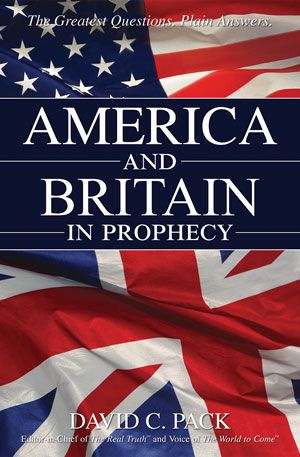
Yet another example of fulfilled prophecy is the rise of the world’s greatest nations. God told the patriarch Jacob, “Be fruitful and multiply; a nation and a company of nations shall be of you” (Gen. 35:11). The context shows these peoples would fulfill the birthright promises made to the patriarchs, which included God causing them to multiply like the sand of the sea and the stars of heaven. Other scriptures and the record of history prove this is referring to America (the “nation”) and Britain (the “company of nations”). God declared thousands of years in advance that He would raise up these nations, and He did!
Read America and Britain in Prophecy to learn more about this inspiring story.
Proof 4: Personal Experience
Perhaps the most powerful proof of the Bible’s authority is its positive impact on those who follow it. Throughout Scripture, there are accounts that demonstrate that obedience or disobedience can bring about positive or negative effects.
Think about young David relying on God and standing up to and slaying the giant Goliath (I Sam. 17:26, 41-51), or Gideon initially doubting God only to step out in faith and defeat a large army with a much smaller one (Judg. 7). Consider Ruth, who displayed tremendous loyalty by putting the welfare of others over her own needs and sticking by her mother-in-law Naomi (Ruth 1:16-17). God eventually blessed Ruth with a husband and allowed her to be in the human lineage of Jesus Christ.
Yet it is one thing to read about blessings experienced by others in Bible stories—and it is another thing entirely for you to experience it personally. Think about the impact that applying God’s principles has had on your life and others in the Church.
Perhaps you showed faith by tithing on a small income from work yet found that you had more than enough to fulfill your financial obligations. Maybe you respectfully stood up to your coach or teacher, letting them know you would not participate in any school activities on the Sabbath, only to see that they were more than willing to allow you to remain a part of the team. You can have fun thinking of many other examples with your parents and siblings—doing so will help prove the authority of God’s Word.
In tough times, the Bible can help. It offers guidance and comfort for those struggling with deep worries or searching for meaning and purpose in life. Reading the Psalms, for example, helps provide solace during difficult times.
The Bible is filled with stories and teachings that resonate with people from all walks of life. And applying its words produces real, tangible change in your life. It is not just a book of ancient history but an active, living Book (Heb. 4:12) that continues to impact people today by providing practical instructions and guidance.
Ultimately, the Bible provides a standard by which we must live. It teaches us the importance of love, forgiveness, and compassion and inspires us to be better people. By studying its teachings, you can find guidance in your daily life and reinforce its divine authority.
The more you see the positive effects from applying the words of this Book, the more you will be assured it was authored by God Himself.
Keep Going!
Consider this article as a start for proving that the Bible is God’s Word. There is a lot more to learn about Creation versus evolution, historical evidence, fulfilled prophecy and personal experience.
Do not settle for merely a surface-level, superficial grasp of Bible authority. Your goal should be to develop full, unwavering faith and confidence in this inspired Book. This takes work, but it is worth it. When you encounter trials and adversity in life (Ecc. 7:14), this conviction will enable you to keep pressing on and living God’s Way.
Proving the Bible can be exhilarating. After you witness how clear and abundant the evidence is, it will be hard to believe anyone would not take the opportunity to seek proof themselves. Yet this excitement can fade over time. Those who have been baptized for decades must periodically go back and review this and other foundational doctrines of the Bible to remain close to God. Be sure to revisit and review the knowledge of Bible authority throughout your Christian life.
The Bible carries authority from God Himself. It is much more than a book of ancient stories—it is a relevant and useful guide for you. Scripture gives hope and inspiration in knowing God’s Plan and answers life’s greatest questions.
Though it is challenging to understand at times, God’s Word is worth digging into every day to learn and apply its teachings. To continue along your path of proof, read Bible Authority...Can It Be Proven?