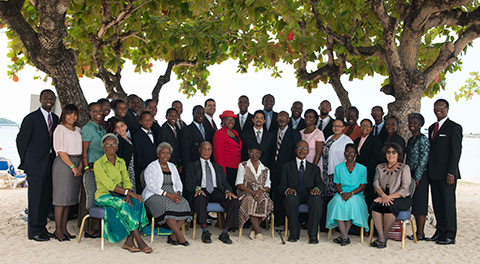
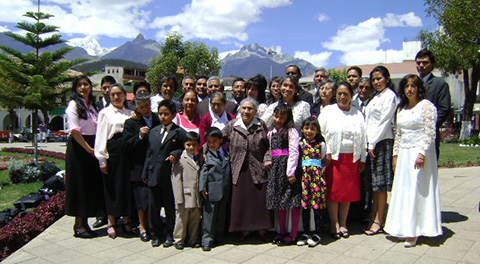
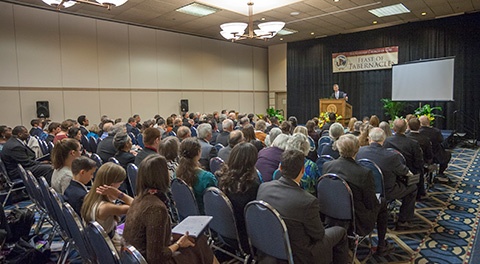
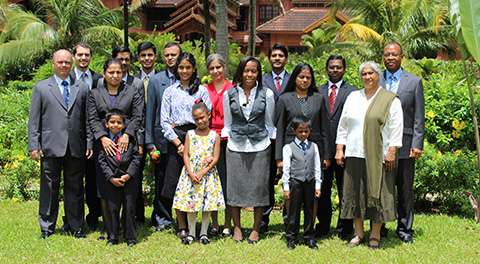
Over the years, young people have been brought into contact with God’s Church through two basic and different “paths.”
In one path to membership, God begins to call a youth out of the world, often during his or her teenage years, apart from any other family members. For many, this is a time during which they begin to ask “the big questions” of life, such as: “What is the purpose of my life? Why is the world around me such a mess? Does God exist? Should I continue in my parents’ religion?” This is sometimes the point at which God begins to reveal His truth.
On the other hand, some youth in the Church are considered to be “second-generation” or, sometimes, even “third-generation.” God had first called their parents and/or their grandparents into the truth. In some cases, it may be said that they were born into the Church, meaning they have attended Sabbath and Holy Day services, as well as Church functions, from very early childhood—sometimes literally starting with the first Sabbath after their birth!
These children and grandchildren of Church members are commonly referred to as “Church kids,” or in the case of a pastor’s children, “pastor’s kids”—with these phrases sometimes shortened to “CKs” and “PKs.”
Young people in this situation have certain advantages. In fact, God considers a member’s children (those who are young enough to still be under the stewardship of their parents) to be “sanctified”—set apart as “holy” through the godly influence of their converted parent or parents (I Cor. 7:14). However, they also face certain obstacles that are unique to this particular path. We will examine both sides of this coin—and look for the lessons that can be learned from those who have gone before you in the Christian walk.
Foundation of God’s Truth
Perhaps the single most important advantage to growing up in the Church is the opportunity to learn God’s truth from an early age. Simply knowing “the basics”—for example, the fact that God is a family, the meaning of the Holy Days, and the certainty that this “present evil world” will soon come to an end—is to have information so far beyond the comprehension of the average person that it boggles the mind!
Paul addressed Timothy, a young evangelist, as one who had, in a sense, grown up as a “Church kid”: “But continue you in the things which you have learned and have been assured of, knowing of whom you have learned them; and that from a child you have known the holy scriptures, which are able to make you wise unto salvation through faith which is in Christ Jesus” (II Tim. 3:14-15). Indeed, we know that Timothy was a “third-generation” Church member because, earlier in this letter, Paul wrote, “…I call to remembrance the unfeigned faith that is in you, which dwelt first in your grandmother Lois, and your mother Eunice; and I am persuaded that it is in you also” (II Tim. 1:5). In this passage, Paul reminds Timothy of the tremendous asset that a lifetime of learning from God’s Word represented.
Less to “Unlearn”
The converse of the previous point and another advantage for “Church kids” is that they do not face nearly as much of a challenge in “unlearning” worldly customs and traditions—for example, attending Friday night parties, sports participation on the Sabbath, involvement in man’s holidays, and elements of worldly “worship” services, such as worship of idols or a false version of “speaking in tongues.”
It has been said that it is harder to unlearn false knowledge, or to break an undesirable habit, than it is to absorb brand new knowledge or establish a new habit. There is an element of “injured pride” in the process of admitting that one’s general pattern of behavior has been wrong. To a great degree, this is a non-issue for those of the second or third generation in the Church.
The Great Challenge
However, just as there is usually a corresponding weakness with every strength, and every desirable thing in life comes with a price, there is a challenge that is “built-in” to this path. The root cause of this challenge lies in human nature itself.
It is natural to be unappreciative of what we are used to—to take what one has for granted. We are inclined to disdain what we have, and to long for whatever is on “the other side of the fence.” As the saying goes, “Familiarity breeds contempt!” Indeed, since human nature is acquired from the “god of this world” (II Cor. 4:4), it should be no surprise that Satan’s initial rebellion against God was directly related to dissatisfaction with what belonged to him at that time—authority over the earth and a third of the angels!
Human nature craves something new and exciting, especially during one’s youth. Most young people become “bored” quite easily, and are increasingly conditioned to be this way by their environment. In the modern age, this tendency is “fed” by an artificial world that man has created, largely based on advancements in technology. With computers and the Internet, hundreds of channels of digital cable television, mp3 players, satellite radio, cell phones (with built-in cameras, text messaging, and thousands of “ringtones” to choose from), DVDs, and video games vying for our attention, when would one find time for spiritual pursuits? How many young people will naturally choose diligent Bible study over the chance to watch a dazzling blockbuster movie that cost tens of millions of dollars to produce?
In the case of the average “Church kid,” the knowledge of the truth is not a novelty—it is not perceived as “new” and “shiny.” When listening to a sermon during Sabbath services, it is all too easy to think, “I’ve heard this before,” and then let the mind wander to thoughts of physical things. If this lackadaisical approach to God’s Way becomes habitual, young people can easily fall into the trap of “playing Church.” In other words, God’s Church unconsciously becomes just another element of one’s “social life.” Sabbath services, potlucks, Feasts and Holy Days, socials and dances can be reduced to mere opportunities to chat with friends.
Focus On the Positive
Although the “first love” of the truth (Rev. 2:4) may occur differently for an individual who has grown up in the Church, this does not mean that second and third generation Christians are “doomed to” (or justified in) a lack of zeal and enthusiasm for God’s Way. It is easy to fall into a rut of dwelling on certain trials involved in growing up in the Church: being seen as different or odd, exclusion from social circles and events, and so on. But growing up in the Church should properly be viewed as a privilege!
Human nature covets the approval and admiration of other human beings. But our calling in the true Church involves battling with and overcoming this carnal nature, and seeking the approval of God. When one considers that it is God alone who can give us success if our ways please Him (Psa. 37:4), and who gives us everything we have, he or she can begin to understand that it is His opinion that we should be most concerned with!
It takes courage and strength to swim against the current of society and determine to be different. Spending a lifetime battling one’s own nature could be compared to disciplined training for a series of Olympic wrestling matches, each with an increasing reward for victory, and with the “trophy” of the final match being eternal life in God’s Family! In the case of God’s truth and way of life, familiarity should breed respect!
No “Handwriting on the Wall”
Many wonder, “When am I going to ‘catch fire’? When will I know the time has come to start counseling for baptism?” God may bring about circumstances in your life—often trials—to “get your attention” and prompt you to think about this decision. However, we must not expect a dramatic, emotional “revelation” or “religious experience” to show us that it is time. You simply will not see a miraculous message, such as the “handwriting on the wall” sent by God to Belshazzar (Dan. 5)!
Young people who grow up in the Church may compare themselves to their acquaintances at school or work, who are part of a world in which character, morality, and values of any sort are rapidly disappearing. This stark contrast can contribute to an assumption that they have been obeying God all along. While this may be partially true in a limited, physical sense, we must realize that “all have sinned” (Rom. 3:23), and therefore Peter’s instruction in Acts 2 applies to each of us: “Repent, and be baptized every one of you in the name of Jesus Christ for the remission (meaning pardon or forgiveness) of sins, and you shall receive the gift of the Holy Spirit” (vs. 38). In the next verse, Peter specifically mentions the sons and daughters of those parents who have been directly called (as the first generation): “For the promise is unto you, and to your children, and to all that are afar off, even as many as the Lord our God shall call” (vs. 39).
God’s Spirit may be with you before baptism, but it is not yet in you. Notice John 14:17: “…the Spirit of truth; which the world cannot receive…it dwells with you, and shall be in you.” The twelve disciples had been taught directly by Jesus Christ for years by the time He spoke these words to them. Similar to second- or third-generation Church youth, the twelve disciples had a head start on others. However, they still were not complete without God’s Spirit in them!
For evidence of this, we need look no further than Peter’s three denials of Christ, which took place four chapters later in the book of John. Peter went on to become the human leader of the first-century Church, being used mightily by God, and was inspired to write two books of the New Testament. However, he needed God’s Spirit in him in order to fulfill his potential: “And the Lord said, Simon, Simon, behold, Satan has desired to have you, that he may sift you as wheat: but I have prayed for you, that your faith fail not: and when you are converted, strengthen your brethren.” (Luke 22:31-32). Even as direct, face-to-face students of Christ during His time on earth as a human being, the twelve did not yet fully belong to Christ (Rom. 8:9).
Despite the fact that the children of Church members may be sanctified, God still allows them, as free moral agents, to make their own decisions. He does not force His way of life on anyone. However, He counsels us, “I have set before you life and death, blessing and cursing: therefore choose life” (Deut. 30:19).
As you move toward adulthood, and begin to weigh the decision to fully commit to God’s Way, be aware of the pitfalls—but grateful for the advantages—unique to the path of the “Church kid.” This will give you a clearer perspective on the portion of this path that is yet ahead!