
 REGINALD MATHALONE/NURPHOTO VIA GETTY IMAGES
Article
American voters are hungry for change. The Bible shows the only path to achieving it.
Learn the why behind the headlines.
Subscribe to the Real Truth for FREE news and analysis.
Subscribe NowPaying the rent. Buying groceries. Getting medical care. For many Americans, basic needs like these have become a source of uncertainty—and a reason to reconsider how the economy should work.
Socialist candidates are offering answers. They promise to make housing and healthcare more affordable, reduce inequality and give working people greater control over economic decisions.
Zohran Mamdani’s election as New York City mayor and other high-profile campaigns by candidates backed by the Democratic Socialists of America (DSA) have brought attention to the movement. Its electoral strength remains concentrated in strongly Democratic areas, but DSA ideas are reaching a wider audience.
A recent Gallup survey found that 43 percent of Americans view socialism positively—the highest figure since the polling organization began tracking the question in 2010. Among adults ages 18-34, 57 percent had a positive view of socialism compared with 43 percent for capitalism.
What is socialism? According to Britannica, it is “an economic and social doctrine that calls for public rather than private ownership or control of property and natural resources.”
The definition continues: “According to the socialist view…everything that people produce is in some sense a social product, and everyone who contributes to the production of a good is entitled to a share in it…This conviction puts socialism in opposition to capitalism, which is based on private ownership of the means of production and allows individual choices in a free market to determine how goods and services are distributed.”
Throughout history, there have been various approaches to applying socialism. The democratic socialism some candidates advocate today is much different from the authoritarian socialism practiced in places like the Soviet Union and Mao-era China. Yet they both emphasize collective ownership and control of productive resources.
Simply having public programs does not make a nation socialist. DSA’s ambitions go beyond expanding assistance programs. Its stated goal is to replace capitalism, including bringing major sectors such as energy and transportation under collective ownership.
Supporters see socialism as a path toward a fairer society. Critics worry about concentrating economic power, discouraging productive investment and funding expansive public programs.
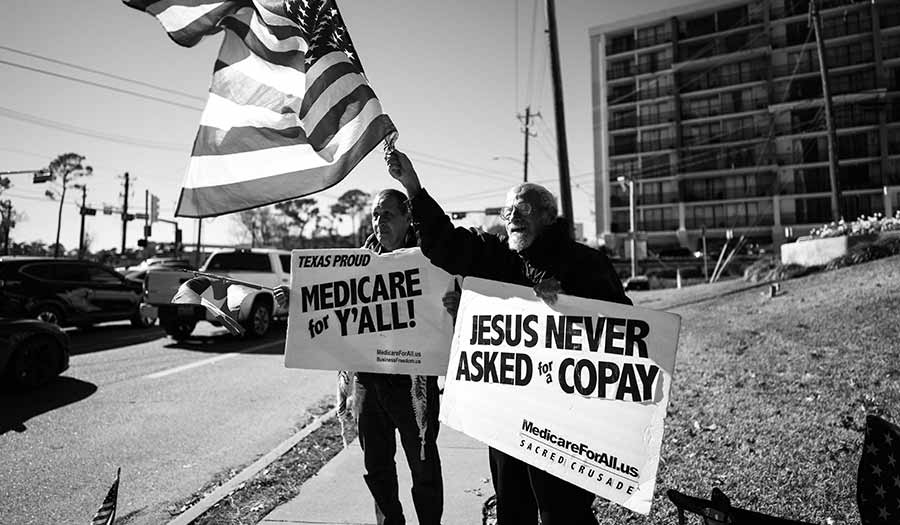
Over the years, some have argued that the Bible contains socialist principles. Jesus Christ’s teachings about love and goodwill toward neighbor can appear to line up with these beliefs, as well as His confrontations with the rich and powerful of the first century.
A recent article published by DSA Religious Socialism argued that the early New Testament Church described in the book of Acts “mirrors the core tenets of democratic socialism: the belief that the material prerequisites of life—housing, food, security—are human rights, and that surplus capital must answer to human need rather than private hoarding. The Jerusalem church instituted a micro-economy where wealth was stripped of its power to oppress, ensuring that basic human dignity was guaranteed for every member of the community.”
Does Scripture show God would approve of socialism? What does the Bible say about ownership, work and the responsibility to care for others?
Jesus and the Early Church
Acts 20:35 records one of Jesus Christ’s central teachings: “It is more blessed to give than to receive.”
During His earthly ministry, Jesus set a perfect example of giving and service to others. Think of the healings He performed and countless other miracles such as multiplying fish and loaves to feed thousands.
In Matthew 19, Christ told a rich young ruler: “If you will be perfect, go and sell that you have, and give to the poor, and you shall have treasure in heaven: and come and follow Me” (vs. 21). This blunt command could bring to mind calls from modern politicians to redistribute wealth and tax the rich. Verse 22 says, “But when the young man heard that saying, he went away sorrowful: for he had great possessions.” His wealth was a roadblock to following Christ.
Jesus also said, “For you have the poor with you always, and whensoever you will you may do them good: but Me you have not always” (Mark 14:7). This is a plain statement for followers to care for those in need—to do them good “whensoever you will.”
Clearly, Jesus cared about the weaker members of society and wanted them to be provided for. Yet these and other teachings about love, giving and service are not proof that God approves of socialism. Nothing is said here about the government.
These were commands for people who were or who wanted to become Christ’s disciples. They can be practiced by anyone today, regardless of what form of government rules their nation.
What about the early Church? Acts 2 describes them this way: “And all that believed were together, and had all things common; and sold their possessions and goods, and parted them to all men, as every man had need. And they, continuing daily with one accord in the temple, and breaking bread from house to house, did eat their meat with gladness and singleness of heart” (vs. 44-46).
Chapter 4 adds, “neither said any of them that ought of the things which he possessed was his own; but they had all things common…distribution was made unto every man according as he had need” (vs. 32, 35).
These verses describe a pooling of resources within the Church based on the circumstances and needs of their time. It was a group of believers distributing possessions under the guidance of the apostles. A shared concern for people’s welfare does not establish biblical endorsement of a particular economic system.
Does the New Testament support socialism? No, it does not. Yet that does not mean God takes no position on what a government should do for its people. The Bible has much to say about how government should work.
Old Testament Pattern
The ancient nation of Israel was meant to be God’s model for the rest of the world, showing everyone else what it looked like when God ruled over a people (Deut. 4:5-8). The Old Testament is filled with their stories.
Because of disobedience, Israel never lived up to its full potential as a shining example. But the laws God set up for that nation show how He thinks.
God ruled the nation and worked through human leaders like Moses and Aaron. The system of government for that “church in the wilderness” (Acts 7:38) allowed for personal ownership while requiring fair treatment.
Exodus 20:9 says, “Six days shall you labor, and do all your work.” God gave everyone a special day of rest called the Sabbath (vs. 8) but required productive effort the other six days of the week.
Israel’s economy was not a free-for-all. There were safeguards in place to protect the vulnerable.
For instance, Deuteronomy 24 says, “You shall not oppress a hired servant that is poor and needy, whether he be of your brethren, or of your strangers that are in your land within your gates: at his day you shall give him his hire, neither shall the sun go down upon it; for he is poor, and sets his heart upon it: lest he cry against you unto the Lord, and it be sin unto you” (vs. 14-15).
God allowed people in Israel to keep hired servants. Yet He commanded that they not be treated unfairly. Not paying workers in a timely manner was considered sin.
Leviticus 19 shows another safeguard. God told Israel: “And when you reap the harvest of your land, you shall not wholly reap the corners of your field, neither shall you gather the gleanings of your harvest. And you shall not glean your vineyard, neither shall you gather every grape of your vineyard; you shall leave them for the poor and stranger: I am the Lord your God” (vs. 9-10).
Israelite farmers were commanded to leave some of their crops in the field for others. Gleaning gave those in need who were able to gather food an opportunity to provide for themselves.
God also preserved fairness in land ownership. He said in Leviticus 25: “The land shall not be sold for ever: for the land is Mine; for you are strangers and sojourners with Me” (vs. 23). People could own land, but God retained ultimate authority over how it was used and transferred.
The passage goes on to explain a “redemption for the land” (vs. 24). If a person came on hard times and had to sell it, their family had the opportunity to redeem the land on behalf of the impoverished family member. Verses 26-27 explain that if the man had no relatives who could do this, he could buy it back himself once he had the means.
Verse 28 adds yet another layer of protection: “That which is sold shall remain in the hand of him that has bought it until the year of jubilee: and in the jubilee it shall go out, and he shall return unto his possession.”
Every 50 years, there was a special jubilee in which ancestral land returned to the family that originally held it. The wealthy could not permanently shut out the poor and consolidate land for their own desires.
Space does not allow us to look at all the laws God made to preserve fairness in ancient Israel. Read Deuteronomy 15:1-11 for more about lending and debt release, Exodus 22:25-27 regarding borrower protections, Leviticus 19:15 for how justice was to be administered, and Deuteronomy 14:28-29 to learn about a special financial benefit for the stranger, fatherless and widow.
This is how God intended Israel to live. It was not a socialist society, yet also not a capitalist society by today’s standards.
God’s way is different from and better than anything man can devise. Although Israel’s story took place thousands of years ago, the way God values both productive effort and care for the needy reveals how He thinks.
God’s Expectations Today
No one has to wait for a change in government to apply God’s principles in their own lives. Anyone can practice what Christ, the apostles and the Old Testament teach.
Those who have resources should give to others. Those who need help should contribute what they can. All must treat others honestly and fairly.
Ecclesiastes 9:10 says, “Whatsoever your hand finds to do, do it with your might.” Young or old, rich or poor, each person can put wholehearted effort into what he or she is able to do.
Ephesians 4:28 brings work and generosity together: “Let him that stole steal no more: but rather let him labor, working with his hands the thing which is good, that he may have to give to him that needs.”
Earning a living enables us to provide for ourselves and our families. But God also wants our labor to put us in a position to help other people. What we earn has a purpose beyond paying our own bills or improving our standard of living.
This requires paying attention to those around us. A family may be struggling after a job loss. An elderly neighbor may need help getting groceries. Someone recovering from an illness may be unable to keep up with basic household tasks. Looking out for these needs gives us opportunities to practice what God teaches. Read Philippians 2:4.
I John 3:17 asks: “But whoso has this world’s good, and sees his brother have need, and shuts up his bowels of compassion from him, how dwells the love of God in him?” The next verse adds, “My little children, let us not love in word, neither in tongue; but in deed and in truth” (vs. 18).
Agreeing that people should be cared for is just the beginning. Living the give way of life requires action.
Those receiving assistance also have responsibility. II Thessalonians 3:10 warns, “For even when we were with you, this we commanded you, that if any would not work, neither should he eat.”
This may seem harsh at first glance. Yet notice the distinction: “would not work.” This addresses unwillingness to contribute, not inability. Illness, disability, age and other circumstances are legitimate factors that can prevent people from providing for themselves. The laws we already examined show God’s concern for people who need support.
But people who are able to work should make an honest effort. If someone is not willing to do that, the apostle Paul says in this verse that they should not eat.
God’s principles apply regardless of the economic system in which a person lives. Pursuing wealth does not excuse exploiting workers or ignoring suffering. Receiving help does not remove the responsibility to do what one can.
A Perfect Government
In today’s world, the concerns weighing on everyone show no sign of abating. People are worried about housing, rent, healthcare, grocery prices, gas costs and many other things.
Despite good intentions, electing more DSA candidates cannot guarantee fairness. Neither can continuing to elect the same parties that have so far failed to solve man’s biggest problems. Society needs a totally new government.
God reveals that a better world is coming.
Jesus did not speak of socialism or capitalism, but He had much to say about government during His earthly ministry. Most miss it, but this was actually the primary message He brought.
Mark 1:14 says, “Jesus came into Galilee, preaching the gospel of the Kingdom of God.” The religious-sounding term “gospel” simply means good news. The word “kingdom” refers to a government. Put together, these show Jesus preached the good news of the government of God.
In Luke 4:18, Jesus said: “The Spirit of the Lord is upon Me, because He has anointed Me to preach the gospel to the poor.” Although He did many other things to help the needy during His time on Earth, Christ considered preaching the gospel to be His most important contribution to the poor. He gave them the hope of a better future.
Jesus did not focus on protesting the government of His time. Instead, He proclaimed a message that one day God would set up a real, literal divine government.
Clearly, that government is not here yet. It is still out ahead of us.
The Kingdom of God will share the Acts 20:35 give way of life with the masses around the world. Principles we have looked at from the Old and New Testaments will be taught to everyone.
What will this look like?
The prophet Micah recorded, “Many nations shall come, and say, Come, and let us go up to the mountain of the Lord, and to the house of the God of Jacob; and He will teach us of His ways, and we will walk in His paths: for the law shall go forth of Zion, and the word of the Lord from Jerusalem” (4:2).
People will be eager to learn and apply all of God’s laws, including those concerning work and caring for the vulnerable.
Micah continues, “They shall sit every man under his vine and under his fig tree; and none shall make them afraid” (vs. 4). The “vine” and “fig tree” picture everyone having their own land to live on, raise their family and grow food for themselves and others. They will not need to fear losing what they have.
Isaiah adds: “They shall build houses, and inhabit them; and they shall plant vineyards, and eat the fruit of them. They shall not build, and another inhabit; they shall not plant, and another eat: for as the days of a tree are the days of My people, and My elect shall long enjoy the work of their hands” (65:21-22).
God will provide abundance to all. Yet He will still give people the opportunity to do things for themselves.
The Kingdom will succeed where the Old Testament nation of Israel failed. Ezekiel 36 explains why: “A new heart also will I give you, and a new spirit will I put within you: and I will take away the stony heart out of your flesh, and I will give you a heart of flesh. And I will put My Spirit within you, and cause you to walk in My statutes, and you shall keep My judgments, and do them” (vs. 26-27).
God will transform the hearts of people so that they genuinely want what is best for others. With the Holy Spirit guiding them, they will live the give way of life sincerely.
There is much more to learn about this coming government and the way of life it will bring. Read our free book Tomorrow’s Wonderful World – An Inside View!

More on Related Topics:
- Building Character in a Crooked World
- Global Trade in Cocaine, Methamphetamine Is Booming, UN Drug Report Shows
- Deadlier Than Fentanyl: Weapons-Grade Carfentanil Surges
- What to Know About Psychedelic Retreats, a Booming Business with Few Safety Guardrails
- Weapons-Grade Chemical Carfentanil Surges as Dangerous Substitute for Fentanyl
Latest News
-
October 27, 2026
- Brazil’s Lula Wins Historic Fourth Term
- After Vucic Defeat, Serbia Waits to Learn How Student-Backed Leaders Will Govern
- From France to Albania, Social Unrest Is Setting Europe’s Streets Ablaze
- Socialism: What Does God Think? October 26, 2026
- America & Canada’s Trade War
- True Thanksgiving Begins with God
- Is Humanity Losing Control of AI? October 20, 2026
- Japan Launches Spacecraft to Mysterious Moons of Mars in Bold Mission to Bring Home Soil Samples
- France Announces Nightly Curfews ‘For as Long as Necessary’ in Paris and Other Big Cities October 16, 2026
- Fundraising to Protect Oceans, Forests and Other Key Nature Sites Falling Short Ahead of UN Summit
- Drone Strikes in the Black Sea Raise Fears of Russian Escalation to Test NATO’s Response
- Nepal’s Devastating Flood Exposes the Risks of Resettling Disaster Survivors October 15, 2026
- Sudan’s Famine Risk Worsened by Conflict, Drought and Funding Shortages
- How the Houthis Are Helping Iran Turn Saudi Arabia into a Pressure Point October 9, 2026
- What Will the Next Leader of the UN Need to Get the Job Done in an Increasingly Complex World? October 8, 2026
- UN Health Agency Wants More Details from Russia on Suspected Pneumonic Plague Case
- Ukraine Claims to Have Taken Out More Than Half of Russia’s Oil Refining Capacity
- Violence Has Displaced Members of More Than Half a Million Mexican Households in Past 5 Years
- As Iran War Smolders, Shunned Eritrea Looks to Come in from the Cold September 15, 2026
- U.S. Acknowledges for the First Time that It Has Deployed Weapons in Space