
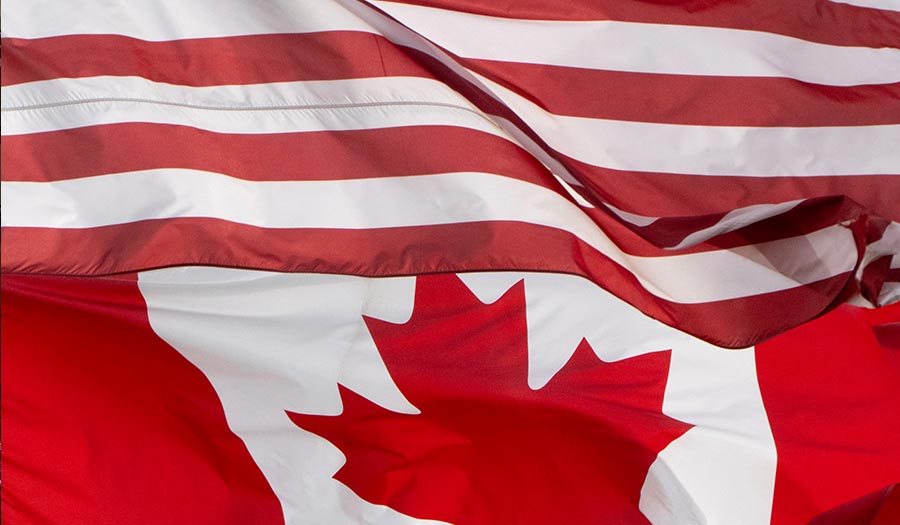
 ADRIAN WYLD/THE CANADIAN PRESS VIA AP
Article
With tensions rising, experts warn that the U.S. and Canada’s trade relationship may never return to normal.
Learn the why behind the headlines.
Subscribe to the Real Truth for FREE news and analysis.
Subscribe NowFor decades, Canada built much of its prosperity on privileged access to the United States. Now, after the collapse of trade talks, one of the world’s closest and most durable alliances has been fundamentally altered, with both countries facing the risk of a full-scale trade war.
Prime Minister Mark Carney acknowledged the break after last-ditch negotiations failed on August 21, saying Canada had recognized that “America has changed” and that the countries would “not return to our old relationship.”
On August 22, the United States imposed 50 percent tariffs on about $20 billion worth of Canadian goods, charging that Canada discriminates against U.S. dairy, auto and alcoholic beverage producers. Canada promptly counterpunched with tariffs of 15 percent, 25 percent or 50 percent, matching U.S. imports dollar for dollar. To punish Canada for retaliating against his tariffs, President Donald Trump decided to ban a list of Canadian products, including dairy products, motorcycles and alcoholic beverages.
Mr. Carney foreshadowed the shift at the World Economic Forum in Davos in January, declaring that the world was experiencing “a rupture, not a transition” and urging countries such as Canada to reduce their vulnerability to economic coercion by strengthening their economies at home and diversifying abroad.
He said in Ottawa on August 22 that warning had been borne out. He accused the U.S. of using “economic integration as a weapon” and said its “signature was written in pencil.”
“The collapse of the tariff talks points to the fact that the old Canada-U.S. relationship is over and, for many Canadians, it also confirms the perception that Canada can’t trust the Trump administration,” said Daniel Beland, a political science professor at McGill University in Montreal.
The pressure from Mr. Trump has gone well beyond tariffs.
He has questioned Canada’s economic viability, repeatedly talked about making it the 51st U.S. state and used trade measures to encourage production to move from Canada to the United States. That has angered many Canadians and fueled a sense of betrayal in a country that had long regarded the U.S. as its closest ally.
Canadian travel to the U.S. remains sharply lower than before the dispute, with July return trips down nearly 29 percent by car and 27 percent by air from July 2024, Statistics Canada said.
The failed negotiations underscored how far the relationship had shifted. Canada had been prepared to accept some U.S. tariffs for market access and greater certainty—a break from decades of policy aimed at eliminating trade barriers.
For Canadians accustomed to preferential access under the 1989 Canada-U.S. Free Trade Agreement, NAFTA and its successor, even reduced tariffs would mark a retreat from the old relationship.
The collapse also puts Mr. Carney’s approach to Mr. Trump to the test.
The prime minister’s “elbows up” posture—hockey shorthand for playing aggressively and refusing to be pushed around—has helped keep him popular at home. His decision to resist U.S. pressure could also resonate abroad with those impressed by his Davos call for countries to resist economic coercion and reduce dependence on great powers.
Provincial and conservative leaders broadly backed Mr. Carney. Saskatchewan Premier Scott Moe said “the old status quo is not possible,” while Ontario Premier Doug Ford praised Mr. Carney for rejecting what he called a bad deal for the auto, steel and manufacturing sectors.
Mr. Ford said Mr. Trump “is not to be trusted whatsoever.”
Former Alberta Premier Jason Kenney said Canada was “not cravenly surrendering in the face of constant economic and political aggression.”
Lana Payne, national president of Unifor, Canada’s largest private-sector union, accused Mr. Trump of trying to weaken Canada’s industrial base.
“What we have seen from the U.S. administration, or Donald Trump, is this consistent attempt to try and destroy the industrial economy of Canada with tariffs that have been strategically designed to attack us,” Ms. Payne said.
The Economic Risks of Fighting Back
Nearly three-quarters of Canada’s goods exports go to the United States. The U.S. economy is roughly 10 times larger than Canada’s, limiting Ottawa’s ability to retaliate dollar for dollar without inflicting disproportionate damage at home.
Royal Bank of Canada economists estimate the tariffs directly affect about 0.4 percent of Canada’s GDP because they cover only about 5 percent of Canadian exports to the U.S. The damage could grow if retaliation broadens, more sectors are targeted or the dispute curbs investment and disrupts supply chains.
Mr. Carney himself acknowledged the cost of retaliation, saying the Canadian measures would “raise costs and reduce choice for Canadians.” He said his government would announce additional assistance for affected businesses and workers.
Mr. Beland said the countries were witnessing “the beginning of a full-scale trade war,” though he cautioned that the situation could change rapidly.
The dependence is not one-sided.
Mr. Carney said Canada supplies 99 percent of U.S. natural gas imports, 85 percent of its electricity imports and 60 percent of its crude oil imports. Mr. Trump has focused much of his pressure on autos, steel and aluminum, fueling resentment among Canadians who see the push as an effort to hollow out key industries.
Goldy Hyder, president and CEO of the Business Council of Canada, said businesses still view the U.S. as Canada’s most important trading partner but increasingly see the shift as lasting beyond Mr. Trump.
“There is a new trade and investment model, one that could well be kept in place by future U.S. administrations whether Democrat or Republican,” Mr. Hyder said.
Canada Looks Beyond the United States
The breakdown adds urgency to Mr. Carney’s push to diversify beyond the United States. He has traveled abroad seeking investment and new trade ties, aiming to attract $1 trillion Canadian (US$730 billion) by 2030 and double non-U.S. investment over the next decade. Canada has signed more than 20 trade and security agreements across five continents in the past year.
That made Washington’s effort to restrict Canada’s ability to negotiate trade agreements with other countries particularly significant.
In July, Ottawa and Alberta advanced plans for a new Pacific Coast oil pipeline to give Canadian crude greater access to Asian markets and reduce reliance on U.S. buyers.
Mr. Carney has embraced the prospect of Canada becoming the European Union’s first associate member. A Canadian official familiar with the discussions told The Associated Press in early September that Ottawa was exploring ties with the EU that could stop just short of membership. The official said Canada would seek an arrangement allowing its citizens to live and work in Europe without visas as part of a broader strategic partnership.
Jonathan Wilkinson, Canada’s ambassador-designate to the EU, said that Canada had talked to the EU about an “Alliance for the Future,” while European officials had raised associate membership. Mr. Wilkinson said Canada is not seeking full EU membership because it would require surrendering some sovereignty. Instead, Ottawa wants “to get as close as we possibly can” to the bloc in a way that strengthens Canadian sovereignty rather than diminishes it, he said.
The immediate question is how long the latest tariff confrontation will last.
“We take note of the coming into force of the Administration’s previously announced trade measures,” said Gabriel Brunet, a spokesperson for Canada-U.S. Trade Minister Dominic LeBlanc. “Our first priority remains on protecting and supporting Canadian workers, farmers, families, and businesses from these unjustified actions. Our core focus is on what we can control: building strength at home, diversifying our partnerships abroad, and building Canada strong for all Canadians.”
Mr. Trump expressed confidence that the Canadians would cave in.
“They’re gonna come in and they’re gonna say, ‘Sir, we are sorry,’” he told reporters in late September. “They’ve treated the United States very, very badly. I think a deal will be made but it’s gonna be fair.”
When asked about Mr. Trump’s remarks, Mr. Carney declined to respond directly but said Canada remains open to talks. “Canada stands ready to negotiate in good faith” toward “a mutually advantageous trade arrangement that respects both our countries’ sovereignty,” Mr. Carney said.
Mr. Carney also left the door open to further Canadian retaliation over U.S. tariffs and import bans, saying he would “never rule anything out.” He said Canada could help lower U.S. living costs and argued that energy, food, information and financial security are best served through reliable partnerships. “Canada is a reliable partner, and we’re ready to work in any or all of those areas,” Mr. Carney said.
Trade attorney Patrick Childress said the standoff is likely to continue for months, not weeks. The import bans and the tariffs so far “probably won’t cause enough economic upheaval to force either party back to the negotiating table,’’ he said.
Mr. Beland said the deeper change probably will, partly because U.S. protectionism is likely to remain influential under future administrations.
“The idea that things will return to ‘normal’ once Donald Trump leaves the White House is probably just wishful thinking,” Mr. Beland said. “It doesn’t mean the relationship might not improve in the future but that things will never be the same.”
This article contains information from The Associated Press.
- Real Truth Magazine Articles
- ANALYSIS
 Biblical Identities of Modern Nations
Many of today’s nations can be found within the pages of the Bible. You just have to know where to look.
More on Related Topics:
- U.S. Removes Syria from Terrorism Sponsor List
- U.S. Unveils ‘Economic D-Day’ of Sanctions to Isolate Iran
- Saudi Arabia, Turkey and Pakistan Have Signed a Key Defense Agreement
- Ukraine and 9 Other Countries Announce a Coalition to Protect Europe from Ballistic Missiles
- Analysis: North Korea, China Claim Wins from Xi Visit, But Limits Remain
Latest News
-
October 26, 2026
- America & Canada’s Trade War
- True Thanksgiving Begins with God
- Is Humanity Losing Control of AI? October 20, 2026
- Japan Launches Spacecraft to Mysterious Moons of Mars in Bold Mission to Bring Home Soil Samples
- France Announces Nightly Curfews ‘For as Long as Necessary’ in Paris and Other Big Cities October 16, 2026
- Fundraising to Protect Oceans, Forests and Other Key Nature Sites Falling Short Ahead of UN Summit
- Drone Strikes in the Black Sea Raise Fears of Russian Escalation to Test NATO’s Response
- Nepal’s Devastating Flood Exposes the Risks of Resettling Disaster Survivors October 15, 2026
- Sudan’s Famine Risk Worsened by Conflict, Drought and Funding Shortages
- How the Houthis Are Helping Iran Turn Saudi Arabia into a Pressure Point October 9, 2026
- What Will the Next Leader of the UN Need to Get the Job Done in an Increasingly Complex World? October 8, 2026
- UN Health Agency Wants More Details from Russia on Suspected Pneumonic Plague Case
- Ukraine Claims to Have Taken Out More Than Half of Russia’s Oil Refining Capacity
- Violence Has Displaced Members of More Than Half a Million Mexican Households in Past 5 Years
- As Iran War Smolders, Shunned Eritrea Looks to Come in from the Cold September 15, 2026
- U.S. Acknowledges for the First Time that It Has Deployed Weapons in Space
- Some Russians Are Fleeing Abroad, Citing Draft Fears and a Loss of Freedom September 11, 2026
- Americans Mark 25 Years Since September 11 Attacks amid Enduring Grief, Reflection
- Yemen’s Iranian-Backed Houthis Seize an Island in a Key Strait, Opening a New Front in the Iran War September 10, 2026
- The Push to Remove Lead Pipes Is On. Thousands of Water Systems Still Don’t Know Where Theirs Are