
 Getty Images
Article
Most Christian denominations accept all meats as okay to eat. Yet a closer look at the Bible shows otherwise.
Learn the why behind the headlines.
Subscribe to the Real Truth for FREE news and analysis.
Subscribe Now“Rise, Peter; kill, and eat.”
In a vision recorded in Acts 10, the apostle Peter witnessed a sheet lowered from heaven, filled with animals—“fourfooted beasts of the earth, and wild beasts, and creeping things, and fowls of the air” (vs. 12)—many of them considered unclean under the laws found in the Old Testament. In verse 13, a voice tells him to kill and eat.
Here is one of Jesus Christ’s apostles, in the early days of the Church, being told to eat what had long been forbidden. For many Christians, this moment appears to signal a turning point. Old restrictions are gone. Case closed.
Other passages seem to support the same conclusion.
In Mark 7:15, Jesus declared that what enters a man from the outside does not defile him. Many take this to mean that all food is okay to eat.
Then there is Paul’s statement in Romans 14: “I know, and am persuaded by the Lord Jesus, that there is nothing unclean of itself” (vs. 14). For those looking for confirmation, this seems to remove any remaining doubt.
The Old Testament distinctions between clean and unclean meats appear to have been removed. What was once forbidden is now allowed.
Meats such as bacon, sausage, shrimp, crab, lobster, scallops—and even more unusual animals like frogs and snakes—are now widely considered acceptable.
Yet if these passages really mean this, why does the Old Testament go to such lengths to define which animals are to be eaten and which are not? And if those distinctions were set aside, does Scripture plainly say that?
These are simple questions. Yet they are often left unanswered.
A closer look at what the Bible really says—both before and after these New Testament accounts—reveals a complete picture.
Clear Instructions
Long before the New Testament was written, the Bible addressed the subject of meats in clear terms. Two chapters—Leviticus 11 and Deuteronomy 14—lay out the animals that are considered clean for eating and other categories of animals that are unclean. They are so detailed and specific that many find them challenging to study.
Consider the context for those receiving these instructions when they were given to ancient Israel. People lived on the land and relied on animals for survival. To “kill and eat” was a normal part of life for them. But just because a creature was available did not mean God intended it to be food.
Based on God’s instructions, if an animal was considered clean, the Israelites knew they could kill and eat it. If an animal was close at hand but it was one God said was unclean, it was off-limits.
Today, we usually purchase our food at a store or a restaurant. But as with the Israelites, we would not know what to eat or avoid unless God told us.
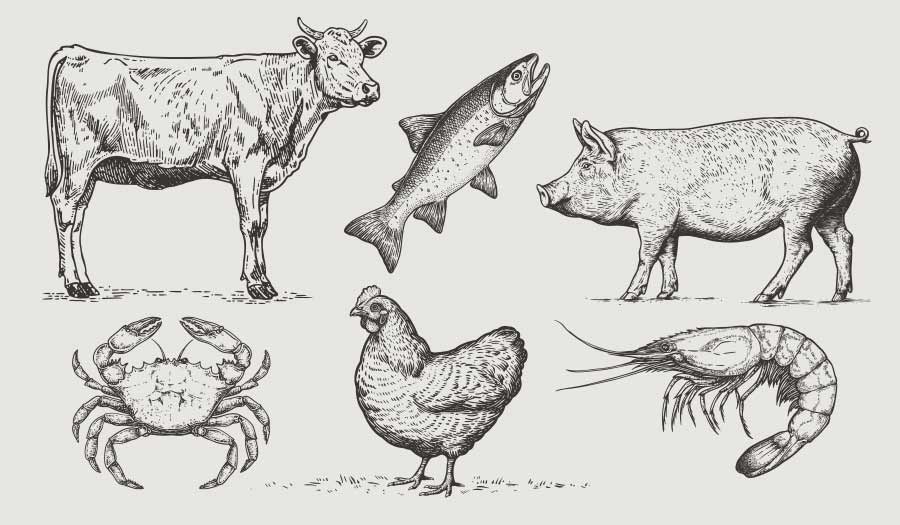
Leviticus 11:3 says, “Whatsoever parts the hoof, and is clovenfooted, and chews the cud, among the beasts, that shall you eat.” Animals such as cows, sheep and deer meet this requirement.
By contrast, animals that do not meet these conditions are excluded. The chapter continues, “the swine, though he divide the hoof, and be clovenfooted, yet he chews not the cud; he is unclean to you: of their flesh shall you not eat” (vs. 7-8).
A clear standard also applies to creatures that live in the water: “These you shall eat of all that are in the waters: all that have fins and scales shall you eat” (Deut. 14:9).
Fish such as salmon, tuna and cod fall into this category. Creatures such as lobster, shrimp and scallops do not meet that criteria. God says of those without these features: “And whatsoever has not fins and scales you may not eat; it is unclean unto you” (vs. 10).
These are plain commands. Certain animals are identified as food—and others are not. Take time to read both chapters for much more detail.
What is sometimes overlooked, even by those who follow these instructions, is that these distinctions did not begin with laws given through Moses.
Centuries earlier, during the time of Noah, God instructed him to take seven pairs of “every clean beast” and only one pair of “beasts that are not clean” into the ark before the flood came (Gen. 7:2). Noah clearly understood the difference. That knowledge had to come from God, long before these laws were recorded in Leviticus and Deuteronomy. God wanted Noah to have food available for the long voyage and made sure he packed animals he could kill and eat.
God defined what qualifies as food in specific terms. The question is, how should the New Testament passages often used to challenge this distinction be properly understood?
Often Misunderstood
Consider first the words of Jesus Christ in Mark 7. The setting here is that the Pharisees were criticizing Jesus’ disciples for eating without first washing their hands. Today that is normal hygiene, but during that time, washing hands was a ceremonial practice the Pharisees had elevated to great importance.
Christ said, “There is nothing from without a man, that entering into him can defile him: but the things which come out of him, those are they that defile the man” (vs. 15).
Was this really a statement about making all foods clean?
Let’s look at the beginning of the chapter: “Then came together unto Him [Christ] the Pharisees, and certain of the scribes, which came from Jerusalem. And when they saw some of His disciples eat bread with defiled, that is to say, with unwashen, hands, they found fault. For the Pharisees, and all the Jews, except they wash their hands often, eat not, holding the tradition of the elders” (vs. 1-3).
The subject here was not which animals could be eaten. It was whether eating with unwashed hands defiled a person spiritually. No mention was made about what kind of food was being consumed.
Jesus was addressing a human tradition, not overturning God’s Old Testament commands. His point was about moral defilement, not diet—emphasizing spiritual cleanliness over ritual practices. Read the full account for yourself.
Christ further emphasized this when He spoke directly to His disciples later in the chapter: “Do you not perceive, that whatsoever thing from without enters into the man, it cannot defile him; because it enters not into his heart, but into the belly, and goes out into the draught, purging all meats?” (vs. 18-19).
Some latch on to the phrase “purging all meats” and miss the bigger point here: Germs from unwashed hands cannot spiritually defile us. What we need to worry about is what comes out of us, meaning thoughts and actions influenced by human nature. Jesus went on in verses 20 to 23 to talk about the evil things people do that originate in their hearts.
The phrase “purging all meats” in verse 19 simply refers to the body’s natural waste elimination process. Anything we eat eventually “goes out into the draught,” as Jesus put it, over time.
People similarly misunderstand Peter’s vision in Acts 10.
Peter saw the sheet filled with various animals and was told to eat them. At first glance, this appears to support the idea that all foods were now acceptable. But as the passage continues, the real meaning becomes clear.
Peter initially refused the instruction to rise, kill and eat, saying he had never eaten anything “common or unclean.” This statement shows that the distinction was still being observed by the early Church years after Jesus’ death.
The account continues, “the voice spoke unto him again the second time, What God has cleansed, that call not you common. This was done thrice: and the vessel was received up again into heaven” (vs. 15-16).
God did not want the meaning to be unclear to Peter. The instruction was given three times for emphasis.
Verse 17 begins to reveal who or what was cleansed: “Now while Peter doubted in himself what this vision which he had seen should mean, behold, the men which were sent from Cornelius had made enquiry for Simon’s house, and stood before the gate.”
Cornelius was a Gentile. Up to that point, only Jews had been part of the New Testament Church. After telling Peter three times that He had cleansed something previously considered common, God immediately turned the apostle’s attention to this Gentile man and his family, showing him that they were being called into the Church.
The vision was about people—specifically, the acceptance of Gentiles—not about food. The imagery of unclean animals served as a familiar way to convey this point. The vision marked a shift in how the gospel would be spread, not a redefinition of what could be eaten.
Peter got the point. He concluded, “God has showed me that I should not call any man common or unclean” (vs. 28). This vision and its lesson were so important to God, the story is told again in the very next chapter.
Romans 14 is the other passage frequently cited. The apostle Paul wrote, “I know, and am persuaded by the Lord Jesus, that there is nothing unclean of itself: but to him that esteems any thing to be unclean, to him it is unclean” (vs. 14).
At first glance, this can seem to set aside the distinction between clean and unclean animals. But the key lies in the context in which the word “unclean” is used.
The term here does not refer to animals that are unclean by biblical definition. Reading the chapter in its entirety shows what is being discussed here are foods considered unclean or defiled in relation to a person’s conscience, such as meat that had been offered to an idol.
Rather than addressing clean and unclean animals, this chapter deals with avoiding offenses among Christians in personal matters of conscience and judgment, particularly with new believers.
For some, eating something that had been offered to an idol felt wrong. Others did not see a problem with it, since the idol represented a “god” that did not really exist. Verse 2, which speaks of a person who “eats herbs,” shows that some new converts were coming out of a previous lifestyle of vegetarianism.
This passage and other so-called proof verses actually address different issues—human traditions, the inclusion of Gentiles, and matters of personal conscience. When understood in context, they do not overturn what had already been clearly defined in Leviticus and Deuteronomy.
If such a fundamental change had occurred—one affecting daily life so directly—God would have stated it plainly. Yet nowhere in the Bible does it say animals once considered unclean are now acceptable for food.
Fearfully and Wonderfully Made
By this point, the Bible truth should be easy to see. God clearly defines certain animals as fit for food and others as not.
Modern culture often treats lobster, scallops, frog legs, escargot (snails), and other unclean foods as delicacies. Some are expensive. Some are associated with status or fine dining. But price and popularity do not determine what is right—God does.
The same God who made the human body also made the food supply that sustains it. Just as He designed the body with order and purpose, God also carefully engineered what kinds of animal flesh were appropriate for it.
David wrote, “I will praise You; for I am fearfully and wonderfully made” (Psa. 139:14). God made us, and He tells us what we should eat. He did so early in human history, repeated it clearly in His Law, and nowhere reversed it.
III John 2 adds, “I wish above all things that you may prosper and be in health, even as your soul prospers.” The truth about meats is one of the ways God guides us into good health and prosperity. If we obey what He says, blessings will follow.
For more information about God’s laws of clean and unclean meats, read our article Are All Animals Good Food? Our booklet God’s Principles of Healthful Living explains what the Bible teaches about many other health-related topics.
Other Related Items:
More on Related Topics:
Suggested Reading
More on Related Topics
Latest News
-
October 15, 2026
- Sudan’s Famine Risk Worsened by Conflict, Drought and Funding Shortages
- How the Houthis Are Helping Iran Turn Saudi Arabia into a Pressure Point October 9, 2026
- What Will the Next Leader of the UN Need to Get the Job Done in an Increasingly Complex World? October 8, 2026
- UN Health Agency Wants More Details from Russia on Suspected Pneumonic Plague Case
- Ukraine Claims to Have Taken Out More Than Half of Russia’s Oil Refining Capacity
- Violence Has Displaced Members of More Than Half a Million Mexican Households in Past 5 Years
- As Iran War Smolders, Shunned Eritrea Looks to Come in from the Cold September 15, 2026
- U.S. Acknowledges for the First Time that It Has Deployed Weapons in Space
- Some Russians Are Fleeing Abroad, Citing Draft Fears and a Loss of Freedom September 11, 2026
- Americans Mark 25 Years Since September 11 Attacks amid Enduring Grief, Reflection
- Yemen’s Iranian-Backed Houthis Seize an Island in a Key Strait, Opening a New Front in the Iran War September 10, 2026
- The Push to Remove Lead Pipes Is On. Thousands of Water Systems Still Don’t Know Where Theirs Are September 9, 2026
- Family Interest in Education Falls as Test Scores Drop
- The Poorest in the U.S. Can’t Find Housing Even as Low-Income Units Sit Empty September 1, 2026
- In U.S. West, Drought Pits Farms Against Industry
- Why Christians Must Watch the News
- Teach Your Children to Be Active
- What Comes After America 250? August 31, 2026
- How Brexit Broke British Politics
- How to Keep the Sabbath