Sabbath after Sabbath, you keep the day at home. Viewing the livestream brings the hymns and the sermon into the house, but when services end, the room goes quiet again.
Age, illness or injury may keep you from attending with the congregation. The Church calls members in this situation shut-ins, and this article is written for you.
Perhaps life once looked very different. You may have driven to services every week, helped set up the hall, hosted brethren at your table or never missed a Feast. Serving others may have been a regular part of your life.
Now, your world has grown smaller. Driving may be behind you. Walking across the room may take effort. Writing may be hard on your hands, and hearing loss may make conversation tiring. You may need help with things you once did without thinking. Adjusting to those changes can be difficult, especially when you were once accustomed to being the one who helped others.
But perhaps the hardest part is not what you can no longer do physically. It is wondering whether you can still contribute. And on the hard days, the questions can become more personal: Do I still matter? What purpose do I have now? What can I give when I can barely take care of myself?
Hebrews 6:10 gives a reassuring answer: “God is not unrighteous to forget your work and labor of love, which you have showed toward His name, in that you have ministered to the saints, and do minister.”
God calls what you have done for His people a “work and labor of love,” and He promises not to forget it. But notice how the verse ends: “and do minister.” Your part in God’s Church is not something that belongs to the past. The ways you serve may have changed, but meaningful service is still possible.
Necessary Members
When the apostle Paul compared the Church to a human body, he deliberately drew attention to the members who are easiest to overlook: “No, much more those members of the body, which seem to be more feeble, are necessary” (I Cor. 12:22).
Do not miss the word necessary. In a body, importance is not limited to the parts that are most visible or active. Paul went on to explain that God has “given more abundant honor to that part which lacked” (vs. 24), and that “whether one member suffer, all the members suffer with it; or one member be honored, all the members rejoice with it” (vs. 26).
Physical limitations do not place you outside the Body of Christ (vs. 27) or make your part in it unimportant. You may no longer be able to attend services in person or serve in many of the ways you once did, but you remain a member of the same Body.
And while your circumstances may limit what you can do physically, they do not prevent God from continuing His work in you. Notice II Corinthians 4:16: “Though our outward man perish, yet the inward man is renewed day by day.”
There may be days when very little activity is possible. Yet patience, faith, hope and endurance can still be growing through a long trial. Romans 5 explains, “Tribulation works patience; and patience, experience; and experience, hope” (vs. 3-4).
The fruit of God’s Spirit (Gal. 5:22) can grow in a quiet house just as surely as in a crowded hall, and the example of someone patiently enduring a difficult trial can strengthen others in ways he or she may never fully know.
There is another side to being part of the Body that can be especially difficult to accept: sometimes you must let others serve you. Accepting the meal, the visit, the ride or the help around the house may take real humility, particularly if you spent years being the one who helped others. But receiving that help graciously also allows another member to fulfill his or her part in the Body.
At some stages of life, we may be able to give in very visible ways. At others, our part may look quite different. Both circumstances allow for faithful service.
The Sabbath Kept Alone
If you keep the Sabbath alone, week after week, it can be easy to wonder whether keeping it at home is somehow lesser than keeping it with a congregation. Yet remember God calls the day “a delight, the holy of the Lord, honorable” (Isa. 58:13). Its holiness does not depend on how many people are in the room with you.
Physical inability to attend is not the same as “forsaking the assembling of ourselves together” (Heb. 10:25). When your circumstances leave you no choice, joining services by livestream or watching downloaded sermons allows you to participate in what is available and remain connected with the Church.
Your part in the Sabbath can also extend beyond listening to services. The hour afterward may be a natural time to reach for the phone. Perhaps there is a new member you could encourage, or another isolated member who understands what it is like to keep the Sabbath far from a congregation.
If you are unsure whom to call, ask your minister. He may know someone who would especially appreciate hearing from you. In the first-century Church, brethren sometimes waited weeks for a letter to travel between congregations. Today, it is possible to reach another member of the scattered Body in seconds.
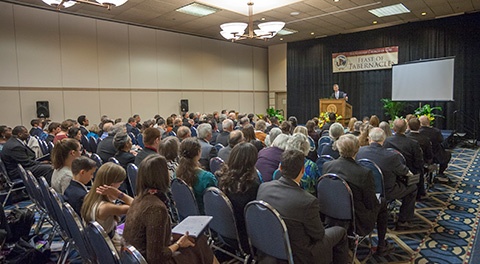
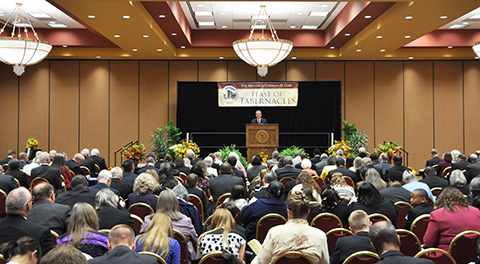
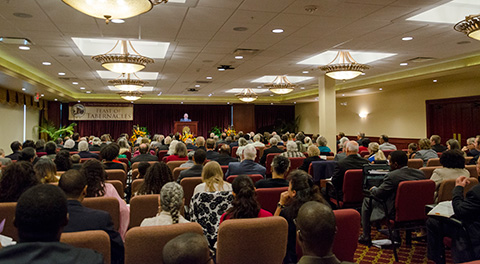
The Feast of Tabernacles can bring these feelings into sharper focus. As brethren prepare to travel to Feast sites, you may once again find yourself staying home.
Yet the Feast can still be made special right where you are. Livestreamed services can keep you connected with what the Church is hearing, and the things you are learning point toward a time when present limitations will be gone.
Isaiah described that future: “Strengthen you the weak hands, and confirm the feeble knees. Say to them that are of a fearful heart, Be strong, fear not: behold, your God will come with vengeance, even God with a recompense; He will come and save you. Then the eyes of the blind shall be opened, and the ears of the deaf shall be unstopped. Then shall the lame man leap as an hart, and the tongue of the dumb sing” (35:3-6).
The time is coming when weak hands will be strong, feeble knees will be restored and no physical limitation will keep anyone at home. Take these words to heart: God promises that what confines you today will not last forever.
Serving From Home
Physical limitations may change the ways you can serve, but they do not remove every opportunity. There is still meaningful work you can do.
Prayer: When Paul wrote to the Colossians from prison, he passed along greetings from Epaphras, who was “always laboring fervently for you in prayers” (Col. 4:12).
You too can labor by going to God in prayer. While that does require effort, keep it simple. A shut-in member in Atlantic Canada shared her approach to prayer: “We don’t need fancy words, just talk to Him. He understands.” She regularly brings her family, friends, the Church family and the ministers before God.
Perhaps you could keep a short list of brethren beside your chair and pray through it by name. When a prayer request is mentioned in announcements, write it down. If you later learn how the matter turned out, thank God for it, and perhaps let the person know you were praying. Much of this service will never be seen by anyone else, but God sees it.
Offerings: Faithful giving is another way to remain involved in the Work of God. Jesus Christ showed that offerings are not measured by size alone. Sitting opposite the treasury, He watched a poor widow drop in two mites and told His disciples that she had given more than all the others because they gave from their abundance, while she gave from the little she had (Mark 12:43-44).
The lesson was not about the amount. Christ saw the willingness and sacrifice behind what she gave. A member whose circumstances allow only a small offering should never conclude that it is insignificant.
Your example: Most members regularly encounter people at work or in town. For someone confined to home, those contacts may instead come through a home care nurse, a visiting family member or someone else who comes through the door.
Such people will see firsthand how you respond to hardship, uncertainty or other difficulties. Peter wrote, “Be ready always to give an answer to every man that asks you a reason of the hope that is in you” (I Pet. 3:15). The way you endure a long trial may cause someone to notice that hope—and perhaps one day ask about it.
In all of this, know your limits, and do not become discouraged when there are times you simply cannot do much. Strength differs from one member to another, and even for the same person it may vary greatly from day to day.
If arthritis makes writing difficult, perhaps a short phone call is easier. If talking tires you, or hearing difficulty makes calls frustrating, perhaps a card works better. If neither is possible today, there are still brethren you can bring before God by name. And on days when pain or fatigue leaves strength for little more than a short prayer, God understands.
He knows the difference between unwillingness and inability: “If there be first a willing mind, it is accepted according to that a man has, and not according to that he has not” (II Cor. 8:12).
This principle removes the need to measure yourself against what you once could do—or against what someone else can do now. The better question is simply: What is within my reach today?
Jesus said that “whosoever shall give to drink unto one of these little ones a cup of cold water only in the name of a disciple…he shall in no wise lose his reward” (Matt. 10:42).
Not Forgotten
Much of what you do will not be under a spotlight. But God sees all of it, and He has promised not to forget.
That is worth remembering when discouragement returns. The shut-in member in Atlantic Canada expressed it simply: “I cannot know the future, but I know He does.”
God also gives us reassuring words for the days when strength is low. Isaiah 41:10 says: “Fear you not; for I am with you: be not dismayed; for I am your God: I will strengthen you; yes, I will help you; yes, I will uphold you with the right hand of My righteousness.”
And when what you are able to do feels too small to matter, remember Paul’s words: “Be you steadfast, unmovable, always abounding in the work of the Lord, forasmuch as you know that your labor is not in vain in the Lord” (I Cor. 15:58).
Your circumstances may have changed in ways you never wanted. You may not be able to serve as you once did or do what another member can do. But God has not forgotten you, and He does not overlook what is still within your reach.
A prayer. A call. An offering. An encouraging word. Patient faithfulness through another difficult day.
You serve a God who sees and remembers. Whatever your strength allows today, your labor is not in vain.