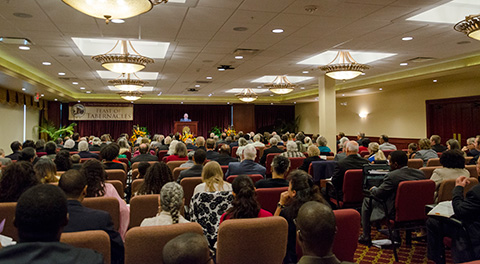
In Acts 2, Luke records the scene of the New Testament Church’s birth. His account begins with a phrase that is easy to pass over on the way to more dramatic events: “And when the day of Pentecost was fully come, they were all with one accord in one place” (vs. 1).
Most readers quickly move on to what follows: the sound from heaven, the tongues of fire, Peter’s powerful sermon and about 3,000 people being baptized that day.
From there, God’s Work began moving outward to Jerusalem, Judea, Samaria and eventually “unto the uttermost part of the earth” (1:8).
Yet the condition of the disciples on that day matters. They were “all with one accord.” They had witnessed events leading up to Jesus Christ’s death, reunited with Him after His resurrection, and spent 40 days hearing Him speak “of the things pertaining to the Kingdom of God” (vs. 3). Before Christ ascended, He had told them they would be “baptized with the Holy Spirit not many days hence” (vs. 5). These shared experiences would have bonded them together as never before.
The Holy Spirit was given on Pentecost just as Jesus promised. God went on to work powerfully in His servants through that Spirit. The unity continued as well. Acts 2:44 records, “And all that believed were together, and had all things common.” They continued “daily with one accord” and with “singleness of heart” (vs. 46). And “the Lord added to the Church daily such as should be saved” (vs. 47).
Being in one accord did not just apply to the Holy Day. It was a way of life.
Pentecost shows us that God can work powerfully through a people who are united. The question for us is this: How can we continue in that same kind of unity today?
We Are to Be One
Notice what was on Jesus Christ’s mind the night before His crucifixion. He prayed for unity—not just for the disciples with Him, but for all who would become Christians over the millennia to come.
He prayed to the Father “that they all may be one; as You, Father, are in Me, and I in You, that they also may be one in Us: that the world may believe that You have sent Me” (John 17:21).
Christ was not merely praying for us to be agreeable or cooperative. He prayed that we would be just as united as He was with the Father. That we would be “one.” That is a high standard.
This gives deeper meaning to Luke’s statement that the disciples were “with one accord” at Pentecost. The Greek word translated “with one accord” is homothumadon, which means to be together “with one mind, with one accord, with one passion” (Outline of Biblical Usage).
The apostle Paul adds another layer to this picture. Writing to the Corinthians, he reminded them, “Know you not that you are the temple of God, and that the Spirit of God dwells in you?” (I Cor. 3:16).
The Church is God’s spiritual dwelling place. His Spirit works in His people and binds them into something far greater than simply a group of people who attend Sabbath services together or believe the same doctrines. We are part of a spiritual house in which God dwells.
Allow this knowledge to shape how you think about unity. If we would show care and respect for a physical place dedicated to God, how much more should we care for His spiritual house? Maintaining unity is part of that care. The way we think, speak and treat one another helps preserve what God is building.
Unity Maintained
In Ephesians, Paul added that we are to be “endeavoring to keep the unity of the Spirit in the bond of peace” (4:3).
The word “endeavoring” comes from the Greek spoudazo, carrying the sense of giving diligence, making haste or being earnest. Paul is describing active, deliberate effort. Maintaining unity requires ongoing work.
Left to itself, any group of people can grow distant, including God’s people. Disunity often begins with things that seem small, such as a misunderstood comment or an offense carried from one Sabbath to the next. Over time, those unresolved matters can become a pattern of coldness and distance. Even worse, they can lead to bitterness and resentment.
Notice that Paul says to “keep” the unity of the Spirit. He does not tell us to create it from nothing. God’s Spirit produces unity among His people. Our responsibility is to preserve it.
King David understood the blessing of unity. Psalm 133 opens, “Behold, how good and how pleasant it is for brethren to dwell together in unity” and concludes, “for there the Lord commanded the blessing, even life for evermore” (vs. 1, 3).
David shows that unity among brethren is something God delights in and blesses. It is not a small matter. God is building a spiritual house and each of us has a responsibility to help preserve peace within it.
Attitude Before Action
Before Paul gave the command to endeavor for unity, he laid out what must come first. He told the Ephesians to walk “with all lowliness and meekness, with longsuffering, forbearing one another in love” (4:2).
These qualities should shape how we see and respond to other people.
Unity cannot survive without these qualities, because every congregation contains people who will, at some point, test our patience. Interpersonal friction always arises where flawed human beings share close quarters. What matters is how we respond when it comes.
Solomon wrote: “Only by pride comes contention: but with the well advised is wisdom” (Prov. 13:10). A prideful attitude will tell us our perspective is correct, our interpretation is the right one and our grievance is justified. Once pride appears, arguments usually follow.
Paul tells us the way to deflate pride is to “let each esteem other better than themselves” (Phil. 2:3).
Applying this verse does not mean pretending others have no faults. It means adopting a humble attitude and emphasizing others’ good qualities rather than focusing on their faults.
Consider asking yourself some questions to help change your perspective: What strength does this person have that I lack? How has God worked with them in ways I may have overlooked? Would I want my own words and actions judged as harshly as I am judging theirs?
Questions like these help us slow down, not be quick to judge and to restore unity.
Speech That Builds Up
Paul’s next instruction in the same chapter moves from attitude to speech. He wrote, “Let no corrupt communication proceed out of your mouth, but that which is good to the use of edifying, that it may minister grace unto the hearers” (Eph. 4:29).
The Greek word translated “corrupt” is sapros, meaning rotten, putrid or worthless. It describes the kind of speech that tears down rather than builds up.
Corrupt communication is broader than foul language or open cruelty. It includes careless words spoken in frustration. It includes the observation shared with a group of people that should have been shared privately with the one person to whom it applies. It includes making a joke at someone’s expense that may get some laughs but lowers them in others’ eyes.
Solomon described the power of words: “A wholesome tongue is a tree of life: but perverseness therein is a breach in the spirit” (Prov. 15:4). The word “breach” carries the idea of walls cracking and foundations giving way. Careless speech can open fractures between God’s people that, if neglected, will widen over time.
Before sharing a concern about one of the brethren with a third party, ask whether the concern has been raised with the person directly. If the answer is no, the comment is almost always better left unsaid. That one habit, practiced consistently, prevents much of the damage careless speech causes.
Yet even the most careful speech cannot prevent every offense.
Addressing Offenses Promptly
Paul’s instruction on how to maintain godly unity continues: “Let all bitterness, and wrath, and anger, and clamor, and evil speaking, be put away from you, with all malice: and be you kind one to another, tenderhearted, forgiving one another, even as God for Christ’s sake has forgiven you” (Eph. 4:31-32).
The phrase “put away” is important. Bitterness does not dissolve on its own. An offense that stays unaddressed shapes how we see the other person, often without our noticing.
We may stop registering the resentment we carry, but those around us can often see it clearly.
Jesus gave the pattern for handling this directly. He said, “If your brother shall trespass against you, go and tell him his fault between you and him alone: if he shall hear you, you have gained your brother” (Matt. 18:15).
Go tell him. It should be between you and him alone. The instruction is to go to the person, not around the person. And we should do so in a private setting. The instructions that follow in the passage are only to be applied after this crucial first step.
This is harder than it sounds. The easier path is to discuss the offense with others, rehearse it in our own minds or wait for the other person to come to us. The rift widens while we wait.
Applied concretely: If there is someone in God’s Church you have been quietly avoiding because of something said, consider picking up the phone this week and addressing the issue. Ask if they have time to talk, and share your thoughts with them. Then listen to their perspective.
“God worked powerfully through His people then. He still works powerfully through a unified people today.”
The conversation may be uncomfortable for a while, but usually the relationship can be restored with this kind of open and sincere communication.
Forgiveness in God’s Church is not optional. Notice the end of Ephesians 4:32. Just as God forgave us for our sins—forgiveness we did not earn—we should be ready to forgive others as well.
The Feast of Firstfruits
Pentecost, known in the Old Testament as the Feast of Weeks or the Feast of Firstfruits, was established by God long before the events of Acts 2.
Leviticus 23 records the command: “And you shall count unto you from the morrow after the Sabbath, from the day that you brought the sheaf of the wave offering; seven Sabbaths shall be complete: even unto the morrow after the seventh Sabbath shall you number fifty days; and you shall offer a new meat offering unto the Lord” (vs. 15-16).
The counting itself was part of the command. Beginning with the wave sheaf offering during the Days of Unleavened Bread, the days were marked off toward the 50th. Israel could not keep Pentecost whenever they chose. The feast had to be anticipated, week by week, until the commanded day arrived.
Pentecost also involved a unique offering. Two loaves of bread baked with leaven were waved before God (Lev. 23:17). The loaves were not the full harvest but the early portion of it, brought in before the bulk of the crop ripened.
A firstfruits harvest represents only a small portion of what will eventually be gathered. Those God calls during this present age, whose minds He opens to His truth and who respond by repenting, being baptized and receiving His Spirit, are part of what the Bible identifies as firstfruits.
James wrote that “of His own will begat He us with the word of truth, that we should be a kind of firstfruits of His creatures” (1:18). Paul added that Christ Himself is “the firstfruits of them that slept” (I Cor. 15:20).
The main harvest will come later, as pictured by the autumn Holy Days. The Feast of Trumpets, the Day of Atonement, the Feast of Tabernacles and the Last Great Day together depict the time when all nations will finally be given the opportunity to know God and enter His Family.
Against this background, God’s choice of Pentecost to pour out His Spirit in Acts 2 was deliberate. The Church that began that day was itself a firstfruits offering, the first of a larger harvest to come. The Spirit placed in those disciples marked them as God’s own: “In whom you also trusted, after that you heard the word of truth, the gospel of your salvation: in whom also after that you believed, you were sealed with that Holy Spirit of promise” (Eph. 1:13).
Stay Connected to the Body
Return to Luke’s statement in Acts 2:1. The disciples were in one place. They were assembled and physically present with one another.
Paul describes how the Church should be gathered spiritually in Ephesians 4:16. He describes Christ’s Body as “fitly joined together and compacted by that which every joint supplies, according to the effectual working in the measure of every part” (vs. 16).
When a joint separates, the body does not operate the way God designed it. No one can contribute to the unity of a body they have withdrawn from.
Withdrawal takes many forms: absence from Sabbath services, emotional distance, or the slow fade that begins when someone stops reaching out.
Hebrews 10 describes the problem and the solution: “Not forsaking the assembling of ourselves together, as the manner of some is; but exhorting one another: and so much the more, as you see the day approaching” (vs. 25).
We must resist the tendency to draw back.
How can you reengage? Attend the next congregational social. Call or text a member you have not spoken with in a while. Volunteer for a task no one else has taken on.
Simple acts like these can put you back on a path toward stronger connection to the Church.
Grieve Not the Spirit
Paul’s instruction in Ephesians 4 includes a direct warning: “And grieve not the Holy Spirit of God, whereby you are sealed unto the day of redemption” (vs. 30).
Recall that the verses surrounding this statement reveal the attitudes and actions that fight against God’s Spirit: bitterness, wrath, anger, clamor, evil speaking and malice. Each of these relates to how we treat other people.
This brings the whole chapter back to unity. The same Spirit that seals us also produces “the unity of the Spirit” Paul told us to keep.
If we allow bitterness, careless speech or division to remain, we work against what God is building in His people. But when we put those things away and choose kindness, tenderness and forgiveness, we help preserve the unity through which God can continue to work powerfully.
If we do that, we will never grieve the Holy Spirit.
Be of One Mind
The apostle Peter gives a simple summary of what godly unity looks like in daily life: “Finally, be you all of one mind, having compassion one of another, love as brethren, be pitiful, be courteous” (I Pet. 3:8).
Notice that none of these are grand, dramatic acts. They show up in how we speak after Sabbath services, how quickly we forgive, whether we reach out to someone we have avoided, and whether we look for ways to encourage rather than criticize.
Each of us can examine our own part in preserving unity. Ask yourself: Has distance grown between me and someone in the congregation? Have I spoken about a brother or sister in a way I would not speak to that person directly? Am I carrying an offense I have not addressed? Have I pulled back from the Body—physically, emotionally or spiritually? Am I helping preserve unity, or assuming someone else will?
Pentecost points us back to the beginning of the New Testament Church. On that day, the disciples were “with one accord in one place” (Acts 2:1). Afterward, the Church continued “daily with one accord” and with “singleness of heart” (vs. 46).
God worked powerfully through His people then. He still works powerfully through a unified people today.
That is why Paul’s command remains so important: “Endeavoring to keep the unity of the Spirit in the bond of peace” (Eph. 4:3).
Unity does not preserve itself. It is kept through humility and steady effort. Let’s all work together to keep the Church in one accord.