In 1850, British archaeologists working in what is now northern Iraq uncovered the ruins of ancient Nineveh. Buried within it was the royal library of King Ashurbanipal—thousands of clay tablet fragments written in cuneiform. In some places, the pieces lay a foot deep.
Years later, a young British Museum assistant named George Smith began puzzling the fragments together. Larger pieces fit in the palm of his hand. Others preserved only a few broken lines. Among contracts, inventories, letters and records of daily life, certain fragments began to form a story.
Then one line stopped him. It described a great flood.
As more fragments were assembled, a larger account emerged. It was what is now known as the Epic of Gilgamesh. Within it was a flood narrative that sounded, in some ways, strikingly similar to the account of Noah in Genesis 6-9: a divine decision to send a flood, a chosen survivor, a great boat, birds sent out and a sacrifice afterward.
When Smith presented his findings in 1872, they made headlines. Some claimed the discovery proved the Bible had borrowed from older myths.
Bible skeptics ask similar questions today: If other ancient writings contain stories about creation, divine beings and floods, then is the Bible simply another version of older legends? Is Genesis just another ancient mythology?
There are similarities between God’s Word and other ancient Near Eastern writings. But when we place the Bible beside pagan writings, something else becomes far more striking: the differences.
Examining those differences can help us more deeply appreciate the Bible—and the God who inspired it.
A World of Competing Stories
The Bible was not penned in a vacuum. Its authors were well aware of the pagan stories, customs and beliefs that filled the societies around them.
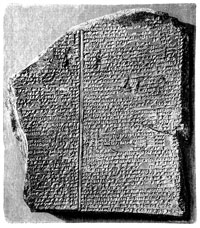
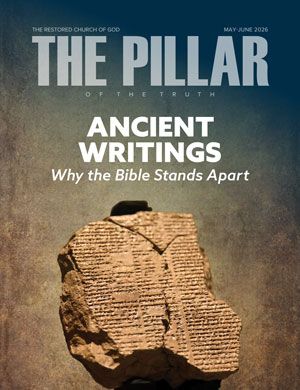
An illustration of a flood tablet relating part of the Epic of Gilgamesh, found in Neo-Assyrian Ninevah, Iraq.
Archive Photos/Getty Images
Moses, who was instrumental in recording the first five books of the Bible, was “learned in all the wisdom of the Egyptians” (Acts 7:22). He knew the religious worldview of one of the ancient world’s great civilizations.
Later, Israel lived among Canaanite nations steeped in the worship of Baal, Asherah and other false gods. Scripture shows how close those influences could be: Gideon’s own father had an altar to Baal and a grove to Asherah on his property (Judg. 6:25).
Centuries later, the Jews were carried into exile in Babylon and embedded in that society for decades (Jer. 29:4-7, 10).
Despite this, the Bible does not absorb or adapt those religious views. Rather, it confronts them and sets the true God apart from all others.
Even Scripture’s writing style helps make that distinction.
Israeli Bible scholar Shemaryahu Talmon observed that Hebrew authors moved away from the lofty epic style common in pagan religion and developed prose narration in its place.
Prose is a direct and straightforward way of recording events rather than presenting them as elevated poetry, mythic song or ritual drama. The epics of the ancient world were often tied to polytheistic worship and ritual. Scripture rejects that pagan world—not only its gods, but even the epic form of writing so closely associated with them.
Robert Alter, in The Art of Biblical Narrative, captured just how unusual this was: “It is peculiar, and culturally significant, that among ancient people only Israel should have chosen to cast its sacred national traditions in prose.”
The Babylonian creation story Enuma Elish displays the epic style. It opens in grand, mythic language: “When in the height heaven was not named, and the earth beneath did not yet bear a name, and the primeval Apsu, who begat them, and chaos, Tiamat, the mother of them both—their waters were mingled together…”
Now compare that with the Bible’s opening sentence: “In the beginning God created the heaven and the earth” (Gen. 1:1).
That opening line immediately sets the Bible apart. And as the chapter unfolds, it becomes clear that Genesis is revealing a God unlike any imagined by the nations around Israel.
A Different Kind of God
In Enuma Elish, creation does not begin with one supreme God carefully bringing all things into being. It grows out of conflict.
The account tells of rival deities, violence and a struggle for supremacy. Ultimately, the god Marduk defeats Tiamat, then uses her divided body to form the heavens and the Earth. In this story, the world emerges from war among gods.
In Genesis, the act of creation is strikingly different: “And the earth was without form, and void; and darkness was upon the face of the deep. And the Spirit of God moved upon the face of the waters” (1:2).
God here is acting alone. There are no rival gods here and no struggle for supremacy.
Then, He simply speaks: “And God said, Let there be light: and there was light” (vs. 3).
Viewed against the backdrop of the ancient world, Genesis 1 does more than merely show us that God created. It helps show us what kind of God did the creating.
The God of Genesis is not one deity among many. He is not working within a universe larger than Himself, nor is He reacting to forces outside His control. He reigns above all of it.
He states this explicitly later in the Bible: “I am the Lord that makes all things; that stretches forth the heavens alone; that spreads abroad the earth by Myself” (Isa. 44:24).
Do not allow the opening chapter of the Bible to become just an interesting story or a series of memory verses. These words can bring us comfort. The same Being who said, “Let there be light,” is the One we serve.
We can face severe trials, unanswered prayers or unsettling world events and wonder how God will resolve the issues of our lives. Reflecting on Genesis 1 can help cut through those anxieties and doubts. It can help ground our thinking.
And Genesis does not stop with God’s power over Creation. It also shows what this supreme Creator intended for mankind.
A Different View of Humanity
In the Akkadian epic Atrahasis, the gods grow weary of labor. Their solution is to create mankind to carry the burden for them: “Let the womb-goddess create offspring, and let man bear the load of the gods.” Man is then born from violence, made from the flesh and blood of a slaughtered god.
In that account, human beings exist to relieve the gods of work.
How different from Genesis: “God said, Let Us make man in Our image, after Our likeness…So God created man in His own image, in the image of God created He him; male and female created He them” (1:26-27).
Read in context with other writings of the ancient world, these familiar words become almost radical. God did not create mankind because He was tired or for them to be His slaves.
Instead, He did something far greater: God created man in His own image and invited them to share in ruling over Creation.
Genesis continues: “And God blessed them, and God said unto them, Be fruitful, and multiply, and replenish the earth, and subdue it” (vs. 28).
The second chapter makes this even more personal: “And the Lord God formed man of the dust of the ground, and breathed into his nostrils the breath of life” (2:7).
God had already shown that He could create by speaking. Yet when it came to mankind, Scripture pictures Him forming man from the dust and breathing into him the breath of life.
Is it any wonder David later asked, “What is man, that You are mindful of him? And the son of man, that You visit him?” He then answered: “You made him to have dominion over the works of Your hands” (Psa. 8:4-6).
For God’s people, this should deepen how we see our calling. The same God who formed mankind with such care is now forming His character in us. As Isaiah puts it: “But now, O Lord, You are our Father; we are the clay, and You our potter; and we all are the work of Your hand” (64:8).
A Different Moral Framework
The flood narratives deepen the contrast in how God interacts with mankind.
In Mesopotamian flood tradition—especially Atrahasis and the related account preserved in Gilgamesh—the crisis leading to the deluge is tied to mankind’s noise. As humanity multiplies, the land is described as bellowing like a bull, and the god Enlil complains that mankind’s racket has cost him sleep.
After the flood, the gods are concerned, but not because human life has been destroyed. They are hungry. With no one left to offer sacrifices, they have no food.
Genesis presents an entirely different picture: “And God saw that the wickedness of man was great in the earth, and that every imagination of the thoughts of his heart was only evil continually” (6:5).
The reason for the Flood is moral collapse. Rather than God being disturbed by noise, He is grieved by evil: “It repented the Lord that He had made man on the earth, and it grieved Him at His heart” (vs. 6). Verse 11 adds: “The earth also was corrupt before God, and the earth was filled with violence.”
Yet in that same world, God also saw Noah who “found grace in the eyes of the Lord” (vs. 8). Peter later describes him as “a preacher of righteousness” and says God brought the Flood “upon the world of the ungodly” (II Pet. 2:5).
The Flood account highlights the outcomes of righteousness and unrighteousness. God saw how mankind was living. Yet He allowed time and gave warnings that punishment was coming. Peter wrote that “the longsuffering of God waited in the days of Noah” (I Pet. 3:20).
Yet after the Flood, God did not pretend human nature had been solved. He said, “the imagination of man’s heart is evil from his youth” (Gen. 8:21). God knew exactly what mankind was like.
And still, He continued working with human beings.
He made a covenant, promising that “neither shall all flesh be cut off any more by the waters of a flood” (Gen. 9:11). He preserved Noah’s family, gave mankind a future and kept His purpose moving forward.
Read against the Mesopotamian flood stories, the difference becomes clear. The Bible reveals a God who cares deeply about how human beings live. Yet He also knows mankind’s weaknesses and continues working with flawed human beings anyway.
A Different Kind of Honesty
The Bible also stands apart in what it is willing to record.
Ancient royal inscriptions were often written to project strength. Assyrian and Babylonian kings emphasized victories and passed over details that weakened their image. As the old saying goes, “History is written by the victors”—it is crafted to paint themselves in the very best light.
One example is the Assyrian King Sennacherib. In his own records, he describes his campaign against Judah by boasting that he had shut up King Hezekiah “like a caged bird” in Jerusalem. The account is carefully crafted to communicate dominance.
“The Bible stands apart from its ancient counterparts.”
But the inscription does not say Jerusalem was taken. The biblical account records what the Assyrian version leaves out: God intervened, the Assyrian army was struck, and Sennacherib returned home without conquering the city (II Kgs. 19:35-36).
Scripture is not written to flatter rulers, protect reputations or preserve national pride. It tells the honest truth so we can see the world as it really is and learn from the mistakes of others.
That same honesty appears throughout the Bible. The first human beings, placed in the ideal environment of Eden, disobey almost immediately (Gen. 3). Abraham, the father of the faithful, struggles with fear and misrepresents his relationship with his wife Sarah (12:11-20). Moses acts in anger and disobeys God’s instruction at a critical moment (Num. 20). David commits adultery and has one of his loyal servants killed (II Sam. 11).
The Bible does not shield these figures from scrutiny. It presents them as they were: capable of faith, yet still human. God worked through them, but they were still in need of correction.
This is all done so that we can learn. Paul wrote, “whatsoever things were written aforetime were written for our learning” (Rom. 15:4). He also explained that Israel’s failures “happened unto them for ensamples: and they are written for our admonition” (I Cor. 10:11).
God did not preserve these accounts so we could keep His servants at a safe distance as untouchable figures. He preserved them so we could learn from them, recognize ourselves in them, and see how faithfully He works with human beings who still need His correction and mercy.
A Final Distinction
The Bible stands apart from its ancient counterparts. It reveals a God without rivals, a Creator who cares for mankind, a Judge who acts righteously, and an Author honest enough to record the failures of His own servants.
Yet there is one final important distinction. For that, return to George Smith in the British Museum.
The story he pieced together had survived on broken tablets, buried in the ruins of Nineveh and scattered in fragments. The Epic of Gilgamesh had to be recovered before modern readers could hear it again.
So did Enuma Elish, Atrahasis and many other writings from the ancient Near East. They came close to being lost to modern readers altogether.
Now consider the Bible. It has remained a constant throughout generations. It was preserved and taught to the New Testament Church, and it has influenced thought, culture and conduct for millennia since. It stands as the best-selling and most widely distributed book of all time.
That did not happen by accident. God inspired His Word and made sure it stood apart from every other book ever written.
That is why Isaiah wrote: “The grass withers, the flower fades: but the word of our God shall stand forever” (40:8).