Have you ever asked yourself: “What can I do?” or “How can I help?” The truth is, you have more to contribute than you may think.
No matter who you are, your time in the Church, your age, background, location, or any other factor, you can become a comforter.
Do not sell yourself short. Think: What has given you comfort? Who encouraged you when you really needed it? What does it mean to encourage someone?
The answers to these questions all point back to the ultimate source of encouragement. II Corinthians 1:3 says, “Blessed be God, even the Father of our Lord Jesus Christ, the Father of mercies, and the God of all comfort.”
Being a comforter is a characteristic of God. It is part of who He is. Whether we use the word comfort, or similar terms like encourage and inspire, all of these trace back to the most positive Being in the universe.
The next verse goes on to explain that God “comforts us in all our tribulation.” Our tribulations, or trials, are when we most need comforting. What is one of God’s purposes for doing this? “That we may be able to comfort them which are in any trouble, by the comfort wherewith we ourselves are comforted of God” (vs. 4).
This is a cycle designed by our Creator. If someone else has comforted us, that comfort traces back to “the God of all comfort,” who empowers us to emulate Him. When we uplift others, it is only possible because of God working through us. We can recall the comfort we got from God and use that as motivation to help someone else.
“Comforter” is also a name for the Holy Spirit. Jesus Christ told His disciples: “I will pray the Father, and He shall give you another Comforter, that He may abide with you forever” (John 14:16).
God’s Spirit strengthens us when we need help. By this we are able to comfort others who are in need of encouragement.
Every member has both the ability and responsibility to comfort and edify one another.
Why Encouragement Matters
The word encourage means to give support and impart courage to others. It can also mean to inspire to continue on a chosen course, to embolden to stay on the right path.
Isaiah 35 records some especially comforting words from God: “Strengthen you the weak hands, and confirm the feeble knees. Say to them that are of a fearful heart, be strong, fear not; behold, your God will come with vengeance, even God with a recompense; He will come and save you” (vs. 3-4).
While this verse has a specific prophetic application, it also illustrates God’s desire to ultimately bring encouragement to all mankind. That should be our desire too.
In the book of Acts, the example of a prominent early Church leader is recorded to be a model for us. Born as Joses, this man was given the name Barnabas by the other disciples for his ability to lift up others. The name Barnabas is interpreted as the “son of consolation” (4:36). He was known to many as a “son of encouragement.” His example illustrates why encouragement matters.
Barnabas was known for encouraging and exhorting other Christians. His work helped connect the church in Jerusalem with a growing number of Gentile converts.
All of us have been disappointed at times. You can likely remember times when expectations were not realized and you were discouraged. Proverbs 13:12 says, “Hope deferred makes the heart sick.”
Imagine how Paul must have felt traveling to Jerusalem just after his conversion to meet the apostles, only to discover that they did not want to speak with him.
Acts 9 tells the story of how Barnabas encouraged him: “And when Saul [Paul] was come to Jerusalem, he assayed to join himself to the disciples: but they were all afraid of him, and believed not that he was a disciple. But Barnabas took him, and brought him to the apostles, and declared unto them how he had seen the Lord in the way, and that he had spoken to him, and how he had preached boldly at Damascus in the name of Jesus” (vs. 26-27).
Barnabas defended Paul when others were suspicious, vouching for him after his road to Damascus experience (vs. 1-18). He helped open the door to Paul having a major role in God’s Work.
Barnabas and Paul went on to work together in the ministry, and they gave comfort to the brethren they served. What did this encouragement look like? “Confirming the souls of the disciples, and exhorting them to continue in the faith, and that we must through much tribulation enter into the Kingdom of God” (Acts 14:22).
Like Barnabas, empowered by the Spirit of God, we too can boldly encourage and comfort others.
Edify and Lift Up Others
Look for opportunities to comfort others with your words. Some may hesitate to reach out because they are unsure if it will be welcome. Do not allow doubts or fears to lead to missed opportunities.
Romans 14:19 says, “Let us therefore follow after the things which make for peace, and things wherewith one may edify another.”
Many Church members live alone, some are part of smaller congregations, while others may live a great distance from the nearest member. They may feel isolated. Think of a widower who has not received a call in weeks. Or a member who drives hours to attend services and cannot attend very often. Or someone who is weighed down by a persistent health trial.
These are people who could use some encouragement!
As God’s people get older, we have less energy and stamina and sometimes lose the ability to travel long distances. Someone who has been recently corrected or gone through a difficult pre-Passover trial may feel down.
While we may not be aware of every circumstance in which comfort is needed, encouragement can make all the difference for someone who is struggling or is feeling lonely.
After Paul had been comforted by Barnabas, he kept the cycle going by comforting others through his epistles. He encouraged the Romans: “I beseech you therefore, brethren…that you present your bodies a living sacrifice, holy, acceptable unto God, which is your reasonable service” (Rom. 12:1).
Outgoing concern requires putting someone else’s needs ahead of your own. It is a sacrifice in time and effort. But it is worth it. Hebrews 13:16 adds, “To do good and to communicate forget not: for with such sacrifices God is well pleased.”
Paul added in I Thessalonians 5:11, “Wherefore comfort yourselves together, and edify one another, even as also you do.” Earlier in the book he tells us to “comfort one another with these words” (4:18).
What are “these words”? Just before that verse, Paul had been teaching about the coming Kingdom of God. We can comfort others by talking about the good news that lies ahead. If you do not know what to say, use “these words,” which are really God’s words.
The Power of Words
Sometimes just being present and being a good listener is an effective way to be supportive. Providing a friendly ear and creating an opportunity for a member to talk about something that is bothering them can be very helpful.
Active listening allows people to feel heard, validated and respected. Showing empathy can be the greatest support one can give. We can do a lot even before we begin talking.
Proverbs 18:21 says, “Death and life are in the power of the tongue: and they that love it shall eat the fruit thereof.” When we encourage, our words liven up the other person.
There are several ways to use words to help others.
Text messaging is a quick and easy way to reach out. A short comforting message at the right moment can make someone’s day. It takes only seconds to send.
Email allows you to send longer messages that can be read and replied to at one’s convenience. Meaningful and heartfelt comments can be better expressed in an email or direct message on social media, where more details and personal feelings can be conveyed.
A phone call is a personal way to reach out. Even a short phone call can make a real difference. “Just called to say hello,” or “was thinking of you today,” can be very encouraging for someone who is struggling or isolated.
Cards and letters are a more traditional way to reach out. Sending a handwritten card or note can be a wonderful way to show someone they are not forgotten. People appreciate and enjoy receiving a handwritten card or letter, and often times will save it to look back on.
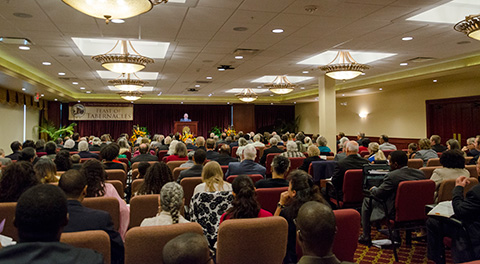
Take advantage of your opportunities to fellowship at Sabbath services. Be encouraging and give edifying praise to others. Socials in your area, Spokesman Club and the Feast of Tabernacles are all additional places you can practice being a comforter.
Use Wisdom
When comforting others, put yourself in their shoes. What are they feeling at the moment? Are they sad, grieving, lonely, disappointed?
Romans 12:15 says: “Rejoice with them that do rejoice, and weep with them that weep.” The principle here is simple. If someone is already happy, we can encourage them to stay that way and become even happier. If someone is crying, we would not want to start cheering and laughing in their face.
Within this instruction there is room for judgment and for God’s Spirit to guide you. We should change our approach based on the situation.
Proverbs 25:20 adds, “As he that takes away a garment in cold weather, and as vinegar upon nitre, so is he that sings songs to a heavy heart.” It is possible to come across as being too reassuringly cheerful to someone who is grieving. It would be like taking a warm coat away from someone who is suffering in cold weather.
Using wisdom is key. Some people do not make it as obvious whether they are rejoicing or weeping as others. People can rejoice or weep on the inside. In other cases, a person could be somewhere between the two and it is your job to help bring them to a place where they can rejoice.
Allow God to inspire you. Do not only say what you think you are expected to say. Be cautious about using common cliches. Instead, try to connect to someone on a deeper, more personal level.
Sometimes, it could be appropriate to try to encourage someone who recently lost a loved one by telling them they will see their relative again when the Kingdom is here. But this is not something you would say in every situation. At other times, it is best to simply let them know you are there for them and that you are praying for them. A simple embrace with few words uttered could be the best course of action.
There is no need to give someone a mini-sermon when all they need is a hug or a kind reassurance. When in doubt, pray about it before you engage the person and ask God to help you handle the situation appropriately. If you accidentally say too much, be ready to apologize and change your approach.
Be a Comforter
Many of your brethren are in need of exactly what you can contribute. Take a small step today towards being a comforter.
Make a phone call. Send cards, texts or emails. Look for opportunities to lift up those who seem worn down by trials and tribulations. These are all ways to “Be kindly affectioned one to another with brotherly love; in honor preferring one another” (Rom. 12:10).
The person you reach out to may say to themselves, “that was just what I needed today.”
Proverbs 16:24 says, “Pleasant words are as a honeycomb, sweet to the soul, and health to the bones.” Step out in faith to deliver these pleasant words.
An encouraging word handled with grace may be what is needed to inspire a member to continue on their chosen path to the Kingdom of God.
God wants each of us to encourage and support one another. Remember, He lovingly comforts all of us so we are able to comfort others. He “comforts us in all our tribulation, that we may be able to comfort them which are in any trouble, by the comfort wherewith we ourselves are comforted of God” (II Cor. 1:4).
Be like your Father in heaven. Be a comforter.