This article begins a series on how the Bible was written and how to get more out of your personal study.
Would you like to study the Bible like Jesus did? For anyone who wants to get more out of God’s Word, the answer is an immediate “Yes, please.”
First, you need to head to the local synagogue. In the first century, that was the only place most people could read the scriptures. Luke 4 records one such moment: Jesus entered the synagogue on the Sabbath and read from the scroll of Isaiah (vs. 16-17).
Going through so much effort to access Scripture is likely not what you had in mind when wanting to study like Jesus Christ.
Yet understanding the way God’s Word existed in the first century can help us see the Old Testament in a new light.
At that time, the books of the Bible were not bound together in a single volume. They existed as individual scrolls stored in synagogues or the Temple. When someone wanted to read a passage, the scroll had to be retrieved and carefully unrolled until the desired section was reached.
Every one of those scrolls had to be copied by hand. Owning a personal copy was extremely rare and required great wealth. The Ethiopian eunuch reading Isaiah in Acts 8:26-35 was an unusual example of someone rich enough to possess such a scroll.
How blessed we are today to have the entire Bible readily available.
Beyond being in scroll format, Jesus and His disciples viewed the Old Testament differently from how we typically do today. They would not have even called it that. They instead used terms like “the scriptures” (Matt. 21:42) or “holy scriptures” (II Tim. 3:15) to refer to God’s Word written before the New Testament.
They also viewed the structure of the scriptures differently than us. Jesus made this clear in Luke 24:44: “These are the words which I spoke unto you, while I was yet with you, that all things must be fulfilled, which were written in the law of Moses, and in the prophets, and in the psalms, concerning Me.”
To Christ and the disciples, the scriptures had three parts, here labeled the law of Moses, the prophets and the psalms. This aligns with how the Old Testament, which can also be referred to as the Hebrew Bible, is still structured today in what is called the Tanakh. It too has three divisions: The Torah, the Nevi’im and the Ketuvim. The initials TNK are expanded to create the fuller name of Tanakh.
This ancient structure shaped how Jews read the Scriptures for centuries, and it was the structure Christ Himself knew.
Yet to truly study the way Jesus did, we must understand something more: how God built the Hebrew Bible. Long before Jesus Christ began His earthly ministry, He existed as the Word (John 1:1). That means He would have been actively inspiring and working with prophets, poets, scribes and editors to record, preserve and arrange God’s Word.
Thankfully, we do not have to guess how that all occurred. The evidence of that process is visible all throughout the pages of Scripture. And once you begin to see it, it can transform the way you read the Old Testament.
God-given Structure
When Jesus referred to the law of Moses, the prophets and psalms in Luke 24:44, He was pointing to the three-part structure of the Tanakh. The word Torah can be translated “law” or “instruction,” Nevi’im means “prophets,” and Ketuvim means “writings.” Christ referred to this last division by the first book of the section, Psalms.
The Hebrew Bible can be viewed as a library of books that God helped write, edit and curate. He came up with the three-part structure as well as the flow of the books, which is different from the arrangement found in most Christian Bibles today.
While the content is the same, the sequence tells the story differently.
For example, the Christian ordering of the Old Testament ends with the prophetic book of Malachi. But the Hebrew Bible ends with the writings of Chronicles, giving it a different narrative arc and thematic closure.
The Tanakh structure is how people in Jesus’ day understood the scriptures. God entrusted the Jewish people to preserve that structure through the centuries. Romans 3:2 says God committed to them “the oracles of God.”
Tradition holds that Moses wrote the first five books of the Old Testament. Other traditional authors include Samuel, David, Solomon and the prophets who wrote the books that bear their names.
While these men played central roles in producing Scripture, they were not the only hands involved.
Evidence of Editors
Throughout the Old Testament we find evidence of scribes, priests and later editors at work. God used generations of faithful servants to preserve and compile these inspired writings.
One simple example appears in the book of Proverbs. It explains that some of Solomon’s sayings were later collected and copied by the scribes of King Hezekiah (Prov. 25:1). That means Solomon himself was not the final editor of the text.
The same is true for Moses and the Pentateuch, or the first five books of the Bible that make up the Torah. He could not have written every line in them. For instance, Deuteronomy 34:5-6 records his own death: “So Moses the servant of the Lord died there in the land of Moab...but no man knows of his sepulcher unto this day.”
“Over millennia, earlier writings were preserved and later woven together into the scriptures we read today.”
The phrase “unto this day” is an indicator that someone added the comment after Moses’ death.
And imagine how deeply ironic it would have been for Moses to write this about himself: “Now the man Moses was very meek, above all the men which were upon the face of the earth” (Num. 12:3).
Another revealing glimpse into this process appears in the story of Jeremiah. When King Jehoiakim burned Jeremiah’s scroll, God instructed the prophet to dictate the message again—and “there were added besides unto them many like words” (Jer. 36:32).
Even within Bible stories, we can see how God’s Word was written and expanded.
Patchwork Quilt
Bible scholar Timothy Mackie compared the Old Testament to a family quilt—a precious heirloom stitched together from pieces gathered across generations.
Family quilts are often made from meaningful scraps of fabric: a square from a grandmother’s wedding dress, cloth from a father’s work shirt, a patch cut from a baby blanket or an old school uniform. Each piece carries stories from different moments in the family’s history.
Something similar happened with the Old Testament. Over millennia, earlier writings were preserved and later woven together into the scriptures we read today. When you know what to look for, you will begin to see the seams where older material was gathered and folded into the larger collection.
Psalm 72 provides one such example. At the end, it declares, “The prayers of David the son of Jesse are ended” (vs. 20). Yet later in the book we encounter additional psalms attributed to David, such as Psalm 86, 101 and 103. This suggests that an earlier collection of David’s songs once circulated on its own before being incorporated into the larger book of Psalms as today’s chapters 51-72.
Other passages preserve even older material. Deborah’s song in Judges 5, for example, contains very archaic Hebrew—an older form of the language than what appears in the surrounding text. Apparently, Deborah wrote the song, and then it was preserved in its original form until the book of Judges was being compiled, likely during a period when Israel had kings. Judges 21:25 speaks of when “there was no king in Israel,” implying that this verse and potentially other material in the book was added later, after Israelite kings had reigned.
Reading this older Hebrew would be somewhat like us encountering a passage from Shakespeare or Chaucer embedded within a modern English book. The language clearly comes from an earlier time.
Several other passages appear to preserve ancient material, including Moses’ Song of the Sea (Ex. 15:1-18), Jacob’s blessing on his sons (Gen. 49), Balaam’s oracles (Num. 23-24), and the Song of the Bow that David wrote after the deaths of Saul and Jonathan (II Sam. 1:17-27).
The last example even tells us where the poem originated, with verse 18 showing it came from the Book of Jasher. Although II Samuel 1:18 references Jasher, God only sourced from this book and did not include it in its entirety, despite Joshua 10:13 also citing it. Yet another example that earlier writings were sometimes preserved and later woven into the Hebrew Bible.
Further evidence of the Old Testament editing process was preserved in the Dead Sea Scrolls, discovered near Qumran in the mid-20th century. These manuscripts date from roughly the third century BC to the first century AD and contain some of the oldest surviving copies of Old Testament books. Many match the Hebrew text used today with remarkable accuracy. At the same time, they show that certain books circulated in slightly different forms before the text was completed. For example, Jeremiah appears in both a shorter and longer form, and one Psalms scroll contains additional psalms not included in later collections.
All of these examples reinforce an important point: God did not drop the Hebrew Bible from heaven as a finished volume. He wrote, edited and reedited the text over time.
Because this is God’s Word, we can know He wanted it this way. And it reveals something inspiring about God’s purpose for mankind.
From the beginning, God has chosen to work through human beings. He created mankind in His image and likeness (Gen. 1:27), intending to work with and through them.
The very construction of the Old Testament reflects that same pattern. God worked through individuals across centuries to shape His Word. And even the structure of the Hebrew Bible itself—the Torah, Nevi’im and Ketuvim—reveals important lessons about His Plan and how He works with people.
The Law: Foundations of God’s Plan
The Torah, the first five books of the Bible, lays the foundation for everything that follows in the Hebrew Bible and the New Testament as well.
Genesis introduces God as Creator and reveals His purpose for mankind. It traces man’s descent into sin and God’s promise to work through Abraham’s family to bring blessings to all nations. Exodus through Deuteronomy records Israel’s deliverance from Egypt, their covenant with God and His instructions for how they were to live.
The books of the Law lay the foundation for the entire Bible. They show what God intends for humanity and what He expects from His people.
How to study it: Read the Torah as the blueprint for everything that follows in the Old Testament—and for that matter the New Testament. The covenants, promises and laws introduced here become the standard by which Israel is later judged. When the prophets warn of punishment or promise restoration, they are usually referring to what was first laid out in these books.
“Over centuries God guided prophets, poets, scribes and editors who recorded, preserved and arranged His Word until the collection was complete in the centuries before Christ.”
The Prophets: Israel’s Story Through God’s Eyes
The second section of the Tanakh, the Nevi’im, picks up where the Torah leaves off.
It begins with the historical books—Joshua, Judges, Samuel and Kings—which tell the story of Israel living in the land God promised them. But these are more than history books. They show events from God’s perspective, explaining how the nation responded to the covenant established in the Torah.
Alongside these narratives are the prophetic books of Isaiah, Jeremiah, Ezekiel and the 12 minor prophets. These books further interpret Israel’s history and detail its future.
A clear theme emerges in this section: Israel repeatedly fails to live up to the covenant established in the Torah. The prophets call the nation back to obedience while also pointing forward to the future restoration God promises.
How to study it: Try reading the prophetic books alongside the historical books they relate to. Isaiah and Jeremiah, for example, make much more sense when read alongside the events recorded in Kings and Chronicles. Seeing the history and the prophetic message together helps reveal the full picture of what God is doing with Israel and all mankind.
The Writings: Reflecting on the Story
The third section of the Hebrew Bible, the Ketuvim, includes the books of Psalms, Proverbs, Job, the Song of Solomon, Ruth, Lamentations, Ecclesiastes, Esther, Daniel, Ezra, Nehemiah and Chronicles.
At first glance, this collection can feel like a bit of a grab bag. Yet many of these books share an important role: They reflect upon and expand the meaning of earlier events in Scripture.
The wisdom books explore what it means to live faithfully according to the Torah and the Prophets. Proverbs presents the general pattern of wisdom—obedience leads to blessings—while Job and Ecclesiastes wrestle with the complexities of life when that pattern does not always seem to hold. Reading them together gives a clearer picture of what it means to follow God.
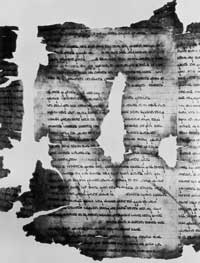
A torn piece of the Dead Sea Scrolls, discovered in caves near Qumran, first found in 1947.
Archive Photos/Getty Images
The Psalms often meditate on the story of Israel and the themes of the Torah and Prophets, reflecting on earlier passages and drawing out their meaning. Bible scholar Michael Fishbane describes this process as “inner biblical exegesis,” noting that interpretation of Scripture actually began within the Bible itself. In other words, later biblical writers were already studying and commenting on earlier parts of God’s Word.
In a sense, reading much of the Ketuvim is like having access to the Bible study notes from ancient authors.
Psalm 8 provides a powerful example. It reflects on the Creation account of Genesis 1, asking: “What is man, that You are mindful of him?” (Psa. 8:4).
“All things must be fulfilled, which were written in the
law of Moses, and in the
prophets, and in the
psalms, concerning Me.” —Jesus Christ (
Luke 24:44)
Genesis says God gave humanity dominion over the Earth (Gen. 1:26-28). Psalm 8 repeats that idea almost word for word, saying God put all things under man’s feet: “sheep and oxen…the beasts of the field; the fowl of the air, and the fish of the sea” (vs. 6-8). David pauses to reflect on what Genesis declares: that human beings, though small in the vast universe, have a special purpose among all Creation.
Later writers would continue reflecting on that same passage. Jesus quoted Psalm 8 (Matt. 21:16), and the apostle Paul used it to explain mankind’s role in God’s Plan (Heb. 2:6-8).
How to study it: When reading the Writings, look for how they echo earlier passages in the Torah and Prophets. They often pause to reflect on lessons, ask deeper questions and help readers process what the earlier books describe.
By doing the same as the writers of the Ketuvim—reading carefully and noticing these connections—we can begin studying the Bible the way its authors intended.
INSPIRED ORDER OF THE OLD TESTAMENT
LAW (Torah)
Genesis
Exodus
Leviticus
Numbers
Deuteronomy
PROPHETS (Nevi’im)
Former Prophets
Joshua
Judges
I & II Samuel
I & II Kings
Latter Prophets
Isaiah
Jeremiah
Ezekiel
The Twelve
Hosea
Joel
Amos
Obadiah
Jonah
Micah
Nahum
Habakkuk
Zephaniah
Haggai
Zechariah
Malachi
WRITINGS (Ketuvim)
Poetic
Psalms
Proverbs
Job
The Scrolls
Song of Solomon
Ruth
Lamentations
Ecclesiastes
Esther
Latter Restoration
Daniel
Ezra
Nehemiah
I & II Chronicles
The Story Is Not Finished
The Ketuvim, and the Hebrew Bible as a whole, ends with the book of Chronicles. This makes perfect sense when you step back and look at the complete Old Testament.
Chronicles serves as a recap of everything that came before it. It begins with a sweeping genealogy starting all the way back at Adam and tracing the line through Abraham, David and the kings of Judah.
The book retells many of the events recorded earlier in Samuel and Kings, such as David’s reign, him preparing to build the Temple, the prosperity during the reign of Solomon, and the rise and fall of the nation under the kings of Judah—finally ending with God’s people in exile in Babylon.
The last verse in the Hebrew Bible records the decree of the Persian king Cyrus allowing the Jews to return to Jerusalem and rebuild the Temple: “Who is there among you of all his people? The Lord his God be with him, and let him go up” (II Chron. 36:23).
That is it. That is how the Hebrew Bible ends.
This conclusion becomes more striking when placed beside the fuller version of Cyrus’ decree preserved in Ezra: “Who is there among you of all his people? His God be with him, and let him go up to Jerusalem, which is in Judah, and build the house of the Lord God of Israel” (1:3).
Chronicles leaves the story open-ended. The author of the book—traditionally associated with Ezra—appears to have intentionally stopped the narrative at the moment of return. Writing after the exile, when the Temple had already been rebuilt, he still chose not to include that in his retelling of the Old Testament. By concluding with the invitation to “go up,” he signals that the rebuilding of Jerusalem and the Temple was not the end.
Throughout the Tanakh, there are many unfulfilled promises. Consider again the editor’s note at the end of Deuteronomy. Recall chapter 34 said no one knew where Moses was buried even “unto this day” (vs. 6). This was likely during Ezra’s day in the 5th century BC.
Then Deuteronomy 34:10 states: “And there arose not a prophet since in Israel like unto Moses, whom the Lord knew face to face.”
By Ezra’s time—even after the leadership of Joshua, the judges, Samuel, Isaiah, Jeremiah, Daniel—there had not yet risen a prophet like unto Moses. That figure had not appeared, neither had God sent the Messiah or Elijah as promised at the end of Malachi.
“The Old Testament is not just a record of what God did long ago—it is a guide to understanding what He is doing now.”
Is it any wonder these were the very figures everyone was searching for in Jesus’ day?
John 1:25 records this question from the people for John the Baptist: “Why baptize you then, if you be not that Christ, nor Elijah, neither that prophet?”
The Old Testament closes with a clear sense that God’s Work was not finished.
A Human and Divine Masterwork
For those in Jesus’ day, they were not just expecting important prophesied figures to arise. They were also looking to specific events God had foretold.
Luke describes Simeon as someone “waiting for the consolation of Israel” (2:25). The prophetess Anna spoke to those who “looked for redemption in Jerusalem” (vs. 38). Joseph of Arimathea was also “waiting for the Kingdom of God” (Mark 15:43).
These individuals had studied the scriptures, and the Hebrew Bible had shaped how they saw the world. Its words taught them how to live righteously while also helping to keep their minds fixed on God’s unfolding Plan.
From the beginning, God has worked through human beings to accomplish His purpose. The Old Testament tells that story. God worked with Abel, Noah, Abraham, Sarah, Deborah, Samuel and David—men and women who accomplished remarkable things, yet were still imperfect.
In the same way, God worked through many individuals to produce the Hebrew Bible itself. Over centuries He guided prophets, poets, scribes and editors who recorded, preserved and arranged His Word until the collection was complete in the centuries before Christ.
God inspired every step of that process. The Old Testament leads neatly into the New Testament, which then added to the story of God working with mankind.
Read again what Jesus told His disciples in Luke 24: “These are the words which I spoke unto you…that all things must be fulfilled, which were written in the law of Moses, and in the prophets, and in the psalms, concerning Me” (vs. 44).
All the scriptures that pointed directly to Christ’s first coming have been fulfilled. Yet so many other verses still point forward to the culmination of God’s Plan.
Just as those living in Ezra’s day knew God’s Plan was not yet complete, we also look forward to what still lies ahead. We are today’s Simeons and Annas.
The same scriptures that foretold Christ’s work in the first century also reveal how God will continue His Plan with the establishment of His Kingdom. They reveal the future God intends for the world, and the role He is preparing human beings to fill within it.
The Old Testament is not just a record of what God did long ago. It is a guide to understanding what He is doing now—and what He is doing with you.
And that story is not yet finished.