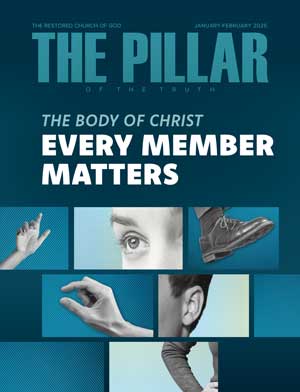
In I Corinthians 12, Paul pictures the Church in a way we can never forget. He gives us a foot sulking because it is not a hand, an ear questioning whether it even belongs, and a body that seems to think it could function perfectly well as one giant eyeball—a rolling, blinking sphere with no hands, no ears and no feet.
The analogy is funny. But it is funny because it is true.
Our human nature can get the best of us. We can forget we are part of a larger whole. We may sometimes wish we had a different role, compare ourselves to others or quietly feel like we do not matter.
Paul wanted to cut through these ideas and set the record straight: “As the body is one, and has many members, and all the members of that one body, being many, are one body: so also is Christ” (vs. 12).
Put simply: The human body has a lot of parts—but they make up one whole body. The same goes for the Church, which is the Body of Christ.
When Jesus was on Earth, He served God using a literal body. He walked from town to town teaching, preaching, healing and serving. His hands blessed children, His voice proclaimed the truth, His feet carried the gospel of the Kingdom to the next town.
Today, Christ is no longer on Earth in the flesh, but He is still working. The Church is the continuation of that living body. That means we are not isolated believers trying to live God’s Way on our own. We are members of a vibrant, active spiritual whole, joined together under Christ our Head (Eph. 5:23), moving in the direction He leads.
If we grasp that, the analogy Paul teaches in I Corinthians 12:12-26 makes even more sense. A body part cannot thrive by separating itself from the rest of its body—or by insisting it should be something it was never meant to be.
God called us into the Body of Christ so we could grow into a united, effective instrument through which Christ continues His Work.
We may know all this, but still quietly wonder where we fit. Some of us may feel limited by age, health or other circumstances. Others see what certain members do and conclude they are less useful. God addresses these concerns directly.
Scripture reveals not only that we each have a place in Christ’s Body, but why God places us where He does—and how we can benefit the whole.
We Are One
Paul’s absurd examples make a foundational point clear: The Church cannot be a collection of disconnected parts. He reiterates this in Romans 12: “Just as each of us has one body with many members, and not all members have the same function, so in Christ we who are many are one body” (vs. 4-5, Berean Study Bible).
That Body is bound together by something incredible: “By one Spirit are we all baptized into one body” (I Cor. 12:13). God’s Holy Spirit is what joins us together and makes us one living spiritual organism.
In a physical body, no part exists to serve itself. A hand cannot decide to live independently, and a foot cannot claim it has nothing to do with the rest. If you are in Christ’s Body, you belong to the whole—and the whole depends on you.
Physically, even small parts matter. One torn ligament can throw off the coordination of the whole. Anyone who has tried to walk on a sprained ankle or suffered a similar injury knows how frustrating it is when one part of your body refuses or is unable to do what you want.
Similarly, the Church thrives when each member stays connected to Jesus and functions as part of the whole.
If we hold on to this knowledge, it can change how we approach life as a Christian. We should not come to Church services simply to attend—we are functioning body parts looking for ways to strengthen the whole. And this mindset is for every day of the week, not just the Sabbath.
We Are Diverse
Each of us has a different background and upbringing, which gives us different strengths and weaknesses. These differences allow each of us to bring something special to the Body. Our diversity is crucial to how the Body works.
Yet we can still sometimes overlook this. Paul wrote, “If the foot shall say, Because I am not the hand, I am not of the body; is it therefore not of the body? And if the ear shall say, Because I am not the eye, I am not of the body; is it therefore not of the body?” (I Cor. 12:15-16).
The foot looks at the hand and thinks, That looks like real usefulness. The ear looks at the eye and thinks, That seems more important. And suddenly a perfectly good body part starts doubting whether it even belongs.
Paul presses the absurdity even further: “If the whole body were an eye, where were the hearing?” (vs. 17). A body made entirely of an eye might be able to see everything—but it would not be able to do anything. It could not speak, walk, work or even hear a warning. God did not design a physical body with one ability. He designed it with many.
That is why Paul says, “The body is not one member, but many” (vs. 14), and later, “If they were all one member, where were the body?” (vs. 19).
God wants each diverse part of the Body to bring its unique attributes and strength to the whole.
If we forget this, we are in real danger of losing our effectiveness. We start to measure our value by whether our role looks like someone else’s. We assume that usefulness must look a certain way. And when we cannot do what others do—or when our service feels unimportant—we begin to pull back. But Paul says the opposite is true: Your role is needed precisely because it is not the same as another member’s.
The way forward is not to wish you were a different part, but to grow where God has placed you. Rather than comparing yourself to others, ask: What can I do well? Where can I support others? What small actions of service can I do consistently?
In whatever role you find yourself, strive to faithfully strengthen the Body where you are.
We Are Placed
God knows exactly where each of us can be most effective right now, even if we cannot quite see it: “For My thoughts are not your thoughts, neither are your ways My ways, says the Lord. For as the heavens are higher than the earth, so are My ways higher than your ways” (Isa. 55:8-9).
God has a plan for us as individuals. Where He has placed us is part of that plan.
Continue in I Corinthians 12: “God has set the members every one of them in the body, as it has pleased Him” (vs. 18). God Himself arranges each member according to His purpose. He wants us to trust His decision and leadership.
The word “set” here is stronger than it first appears. It is not like setting down a cup of coffee or placing your car keys by the front door. The original Greek word carries the idea of placing, establishing, fixing—even ordaining.
God is not guessing with His placement of each of us. He is not absent-mindedly filling spots. He establishes and fixes each member where it pleases Him—because the Body needs what that member can contribute right there.
At the same time, we should be careful not to confuse God’s placement with every temporary circumstance in life. Some situations restrict our ability to serve—lack of a stable job, being unorganized, not resolving interpersonal conflicts, holding unto unhealthy habits, or being distracted by the “cares of this life” (Luke 21:34).
The Father has not placed us in spiritual stagnation. Often, serving faithfully includes taking steps to change what can be changed so we can become more useful to the Body. If we grow, God could decide to use us in greater ways.
God will shape our placement over time. He may redirect how we strengthen His Church. Newer members may grow stronger in the faith to eventually become pillars in their congregations. Some brethren may be ordained as deacons or elders. And as age or health slows us down, we remain essential to the Body—though our service may shift more toward prayer and encouragement than physical labor.
We Are Interdependent
Paul now takes his analogy in a sharper direction. It is not just that Christ’s Body has different parts—it is that the parts need one another: “The eye cannot say unto the hand, I have no need of you: nor again the head to the feet, I have no need of you” (I Cor. 12:21).
Imagine one Church member saying to others, “Honestly, I could do this whole Christian life without you.” That is absurd! We were not placed in Christ’s Body so we could operate as self-sufficient pieces.
But Paul’s next point becomes incredibly encouraging: “Much more those members of the body, which seem to be more feeble, are necessary” (vs. 22).
Notice the word seem. Some parts only appear weaker because their usefulness is not as obvious. We tend to measure value by visibility—by who speaks, who leads, who serves publicly, who is always “doing something.” But the Body depends on far more than what is outwardly visible.
In a physical body, some of the most essential parts are ones you rarely think about. That is, until something goes wrong. You can live without noticing them for years, but you cannot live without them.
I Corinthians 12 reveals that the Church is the same. Members who are quieter, older, limited by health, stretched thin by family responsibilities, facing financial strain, or still learning their place may feel less useful—but God says they are necessary. The Body is incomplete without them.
And because those parts seem weaker, Paul says they should not receive less attention, but more: “Those members of the body, which we think to be less honorable, upon these we bestow more abundant honor” (vs. 23-24).
In other words, our bodies instinctively protect and care for what is vulnerable. That is how God designed it to work—and that is also how Christ wants His Church to function.
This is where those who have more strength, physically or spiritually, have an obligation. We should not overlook those who seem feeble.
Sometimes that honor is simple: Showing respect, listening, making someone feel cared about. Sometimes it is practical: Offering a ride, helping with a meal, checking in when someone missed Sabbath services, making room in our schedule when someone needs help. Even something as small as standing to greet an older member (Lev. 19:32), or making sure a quiet new member is not left alone, reflects the kind of “more abundant honor” Paul describes.
And it works both ways. If you are one of those members who sometimes feels less useful, do not withdraw. Quiet service—especially prayer—is much more powerful than most realize. Anna the prophetess could not travel the countryside or lift heavy burdens, but she served God in the Temple with “fastings and prayers night and day” (Luke 2:37).
No one gets to decide they “have no need” of another member—and no one should decide the Body has no need of them. God designed us to rely on one another. As Paul put it, “God has tempered the body together” to give “more abundant honor to that part which lacked” (I Cor. 12:24).
“God did not place you here to be a spectator. He set you in the Body because it needs what you can contribute.”
We Are Connected
Keep reading in verses 25-26: “There should be no schism in the body; but that the members should have the same care one for another. And whether one member suffer, all the members suffer with it; or one member be honored, all the members rejoice with it.”
This is how a real body works. When one part hurts, the rest of the body instinctively adjusts.
You limp to protect an injured foot. You cradle a sore hand. You slow down because one part is weak. And when something feels good—when a soreness dissipates, when strength returns—it is not isolated to one area. Relief and joy spread through the whole.
The Church was designed to function the same way. What touches one member is meant to affect the rest. If one of us is struggling, the Body should not remain unaware or unaffected. If one member is blessed, the Body should not respond with indifference or quiet resentment. We are meant to share burdens and share joy.
Pain is often carried silently—especially chronic pain, long trials, discouragement or grief. And joy can also be hidden, because sharing good news can feel like bragging. Paul’s instruction cuts through both: A healthy body does not leave suffering unseen, and it does not leave joy unshared.
This kind of connection does not happen automatically. We have to put the work in by building relationships over time. It can start as simply as asking someone sincere, thoughtful questions in fellowship, or asking if you can help someone who is going through a trial.
Even when we cannot be together physically, we can still stay connected. That can be as simple as a text message, a direct message on social media or a brief phone call of encouragement. In the Body of Christ, distance does not have to mean disconnection.
Pursue deep friendships within the Church. Build relationships where others can share their pain without embarrassment, and where you can rejoice together without comparison. In Christ’s Body, your experiences are not meant to stay private. They are meant to strengthen the whole.
We Can Be Effective
Paul concludes the passage with a stir to action: “Now you are the body of Christ, and members in particular” (I Cor. 12:27). The apostle is reaching out to everyone reading it: “You, yes you, are a member of Christ’s Body!”
The Body of Christ teaching is more than an analogy—it is spiritual reality. Christ is the Head, and we are His Body. God called each member to fit in, function and support one another.
Being an effective body part does not mean doing everything. It means doing what you are meant to do where God has placed you. The hand does not apologize for not being a foot. The ear does not try to become an eye. Each part strengthens the whole by simply being what it was designed to be, and by staying connected to the Head.
So ask yourself honestly: Am I strengthening the Body in the ways God expects? God did not place you here to be a spectator. He set you in the Body because it needs what you can contribute.
For some, that may mean carrying more responsibility—visiting, hosting, serving, helping, giving. For others, it may mean quietly praying, being a steady presence, giving thoughtful encouragement, reaching out to those who are struggling, or simply being dependable and consistent. And sometimes being a healthy Body part also means allowing others to serve you when you genuinely need it—letting the Body carry you for a time, the way it naturally compensates for an injured limb.
Whichever stage you are in, the goals are the same: Stay connected, stay active and keep strengthening the whole. Look for the member who seems overlooked. Lift up the one who seems worn down. Rejoice with those who are blessed. Share burdens. Make the phone call. Send the note. Follow through. Pray specifically. Be present. Be dependable. These seemingly small things are how the Body thrives.
God has placed you in Christ’s Body for a reason. If you are here, you are necessary. Never forget: Christ is still working today—and you are part of how He does it.