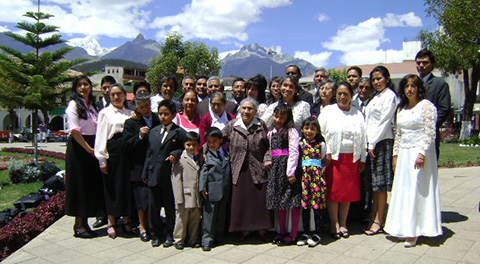
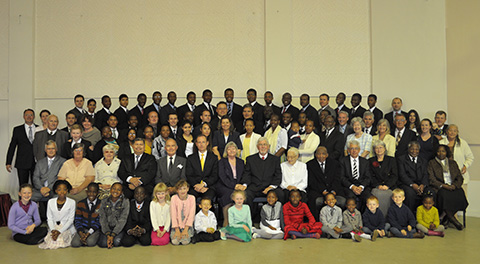
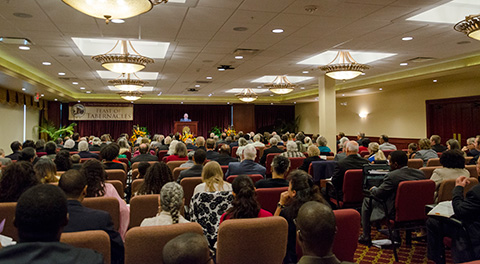
Paging through an old Ambassador College Envoy yearbook from God’s Work under Mr. Herbert W. Armstrong, one thing stands out most.
Each page contains images of happy men and women in elegant settings. When you see pictures of people working, you see decency and order. When you see photographs of socials—maybe a sing-along or a dance—you see the joy that comes from living God’s Way.
How can simple photographs so powerfully portray true Christianity?
The answer lies in how those pictured presented themselves. For example, a 1950s Envoy shows students in the letter-answering department dressed neatly—men in slacks and ties, women in modest skirts and graceful blouses. Another photo from the 1960s shows the Ambassador Chorale: men in tuxedos, women in floor-length gowns and gloves. These images promote refinement, balance and joy.
Ambassador College was operated by the Worldwide Church of God, the predecessor organization of The Restored Church of God. In those days, personal appearance was considered part of one’s character. As etiquette writer Emily Post observed, “How we look to others entirely depends upon what we wear and how we wear it; manners and speech are noted afterward, and character last of all.”
Emily Post was not the first one to connect clothing with character. The Bible describes character as something that is put on—something worn. This fact elevates the importance of our physical appearances.
For example, Christians are supposed to be like Jesus Christ. He and His followers are described as being “clothed” with majesty, righteousness, humility, salvation, honor and strength (Psa. 93:1, 104:1, 132:9; Isa. 61:10; Col. 3:12; I Pet. 5:5).
Good character traits are contrasted with being “clothed” with shame, cursing, dishonor, desolation and confusion (Psa. 35:26, 109:18, 29; Ezek. 7:27; Zeph. 1:8).
What we wear, both spiritually and physically, matters to God. This was emphasized to those attending Ambassador College in the mid-20th century.
Also taught was the principle of Jeremiah 6: “Thus says the Lord, Stand you in the ways, and see, and ask for the old paths, where is the good way, and walk therein” (vs. 16).
This verse means to follow the godly principles that have brought success and prosperity to those who came before us. When applied to dress, it means focusing on traditional—time-tested—clothing styles.
To recapture elegant and timeless styles, refer to the photographs from the Envoys of the past. Almost everything worn during that time would be suitable today.
This is one of the great keys to cultivating an appearance that upholds God’s standards: Stick to the classics!
Strive for Class
Classic types of dress are defined by being viewed over a period of time to be outstanding and of the highest quality. These styles are always balanced and avoid extremes. For example, while men’s jeans have gone from saggy to ultra-skinny to saggy again over the years, pants in line with traditional values—not too baggy, not too slim—have never gone out of fashion.
Taking a balanced approach applies to every part of our appearance. Patterns should be simple rather than garish and loud. Neckties should be a moderate width rather than too narrow or too wide. Women’s skirts should be long enough to be modest but of course do not need to drag along the ground or cover the ankles. The same applies to blouses and tops: Ladies should avoid ones that are too tight or too revealing but should not look like they are wearing paper sacks.
Remember who you represent when making clothing choices. In II Corinthians 5:20, we are called to be “ambassadors for Christ”—representatives of Him and His government. We have been given the responsibility to model His way of life to a world that does not know Him—including through the way we dress. This should drive us to care about the way we look.
Even in an age of lowering dress standards, world leaders, members of government, diplomats and international representatives still adhere to conservative styles.
How much more should those who are preparing to be a part of God’s government?
The apostle Paul exhorted in I Corinthians that “whatsoever you do, do all to the glory of God” (10:31). All means all. Whether shopping at the grocery store, working at the office or on a simple walk in the park, we should be shining our lights to onlookers. And just as with Ambassador College students of the 20th-century Work, we too can be glowing examples of God’s Way.
In addition to this principle, chapter 14 of I Corinthians states that all things should be done “decently and in order” (vs. 40).
The Greek word for “decently”—euschemonos—has a rich meaning. Strong’s Exhaustive Concordance defines it as “decorously.” The Strong’s meanings for the root words of euschemonos include “well formed, noble, comely, honorable,” and these refer to the “external condition.”
Apply this to appearance: We are to have a dignified, noble, honorable external condition. This is an overarching principle we should consider when making wardrobe choices.
Test of Time
Classic styles are often referred to as “timeless.” The Britannica Dictionary defines timeless as “staying beautiful or fashionable as time passes” and “lasting forever.”
Obviously, overall clothing trends change from century to century. We no longer wear long, flowing robes as they did during Christ’s time on Earth. A man would also look strangely out of place today if he wore a coat with long tails and knee-high breeches such as George Washington. Similarly, if a woman was walking down the street in a gigantic hoop dress from the 1850s, she would get odd looks.
It is important to stick to classic and balanced styles of the times in which we live. For the Western world, conservative classic styles were generally cemented during the 1950s and early 1960s. There have been some changes and updates since that time, but general types of clothing have remained the same.
Notably, garment styles that have lasted throughout these decades are ones that employ balance and modesty. While you will always need to use judgment when viewing styles from any era, seeing that a particular item has withstood the test of time over decades is a good indication that wearing it will be in line with God’s standards.
Yet there is another test of time that you can employ. Whenever you consider buying an item of clothing, imagine yourself in the future looking back on that wardrobe choice.
If the item you are considering buying gives off an air of vanity, lust, etc., or you anticipate that it is something that could go out of style as quickly as it came in—you would likely look back with embarrassment and think, “I wore that?!”
Two more biblical principles are helpful when selecting clothing. In I Timothy 2:9, women are instructed to “adorn themselves in modest apparel.” I Corinthians states that love “does not behave itself unseemly” (13:5).
While the first verse is directed at women, it can also apply to men. Avoid styles that scream for attention and are unbecoming of an ambassador of Christ. This will further display the character you possess on the inside.
Stick to What Suits You
Another key principle for dressing well is to wear clothing that suits you. While clothes can look attractive on a mannequin in a store or on another person, it is important to wear apparel that complements your individual body type and gender.
How clothing fits is just as important as the quality or style of clothes. For example, if someone buys a suit that costs hundreds of dollars, but it does not fit correctly, this was money poorly spent. If you have questions on proper fit, talk to a friend, do some research online or visit a conservative clothing establishment. Note that employees of such stores may still push you toward trendy styles.
Keep in mind that clothing should not be too baggy or too tight. If you look as though you are swimming in a suit coat or uncomfortably squeezed into a sweater—it is not for you! Also, sleeves and pant legs should be neither too long nor too short.
Another trend in today’s society is to wear clothing that is either effeminate for men or boyish/masculine for women. God instructs us to avoid both (I Cor. 6:9-10; Deut. 22:5).
Build on the Basics
So where should you start to make sure your wardrobe sticks with traditionally conservative styles? The best place to begin is by obtaining clothing that is simple, neutral and interchangeable.
Emily Post stated in Etiquette in Society, in Business, in Politics and at Home: “Choose the clothes which you must have, carefully, and if you must cut down, cut down on elaborate ones. There is scarcely anywhere that you cannot fittingly go in plain clothes. Very few, if any, people need fancy things; all people need plain ones.”
Solid-colored black, navy, gray or other neutral articles of clothing provide a basis from which to build an elegant wardrobe. Although you may only be able to afford one of each, over time, their versatility will yield more outfits and you will be able to mix and match them. Adding accessories such as scarves and jewelry for women or ties for men will also expand your options.
“A good principle is to always buy the highest quality items you can afford.”
View updating your wardrobe as a long-term process. Take each step slowly. By thinking through purchases, you can elevate your dress standards in a way that does not break your budget.
A guiding principle is found in Philippians 4: “Let your moderation be known unto all men” (vs. 5).
Some styles that are classy by the world’s standards are not ones we want to emulate. In everything, use judgment. Take a balanced and modest approach in your selections and refrain from wearing anything gaudy, loud or bulky.
By starting with the basics, you will have clothes and accessories that are both moderate and versatile. Refer to the inset infographic “Dress for the Occasion” for clarity on dress codes and what items are a good starting point for each category.
Invest in the Future
When purchasing versatile articles of clothing, it is worthwhile to invest in quality products. While they may initially appear more expensive, they usually last much longer than cheaper counterparts. Yet be careful. Sometimes, an item is pricey because of its name brand—not because of its quality construction.
Consider the following scenario. Perhaps you want to buy a pair of men’s leather dress shoes. One pair costs $40 and will last you six months—the other costs $150 but will last for many years. At face value, it would appear that the cheaper option would be the frugal route. But the less expensive option will quickly gain unsightly creases and cracks, and will soon need to be replaced.
A good principle is to always buy the highest quality items you can afford. By investing in quality, you will “only cry once.”
Realize this does not mean you should spend thousands of dollars on your wardrobe. Be resourceful! Consignment shops, thrift stores and websites such as eBay offer quality clothing for reduced prices.
Start small. Men, if you do not have a full suit, work toward purchasing one. Ladies, if you only own simple cotton skirts or dresses for Sabbath services, take steps toward purchasing a skirt suit or dress with higher quality fabric. The goal is to budget funds so that you can continually refine and improve what is in your closet.
Clothed with Character
What we wear—and how we view dress—points to our character. Even if we do not think anyone is watching, be certain that God is.
Learning godly standards of clothing actually has eternal implications. Our clothing and character will one day be truly timeless.
Notice Revelation 19: “Let us be glad and rejoice, and give honor to Him [God the Father]: for the marriage of the Lamb [Jesus Christ] is come, and His wife [the saints] has made herself ready. And to her was granted that she should be arrayed in fine linen, clean and white: for the fine linen is the righteousness of saints” (vs. 7-8).
Upon receiving eternal life, true Christians will be adorned in righteousness—forever. Strive to put proper, balanced attention on your wardrobe, knowing everything it represents.
Stick to the classics!
Dress for the Occasion
“Dress changes the manners.”
This quote from French philosopher Voltaire is a key reason for dress codes that come with invitations: to provide clarity for guests both on what to wear and how to conduct themselves.
Because dress standards and terms have changed drastically over the past few decades, terms such as “business casual” and “semi-formal” often perplex invitees.
If in doubt of what to wear at an event, contacting your host for clarification is the most appropriate method to learn what is expected. But the most common terms you will encounter can be found using etiquette standards such as the Emily Post Institute and Gentleman’s Gazette. You can refer to this guide for a summary of dress code basics, including for which occasions they apply and a general sense of suitable clothing.
Black Tie
The most formal attire aside from white tie; expresses high social class.
Men: Peak- or shawl-lapel tuxedo jacket and silk-lined trousers, tuxedo shirt with studs, black silk bow tie, patent leather capless shoes, cummerbund or waistcoat.
Women: Full-length evening gown, dressy cocktail dress, heels or flat dress shoes, optional long gloves, clutch and minimal jewelry.
Wear to: Evening dances, special dinners and entertainment events.
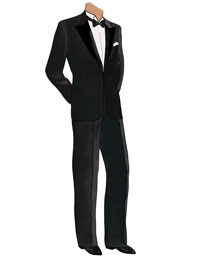
Black Tie
Graphic by RCG

Black Tie
Graphic by RCG
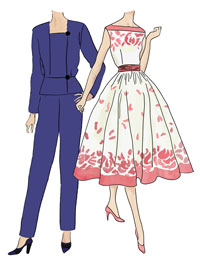
Business/Cocktail Attire
Classic attire with a professional image and limited personalization. We often refer to this as Sabbath wear.
Men: Two-piece suit in dark color (black, navy or gray). Solid white or light blue dress shirt, conservative tie, black or burgundy captoe oxford shoes with matching leather belt.
Women: Suit, knee-length to calf-length cocktail dress, long dressy skirt and blouse, button-down shirt or dress and blazer, stockings. Heels no higher than three inches. For Sabbath attire, wear dresses and skirts.
Wear to: Corporate office environments, interviews and most religious and business meetings.

Business/Cocktail Attire
Graphic by RCG
Business/Cocktail Attire
Graphic by RCG
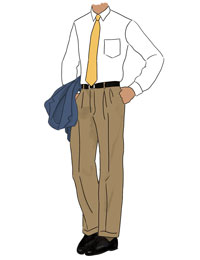
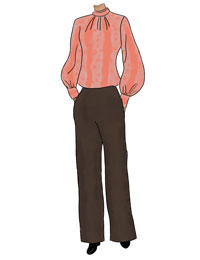
Business Casual
A more versatile professional look with some personalization.
Men: A button-down shirt tucked into slacks or khakis, matching brown or black belt and lace-up shoes, optional tie, and a sport jacket or navy-blue blazer.
Women: Skirt, khakis or dress pants and an open-collar shirt, knit shirt or sweater, and boots or heels.
Wear to: Sabbath-evening dinners, upscale restaurants, business travel.
Business Casual
Graphic by RCG
Business Casual
Graphic by RCG
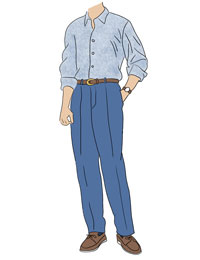
Dressy/Smart Casual
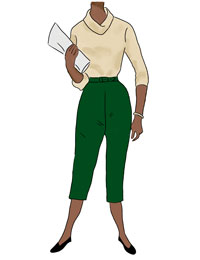
A versatile balance between relaxed and dressy.
Men: Button-down sport shirt with a sweater, khakis or dark casual pants, leather shoes optional.
Women: Skirt, dress pants or capris paired with a silk or three-quarter sleeve top and flats.
Wear to: Fundraising events, luncheons and most other social gatherings.
Dressy/Smart Casual
Graphic by RCG
Dressy/Smart Casual
Graphic by RCG
Casual
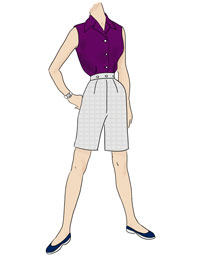
Clothing that is relaxed, yet clean and professional. Note that casual does not mean sloppy—exercise moderation and avoid loose- and tight-fitting clothes.
Men: Collared or crewneck shirts, chinos or good jeans, and boat shoes, sneakers or loafers.
Women: Sun dress, blouse or sweater, jeans, full-coverage shorts, and boat shoes, sneakers or sandals.
Wear to: Picnics, visiting friends, working inside or around your home.

Casual
Graphic by RCG
Casual
Graphic by RCG