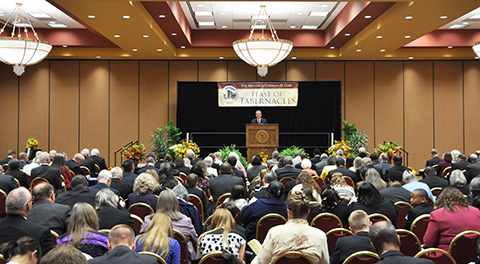
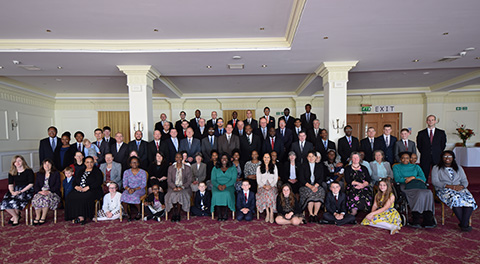
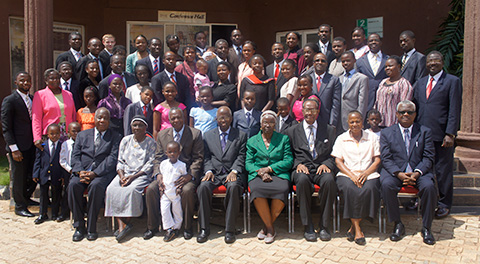
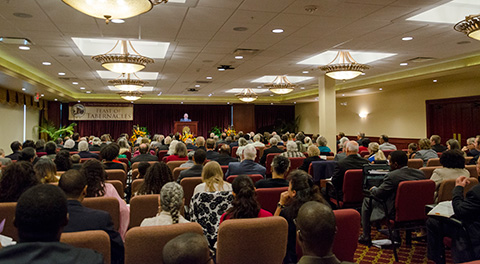
The Feast of Tabernacles is the sixth of seven feasts commanded by God. Like the Days of Unleavened Bread, the Feast of Tabernacles is a seven-day festival, but with only the first day as a Holy Day.
Jesus Christ’s gospel focused on the good news of the coming Kingdom of God. The Feast of Tabernacles pictures the rule of the government of God on Earth.
The Feast represents a joyous, utopian time of peace and fulfillment that has always been the hope and focus of true Christians.
(1) Where is the biblical command to keep the Feast of Tabernacles? Leviticus 23:34-36.
This Feast begins on the 15th day of the seventh month and continues for seven days. The first day is a Holy Day with a commanded assembly. Verse 36 shows that an offering was given each day of this Feast under the Levitical system. Yet today, an offering is only given on the first day of the Feast of Tabernacles, as verse 37 indicates for Holy Days. The convocation and offering commanded on the eighth day (vs. 36) are part of a separate feast, the Last Great Day.
(2) Was the Feast of Tabernacles known by any other names? Exodus 34:22.
The Feast of Ingathering was the major annual harvest in the fall season. The spring harvest was very small in comparison to the fall harvest.
The spiritual harvest will follow this same pattern. God shows that He gives the former rain moderately, but the latter rain will come down abundantly and will yield a plentiful harvest (Joel 2:23-24). The Feast of Tabernacles typifies this plentiful spiritual harvest.
(3) What are the themes of the Feast of Tabernacles? Leviticus 23:40 (last part); Deuteronomy 16:13-15; 14:23.
This is the one Feast in particular in which God commands everyone to rejoice! This Feast looks forward in time to the most joyful occasion of all time. It also teaches us to fear God, which means to deeply reverence Him as our Creator.
(4) How are people to finance their travel, food and lodging for a feast lasting this long? Deuteronomy 14:22-27.
This special festival tithe (known as second tithe) was used to finance not only the expenses of the Feast of Tabernacles, but the other Holy Days as well. God blesses those who are faithful in keeping this tithe, which people are to spend for their own needs and desires in order to rejoice before the Eternal.
(5) Is this Feast commanded to be observed forever? Leviticus 23:41; Zechariah 14:16-19.
The account in Zechariah 14 emphasizes the fact that this Feast is a statute forever. All nations will observe this Feast in the Kingdom, whether they want to or not. Eventually, all nations will come to understand and appreciate God’s commanded Feasts.
(6) Does God promise to protect the property of those who leave their homes and businesses to keep the Feast of Tabernacles? Exodus 34:24.
God mandates that His people keep all of His Holy Days: the two during Unleavened Bread, Pentecost, Trumpets, Atonement, Tabernacles and the Last Great Day. God intends that His people keep them without distraction or worry—and with the full joy of these annual events. Although we are expected to plan ahead and do our part to ensure the preservation of our property, business, and/or farm in our absence, God promises to protect our interests while we are rejoicing at His feasts—and He delivers on this promise.
Observed by Ancient Israel
(1) Even when Israel was in the depths of disarray, were some still faithful in keeping the Feast of Tabernacles? Judges 21:19.
The tabernacle had been set up at Shiloh since the time of Joshua. Yet, much of Israel was oblivious to this crucial knowledge by the period that Judges 21:19 discusses. This was during the time Israel had deteriorated to the level described in verse 25. About 250 years earlier, all Israel had assembled in Shiloh (Josh. 18:1) and had proven themselves faithful and obedient to God’s laws and statutes (24:25, 31). The term “statutes” in verse 25 refers to the portion of God’s laws generally applying to worship on the national level. This included the proper keeping of the annual feast days.
(2) Did Elkanah and Hannah, to whom Samuel was born, go up to keep the Holy Days at Shiloh each year? I Samuel 1:3.
God intervened and granted Hannah a child, Samuel, whom she dedicated to God. After Samuel was weaned, she presented him to the high priest and visited the child every year when her husband offered sacrifices of burnt offerings (I Sam. 2:19).
(3) Was the Feast of Tabernacles observed when the Temple was dedicated by Solomon? I Kings 8:1-2, 65-66.
When the Temple was dedicated, a period of seven days was set aside for this dedication immediately before the Feast of Tabernacles. Then, the seven days of the Feast were kept and the people were sent home on (after) the eighth day (vs. 66). This eighth day following the Feast was the same day we read about in Leviticus 23:36. The month Ethanim was the original Hebrew name for the seventh month and meant the month of “permanence or permanent things”—representing events in the future leading to spiritual permanence or eternity.
(4) Had ancient Israel been negligent in keeping the annual Sabbaths and the weekly Sabbath? Ezekiel 22:26.
Because of this long-term negligence, Israel and Judah were taken into captivity—Israel first and Judah just over a century later. The blessings and cursings recorded in Leviticus 26 and Deuteronomy 28 reveal the consequences of disobedience. Read Ezekiel 20:1-44 to better grasp how Israel repeatedly ignored God’s Sabbaths. (Ezekiel 20:25 means that God gave Israel over to their own ways.)
(5) Did the Jews who returned from captivity in the time of Ezra and Nehemiah greatly rejoice to keep the Feast of Trumpets and the Feast of Tabernacles? Nehemiah 8:1-2, 6, 8-10, 14, 17-18.
To these Jews, who were old enough to remember the feasts from their childhood, after 70 years of captivity, the feasts now held a deeper, more profound meaning than ever.
The statement in verse 17 pertaining to the Feast not having been kept in this fashion since the time of Joshua was referring to the booths that were made from tree branches. Certainly, this Feast had been kept since the time of Joshua, but not exclusively in such booths and possibly not with the desire and passion that these Jews displayed—prophetic of those who will joyfully keep the feasts as the Kingdom begins.
(6) Are we commanded to dwell in booths during the Feast of Tabernacles? Leviticus 23:40, 42.
Verse 40 describes the use of boughs or branches of trees such as palms or willows with thick or abundant leaves for coverings of temporary dwellings. The Hebrew word cukkah (pronounced as sook-kaw) in verse 42 means “a booth, tent or tabernacle”—basic temporary dwellings. Verse 40 shows the least expensive way to provide shelter for the Feast of Tabernacles.
The reason God commanded Israel to dwell in such tabernacles is found in verse 43—to show that God had Israel dwell in booths when he brought them out from Egypt. The lesson for us is that this life is temporary, and all our long-term hopes and plans should point to the coming Kingdom of God. Hence, we are to live in temporary tabernacles during the Feast of Tabernacles—whether we stay in tents, campers, motels or hotels.
Observed by Jesus and the Apostolic Church
(1) Is there any biblical evidence that Jesus Christ observed the Feast of Tabernacles? John 7:1-2, 8-11.
John’s use of the phrase “the Jews’ feast of tabernacles,” was necessary since the vast majority of the readers of his gospel were non-Jewish. This phrase showed that the Jews were the only ones keeping God’s feasts in Christ’s time, as the other descendants of Israel had not returned to keeping them.
Yet we see in verse 8 that Jesus charged His physical family to keep this Feast. In verse 10, Christ also went to keep this Feast, after His brothers had left. Verse 11 shows that the Jews were looking for Him at this Feast, because they were well aware that He kept all of God’s commanded feasts.
Jesus’ example shows that He was not deterred from keeping the Feast of Tabernacles, despite the fact that the Jewish religious leaders sought to kill Him. Verse 14 shows that it was not until the middle of the Feast that He made His presence known, due to the precautions He had to take with His life in danger. This Feast was so important to Christ that He attended even under such threats. It should be just as important to us.
(2) Does Scripture show that the first-century apostles kept the Feast of Tabernacles? Acts 18:21.
The Feast to which Paul was referring could only have been the Feast of Tabernacles, as it fell within the fall season. Looking back, it was late summer of AD 50 that Paul had arrived in Corinth (vs. 1) where he stayed at the home of Justus for his final 18 months (vs. 11). By the time Paul passed through Ephesus en route to Jerusalem, two full years had elapsed. He traveled through Syria toward his destination of Jerusalem for this Feast season in the fall of AD 52—primarily the Feast of Tabernacles.
“In God’s Kingdom, all the world will begin to live the way that produces happiness, peace and every desirable outcome, as God always intended.”
(3) Does Church history reveal specific references to the true Church observing the Feast of Tabernacles?
There are a number of references that the feasts continued to be observed throughout history. One particular source, Sabbatarians in Transylvania by Samuel Kohn, noted that the Sabbath-keepers in this region were observing the feasts during the early 1600s. Besides numerous songs commemorating the weekly Sabbath, the hymnal of these Sabbatarians contained songs dedicated to the following feast days: eleven songs for Passover and the Days of Unleavened Bread, six songs for Pentecost, three songs for the Feast of Trumpets, one song for the Day of Atonement, and six songs for the Feast of Tabernacles. Unlike the Jews of their time, there is strong evidence that they understood the general meaning of the feast days.
The Kingdom of God Ruling on Earth
Finally, after 6,000 years of being under the sway of Satan’s deceptions and attitudes, the world will be free of such influence. The truth and God’s Law will be the established way that the vast majority will be seeking.
(1) Does the Bible explicitly state that in the coming Kingdom, the world will no longer be subject to angelic powers? Hebrews 2:5.
(2) Who is the supreme ruler during this time? Revelation 11:15; 19:6; Daniel 7:13-14.
(3) Who else will be ruling in the Kingdom of God? Revelation 20:4; 5:10; Daniel 7:27.
(4) Will God’s rulership be firm when necessary? Isaiah 2:4; Ezekiel 20:33-38.
(5) Will people in the Kingdom be treated with understanding and mercy?
Jeremiah 31:8-9; Isaiah 30:19; 40:10-11; 61:3.
God’s mercy is infinitely greater than mankind’s, as we find in Psalm 103:8, 11. His approach to people depends chiefly upon their character, as we read in Psalm 18:24-26.
(6) Will those ruling under God be able to manifest themselves to those they are teaching? Isaiah 30:19-20.
(7) Will the natural ecosystem—including all plant life, the soil, atmosphere, and all bodies of water—be healed during this time? Ezekiel 47:1, 8-9; Amos 9:13-14; Isaiah 35:1-2, 7.
As described in Ezekiel 47, the stream of water that flows from under the Temple to be built on Mount Zion will bring healing to the oceans and waters as God renews the environment.
(8) Will people be healed of physical impairments and afflictions, as well? Isaiah 35:3-6.
(9) When the God Family rules the Earth, does the very Creation—hills, trees, water, etc.—also rejoice, in a figurative sense? Psalm 96:10-13; 98:8-9; Romans 8:19-23.
So great is the relief, joy and celebration that the land, sea and sky, which will all be restored to their original purity, reverberate with similar cheerfulness. The term “creature” in Romans 8:19, 20 and 21 is derived from the same Greek word translated as “creation” in verse 22. Thus, “creature” should be read as “creation” in all these verses.
(10) As a result of the restored environment, restored health and true knowledge, will people’s lives be more fulfilled? Micah 4:4; Isaiah 25:9; Zechariah 10:7.
(11) Will the nature of carnivorous animals and dangerous reptiles be changed? Isaiah 11:6-9.
(12) Is the Kingdom of God the time the apostle Peter referred to when he spoke of “the restitution of all things”? Acts 3:19-21.
The Kingdom is the only time that could be described as “the times of refreshing” and “the restitution of all things,” as these verses clearly depict. In God’s Kingdom, all the world will begin to live the way that produces happiness, peace and every desirable outcome, as God always intended.
The Feast of Tabernacles is full of meaning that can only be truly appreciated by observing this convocation each year as commanded.