“Four score and seven years ago…”
In less than 300 words and under three minutes, President Abraham Lincoln’s Gettysburg Address stirred a crowd of about 15,000 people. Over time, its impact spread across a divided nation and helped redefine the American identity. A century and a half later, those words are still recited in classrooms, studied in universities and revered for their precision and power.
History holds many such moments, when spoken words changed the course of events. Winston Churchill’s “Blood, Toil, Tears and Sweat” speech steeled a nation to keep fighting during World War II. John F. Kennedy’s call to “go to the moon” roused Americans to reach beyond Earth…and they did.
Such speeches live on because of what followed. Well-crafted, passionately delivered words can move people to action, whether addressing a stadium or a small group.
This principle should not be lost on Christians. Every day, we are given the opportunity to speak to the almighty God of the universe.
While public speaking and prayer may seem like opposites—one public and one private—they share more in common than we may think. And understanding the connection can transform how we approach our Creator.
Crucial Quality
All powerful speeches have one essential trait: The speaker believes what he is saying. He speaks with conviction, emotion and passion.
Public speaking coach Ty Boyd once stated, “The greatest asset any public speaking expert can have is energy.” Effective speakers bring a level of identifiable energy that draws the listener in.
Prayer is no different. James wrote, “The effectual fervent prayer of a righteous man avails much” (5:16).
The phrase “effectual fervent” comes from the Greek word energeo. According to Strong’s Exhaustive Concordance, it means “to be active, efficient.” In the King James Version, it is also translated as do, be mighty in or work effectually in. The English word energy comes from this same root.
This is a dynamic, vigorous term—derived from ergon, meaning toil, an act, deed, doing, labor or work.
Physical labor involves real exertion. Prayer should reflect a similar level of spiritual effort. We should not be groggy, distracted or sound disinterested. Rather, we should bring focus and care to every word spoken before God.
Just as there are various styles of public speaking—inspirational, persuasive, instructive—the God of variety designed multiple forms of prayer. The apostle Paul listed these in I Timothy 2:1: “I exhort therefore, that, first of all, supplications, prayers, intercessions, and giving of thanks, be made for all men.”
Each term describes a distinct type of prayer.
- Supplications: Petitions or requests.
-
Prayers: General prayer where we earnestly speak to God.
-
Intercessions: Implies personal engagement, like a conversation. God wants us to open up and talk to Him.
-
Giving of thanks: Expressing gratitude and thankfulness.
These four types of prayer add depth, variety and meaning to your time before God.
Whatever form your prayer takes, it should come from the heart. Be sure to give it the necessary time and focus.
Ecclesiastes 9:10 says, “Whatsoever your hand finds to do, do it with your might.” This includes prayer.
As we put these principles into daily practice, our prayers will grow stronger and more effective. As James declared, they will “avail much.”
Important Preparation
Another public-speaking principle applies directly to prayer: Know your audience.
Effective speakers tailor their message to whom they are addressing—whether to a few friends at a casual gathering or before a queen in a royal court. The context shapes our tone, content and demeanor.
The same is true in prayer. Jesus taught us to address “Our Father” (Matt. 6:9). This reflects a deeply personal relationship, as with a son or daughter speaking respectfully to a loving parent (John 15:16; Eph. 5:20).
What should we picture when we pray? Scripture reveals that Jesus Christ is present at the Father’s right hand (Eph. 1:20). Hebrews 12:22-23 expands the scene further: “You are come unto mount Zion, and unto the city of the living God, the heavenly Jerusalem, and to an innumerable company of angels…to God the Judge of all, and to the spirits of just men made perfect.”
Each time we kneel before God, we are not simply on a carpet or beside a bed. Spiritually, we appear before the throne room described in Revelation 4: “And He [God] that sat was to look upon like a jasper and a sardine stone…a rainbow round about the throne, in sight like unto an emerald…lightnings and thunderings and voices…a sea of glass like unto crystal…” (vs. 3-6).
Understanding where we are—who is present, and what this setting represents—should shape the way we pray. We are entering a majestic court filled with radiant glory, countless angels and our living High Priest, Jesus Christ, at the Father’s right hand.
There is another important factor to consider. Revelation 12:10 calls Satan “the accuser of our brethren…which accused them before our God day and night.” Like a hostile prosecutor, the devil looks for any opportunity to condemn.
This underscores the need to come before God with a clear conscience. Read Isaiah 59:2 and Psalm 66:18. We must be spiritually prepared to speak before God, not only out of reverence but also to guard against Satan’s accusations.
Think of the full picture: a vast audience of spirit beings and a throne of glory. If we would diligently prepare to speak before millions of people, how much more should we prepare when coming before the great God of heaven?
Foundation for Success
Skilled public speakers know that word-for-word memorization almost always results in dry delivery. Instead, they rely on extemporaneous speaking. This method involves preparing thoroughly, then delivering from an outline rather than a script. This gives structure to the talk without sacrificing sincerity or spontaneity.
Prayer should follow a similar approach.
In Matthew 6:9-13, Jesus Christ provided a model prayer that gives us a strong framework to guide and deepen our conversations with God. He said, “After this manner therefore pray you…” (vs. 9). In other words: “Pray in this way. Use this as your outline and build on it with your own words.”
The prayer begins, “Our Father which art in heaven, hallowed be Your name.” This sets the tone by identifying who we are addressing, where He is, and how we should speak to Him. This portion can—and should—change daily. We might reflect on God’s role as Creator, Judge, Lawgiver or Shepherd. We can draw from the many attributes and titles of God found throughout Scripture: merciful, faithful, patient, just, all-powerful…and so many more!
This is also a fitting place to express gratitude for God’s blessings. As I Thessalonians 5:18 instructs, “In everything give thanks.”
The next phrase—“Your Kingdom come, Your will be done” (Matt. 6:10)—gives purpose to our prayers. Like the specific purpose statement in a speech, this phrase helps set the focus.
Later in Matthew 6, we are told to “seek…first the Kingdom of God, and His righteousness” (vs. 33). Everything we ask should align with God’s will and His purpose for our lives.
The next part of the outline: “Give us this day our daily bread.” This reflects our dependence on God for every daily need, both physical and spiritual. We must ask in faith and with a thankful attitude for Him to continue to supply our needs.
Jesus continues: “And forgive us our debts, as we forgive our debtors. And lead us not into temptation, but deliver us from [the] evil [one]” (vs. 12-13). These words remind us of our need for repentance—and of God’s continual mercy. They also prompt us to examine whether we are extending the same forgiveness to others. The passage closes with an urgent plea for spiritual protection, recognizing that Satan the devil actively seeks to derail us.
Christ concludes with praise: “For Yours is the Kingdom, and the power, and the glory, forever” (vs. 13). This directs our focus back to the purpose and ultimate goal of our Christian calling while praising and honoring God.
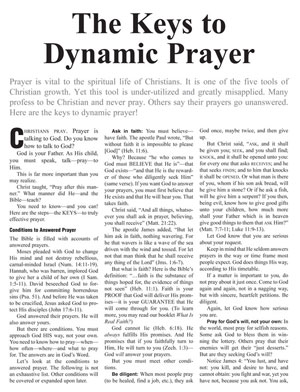
This all-important framework is expanded on in the article “The Keys to Dynamic Prayer”.
Each element of the model prayer should be made personal—supplemented with specifics from you. Just as a speaker might jot down a few guiding points before presenting, it can be helpful to briefly note topics to cover in prayer.
This does not mean scripting every word. Jesus warned against “vain repetitions” (Matt. 6:7). Entirely pre-written prayers leave no room for God’s Spirit to guide our thoughts and tend to lack the sincerity God seeks.
Instead, we are told, “Now therefore fear the Lord, and serve Him in sincerity and in truth” (Josh. 24:14). And John wrote, “God is a Spirit: and they that worship Him must worship Him in spirit and in truth” (John 4:24).
The Church witnessed this kind of powerful prayer on the day of Pentecost: “And when they had prayed, the place was shaken where they were assembled together; and they were all filled with the Holy Spirit, and they spoke the word of God with boldness” (Acts 4:31).
This prayer was not boring or half-hearted—it was filled with passion, power and sincerity.
While this section has focused on longer, dedicated prayers, God also expects us to pray throughout the day.
Emergencies may arise that call for immediate, spontaneous prayers. In such moments—when you cannot get on your knees or are in public—you can still cry out to God from the heart. Romans 12:12 tells us to be “instant in prayer.” But these brief moments must be supported by regular, meaningful prayers in private, on our knees.
Prayer Prep Checklist
Skilled public speakers never approach a lectern unprepared. They consider their audience, organize their message and determine what they want to accomplish. They eliminate distractions and focus their minds.
How much more should we do the same before speaking to God?
Here are some things to consider:
Am I alert and mentally present?
Our longer daily prayers should not be haphazard or done when half-awake. God appreciates thoughtful, deliberate communication (Ecc. 5:2; I Pet. 4:7).
Do I need to ask God for forgiveness?
Sin separates us from God. We must come before Him with a clean and sincere conscience (Psa. 66:18; I John 1:9; Heb. 10:22).
What do I need to thank Him for today?
Gratitude should be a daily part of prayer—it refocuses the mind and aligns us with God’s will (I Thes. 5:18; Phil. 4:6).
What are the needs in my life—and in others’ lives?
Our prayers should include not only personal needs, but also the needs of the Church, the Work, family and fellow brethren (I Tim. 2:1; Gal. 6:2).
What scriptures can guide what I say?
Let God’s Word shape your words. Praying with an open Bible deepens understanding and can help us better articulate our thoughts (Psa. 119:18; John 15:7).
Do I know the main focus of this prayer?
Like a speaker with a clear message, the most effective requests in prayer have purpose and direction (Matt. 6:10, 33; Luke 22:42).
Elijah’s Example
God wants His people to understand the real impact that prayer can have. Throughout the Bible, His servants consistently practiced active, fervent prayer—and the results were powerful.
Consider the prophet Elijah. James used him as a direct example of “effectual fervent prayer” (5:16). Verse 17 adds, “Elijah was a man subject to like passions as we are…” In other words, he was human just like us. He faced discouragement, fear and spiritual fatigue (I Kgs. 19:4). Yet once he repented and changed his attitude, God was able to use him mightily.
At a time when Israel was steeped in idolatry, ruled by its most wicked king to date (16:30), Elijah boldly declared a drought in the land. James records that “he prayed earnestly that it might not rain: and it rained not on the earth by the space of three years and six months” (5:17). That prayer triggered a famine that reached across the nation (Luke 4:25).
While the specifics of Elijah’s request are not recorded, the outcome leaves no doubt: his fervent, faith-filled prayer had a dramatic effect.
Later, when the time came for the drought to end, “he prayed again, and the heaven gave rain, and the earth brought forth her fruit” (Jms. 5:18).
Think of the preparation that likely went into that second prayer: The entire country was in horrific drought, a great famine was occurring, many wives lost their husbands, and millions of fellow countrymen—including children—were suffering because an evil king was on the throne.
Imagine yourself praying in that context. How thoughtful would your words be? How specific? How much would you labor in prayer?
Elijah’s example challenges us to ask: Do my prayers reflect that level of intensity? Do I approach God’s throne with heartfelt purpose and clarity? Can my prayers produce real change?
They can.
At another point, Elijah prayed over a child who had died. I Kings 17:21 states, “And he stretched himself upon the child three times, and cried unto the Lord, and said, O Lord my God, I pray You, let this child’s soul come into him again.” And God answered.
Elijah was not an exception. James included his story in an epistle written to the entire Church to remind us that ordinary people, through extraordinary faith, can pray with similar results.
Nehemiah offers another example. He was a cupbearer to the king of Persia—a lowly servant in a foreign court. He prayed earnestly and humbly for God to give him the right words to speak to the king (Neh. 1:4-11). God heard. His words stirred the monarch’s heart, and Nehemiah was granted permission to go lead the rebuilding of the wall of Jerusalem.
Be Persistent!
God has given His people a priceless privilege: direct access to Him in prayer (Eph. 2:18; Heb. 4:16). He is eager to listen to us and desires to give “every good gift” when we ask according to His will (Jms. 1:5, 17).
Yet not every answer comes immediately. Sometimes, God responds at once. Other times, He allows a delay—giving us time to learn and grow in faith.
This is why persistence is such a vital part of effective prayer. God wants to know: Will we continue seeking Him when the answer does not come right away? Will we stay fervent over time—or gradually give up?
James 5:16 shows that persistent, heartfelt prayer “avails much.” Philippians 4:6 encourages us to “let your requests be made known unto God.” And Acts 4:31-32 describes the early Church praying in unity—“of one heart and of one soul”—with results that shook the building they were in!
Jesus Himself taught this lesson through the parable of the persistent widow (Luke 18:2-8). A poor woman continually brought her case before an unjust judge. At first, he ignored her. But over time, her unrelenting appeals wore him down. He finally granted her request—not because he was righteous, but because she would not give up.
Christ made the point unmistakable: “And shall not God avenge His own elect, which cry day and night unto Him, though He bear long with them? I tell you that He will avenge them speedily…” (vs. 7-8).
Persistence moves God. He wants us to develop the spiritual tenacity to keep praying even when an answer seems delayed.
A prayerful mindset is even more important as the end of the age draws near. In Luke 21:36, Jesus instructed, “Watch you therefore, and pray always, that you may be accounted worthy to escape all these things that shall come to pass, and to stand before the Son of man.” This verse should be placed alongside being instant in prayer (Rom. 12:12) and praying without ceasing (I Thes. 5:17).
We should take every opportunity throughout the day to talk to God—with our most dedicated time spent in private, on our knees, before the One who governs the universe.
As we see Christ’s return approaching, we must never underestimate the power of our prayers.
Determine to approach each day’s prayer as you would a carefully prepared message—offered with conviction, spoken in faith and aligned with God’s will.
Never forget: “The effectual fervent prayer of a righteous man avails much.”