The Feast of Pentecost illustrates the third step in God’s Plan of Salvation. The meaning of this festival builds on the lessons taught by the previous Spring Holy Days.
Remember, Passover is the annual memorial of the sacrifice of Jesus Christ—and includes the vital symbols of the bread and wine and the ordinance of humility He introduced on the eve of His crucifixion. Jesus’ sacrifice makes possible the forgiveness of our past sins and the opportunity for a completely new start, living in harmony with God’s will. This constitutes the first step in the plan of salvation.
The Days of Unleavened Bread picture God’s people coming out of sin, just as ancient Israel came out of Egypt. This is the second step. But another vital step is necessary for people to successfully overcome sin in this physical life. This missing element, central to the Day of Pentecost, is the Holy Spirit—the very power of God.
Wave Sheaf Offering
The seven feasts in God’s sacred calendar are tied to the two harvest seasons in the region of Judea. The first season is the small spring harvest, followed later by the main harvest that occurs in the fall.
The spring harvest is very small compared to the large fall harvest. It begins during the Days of Unleavened Bread and ends by the time of Pentecost—also called the “Feast of Firstfruits” and the “Feast of Weeks.” The latter name reflects how the time of this feast was derived by counting seven Sabbaths, covering seven weeks. The term Pentecost is derived from the Greek language and means “fiftieth.”
Before the spring harvest (or firstfruits harvest) began, the wave sheaf offering had to take place. This offering always occurred on the Sunday following the weekly Sabbath during the Days of Unleavened Bread, unless the First Day of Unleavened Bread is itself a Sunday, in which case the wave sheaf would be offered on that day. This wave sheaf offering of barley was the very first of the firstfruits brought to the priest to be presented before God. Barley was generally used in the wave sheaf offering because it was the first grain to mature and be ready for harvest in early spring.
(1) What did the wave sheaf offering represent? Leviticus 23:10-11; John 20:17; I Corinthians 15:20-23.
In John 20:17, Jesus had already been resurrected and first manifested Himself in human form to Mary Magdalene. He had been resurrected three days and three nights from Wednesday evening to Saturday evening just before sunset—near the end of the weekly Sabbath. Note that He had not yet ascended to the Father, but had revealed Himself to Mary (vs. 1, 11). He indicated that she could not touch Him at that particular time, because Christ had not yet ascended to His Father.
(2) Were the disciples permitted to touch Christ later that same day? Matthew 28:9.
Since the disciples were allowed to touch Christ, He had to have been accepted by the Father by that time. As a spirit being, Christ was able to return instantly once He had ascended to heaven and been accepted. As the fulfillment of the wave sheaf offering, Jesus was accepted on the first day of the week (see John 20:19), just as the wave sheaf was always offered and accepted on that same day (see Leviticus 23:11).
The Outpouring of the Holy Spirit
(1) Did Christ promise His disciples that after His departure, He would not leave them comfortless, but would send them spiritual help? John 14:16-18.
(2) Did Jesus repeat this promise of sending forth spiritual power, even after His resurrection? Luke 24:49; John 20:21-22; Acts 1:8.
(3) On what day did Christ send the Holy Spirit to His disciples? Acts 2:1-4.
(4) What was the reaction of the devout Jews who witnessed these miraculous events? Acts 2:5-13.
This Day of Pentecost in AD 31 was the beginning of the Church of God. The disciples who had been trained by Christ for years now received the Holy Spirit and began to fulfill their responsibilities as apostles. The sending forth of God’s Spirit is the central meaning of Pentecost.
This Holy Day also depicts the small early spring harvest, which typifies those called into God’s Church in this age as firstfruits. The vast majority of humanity will only be called during the reigning Kingdom of God. Only a tiny minority are called now to fulfill special purposes in God’s Plan.
Early Church Kept Pentecost
(1) Was Pentecost commanded to be kept forever, just like Passover and the Days of Unleavened Bread? Leviticus 23:9-16, 21.
When God says “forever,” this is precisely what He means. The Holy Days will be observed in the coming Kingdom, contrary to the opinions of critics who denounce them as temporary Jewish days that were done away with.
(2) Did the apostles come together in Jerusalem for the Day of Pentecost? Acts 2:1, 5.
In this particular case, they were among the many thousands of devout Jews assembled for the purpose of manifesting the power of God.
(3) Is there evidence that the Church in this era continued to keep Pentecost? Acts 20:16; I Corinthians 16:8.
Pentecost is mentioned in these two places after the event recorded in Acts 2. In Acts 20:16, Luke recorded that Paul was determined to keep this feast in Jerusalem. I Corinthians 16:8 shows Paul informing the Church at Corinth that he would stay in Ephesus until Pentecost. All the Holy Days were important milestones and the apostles often used these days as benchmarks in time.
Counting Pentecost
We have already seen that the wave sheaf offering depicts the beginning of the small spring harvest, which represents those few now being called as firstfruits. Now we need to understand how Pentecost was counted in order to arrive at the correct date each year.
(1) Upon what day was the wave sheaf offering made each year? Leviticus 23:10-11.
“The morrow after the Sabbath” meant the first day of the week—Sunday. The context of this verse falls within the timeframe of the Days of Unleavened Bread, as verse 8 summarized the seven days and that the seventh day was a time of holy convocation. The Sabbath referred to in verse 11 could have only been the weekly Sabbath that fell within the Days of Unleavened Bread. If it were counted from either one of the Holy Days (first or seventh), then Pentecost would always fall on the same day of the month year after year and would not need to be counted.
(2) How was the count made from the day of the wave sheaf offering to arrive at Pentecost? Leviticus 23:15-16.
We are to begin counting on the day after the Sabbath (day of the Wave Sheaf offering) and to number seven Sabbaths (or weeks) from that day. The target day is clearly stated in verse 16, which shows that we are to number “even unto the day after the seventh Sabbath.” Clearly, the target day is the day that follows the seventh Sabbath—the first day of the week following that Sabbath.
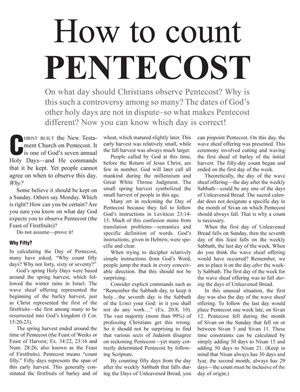
For more information, read our article “How to Count Pentecost”.
Why the Early Harvest Represents So Very Few
(1) In what capacity are the 12 apostles to serve in the coming Kingdom of God? Matthew 19:28.
(2) Are those called in this age qualifying to rule over cities? Luke 19:12-19.
(3) Are those called in this age destined to judge the world and even angels in the future? I Corinthians 6:2-3.
(4) Will God’s faithful servants reign in the Kingdom of God as kings and priests? Revelation 5:10.
Those whom God is calling now are preparing to serve in the Kingdom of God as teachers and instructors—as kings and priests. The number of those serving in the government of God is understandably far smaller than the number of their subjects.
(5) Why do even highly educated people in the world have difficulty understanding Scripture? Isaiah 28:9-13; Matthew 13:10-16.
(6) Do we find the vast majority of humanity in a state of blindness in this age? II Corinthians 4:4; Romans 11:7; I Corinthians 2:14.
Only those God is working with have their minds opened to the truth. The rest remain blind until the time God will begin to work with them. Review the following scriptures to learn more about why the current blindness serves God’s overall purpose: Matthew 13:10-17, II Corinthians 3:12-18 and II Peter 3:9.
Firstfruits Qualifying for the Kingdom
(1) Are those called out of the world by God in this age known as firstfruits? James 1:18; Revelation 14:4.
(2) Do we find examples of specific brethren being referred to as firstfruits in Scripture? Romans 16:5; I Corinthians 16:15.
The small spring harvest of the firstfruits did not begin until the high priest presented the wave sheaf offering (the first of the firstfruits) for God to accept. Likewise, the harvest of the firstfruits in God’s Plan of Salvation did not begin until Christ was accepted as the First of the Firstfruits.
This small harvest of the firstfruits will not take place until Jesus’ Return. The intervening period of 50 days between the acceptance of the wave sheaf and the completion of the harvest symbolizes the nearly two millennia that will have elapsed in which the firstfruits will have overcome and qualified to rule in the Kingdom of God.
(3) What is the meaning of the loaves of bread offered at the Feast of Firstfruits? Leviticus 23:17.
The "wave loaves" symbolize Christians who are called to be firstfruits. Jesus Christ, represented by the wave sheaf offering that starts the count to Pentecost, made it possible for others to follow (I Cor. 15:23). The fact that the loaves contain leavening shows that Christians are still overcoming sin and building character.
Law Written in Our Hearts
Although the Law was written in stone during the time of ancient Israel (Ex. 31:18), those God works with in His Church today and in the Kingdom will have the Law written in their hearts.
Jeremiah 31 says, “But this shall be the covenant that I will make with the house of Israel; After those days, says the Lord, I will put My law in their inward parts, and write it in their hearts; and will be their God, and they shall be My people” (vs. 33).
This is only possible with the power of the Holy Spirit, given to the Church of God on this same day. Through the power of God, a Christian can keep the Law, overcome sin, and qualify to be a firstfruit ruling in the Kingdom of God.
To learn more, read our booklet God’s Holy Days or Pagan Holidays?