Think of fond family memories. A special recipe passed down through generations. Bedtime stories. Father-son baseball catch. These are all examples of simple traditions that may be treasured through generations.
Few things glue families together more than such cherished routines. They help children develop a sense of identity, bring distant relatives closer and build fond memories that can be passed on.
Merriam-Webster defines a tradition as “an inherited, established, or customary pattern of thought, action, or behavior (such as a religious practice or a social custom)…the handing down of information, beliefs, and customs by word of mouth or by example from one generation to another without written instruction…cultural continuity in social attitudes, customs, and institutions.”
These terms all apply to family traditions. Protocol, customs, ritual, rule, heritage and routine are related terms.
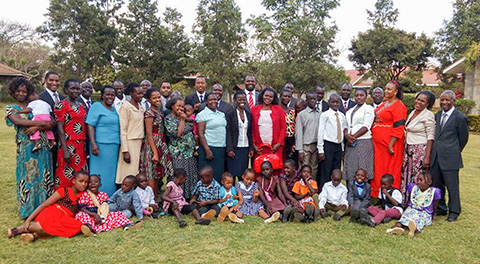
The Bible teaches that Christians are God’s begotten family on Earth. God is our Father. Galatians 4:26 says, “Jerusalem which is above [meaning the Church]…is the mother of us all.” The Pillar article “Is the Church Our Mother?” explains this in detail. Jesus Christ is called the “firstborn among many brethren” (Rom. 8:29).
The fact that we are God’s spiritual family is not a tradition—it is a doctrine. Unlike traditions, doctrines are teachings found explicitly in the Bible. Hebrews 6:2, for instance, mentions some foundational ones every Christian should understand, including “the doctrine of baptisms, and of laying on of hands, and of resurrection of the dead, and of eternal judgment.”
Alongside these and many other Bible doctrines, Church traditions help cement us as a spiritual family. The apostle Paul stressed their significance when He instructed us in II Thessalonians 2:15 to “stand fast, and hold the traditions which you have been taught, whether by word, or our epistle.”
Do not miss the point: Upholding Church traditions is itself a crucial doctrine of God.
How Traditions Are Set
Understanding how traditions develop can help explain why we hold on to them.
Some begin spontaneously. A family member enjoys a cup of tea before bed, and another joins in. A pleasant conversation is sparked. Soon enough, it becomes a traditional “family chat over a late-night tea.” Even small practices like these can be significant.
Others require a little more planning and forethought. For example, dinner together is always at 6 p.m., and no one starts eating until Dad prays for a blessing on the meal. After the meal, a Bible passage is discussed at the table, and then the children wash dishes.
In this example, someone with authority in the family had to take the initiative to establish what would be done regularly. It may have been explained in detail to the oldest child, while the younger children or visitors learned it by observation.
The Church works the same way. II Thessalonians 2:15 shows ministers are tasked with establishing or preserving certain traditions in one of two ways: by “word” or “epistle.”
The Greek word translated as “word” is logos. Strong’s Dictionary defines it as something said, reasoning, communication, intent, or treatise, utterance, word, work.
In summary, this refers to instructions imparted orally, whether in person or over the phone, through video or any other medium that can transmit audio.
Interestingly, this Greek word is the same one used in John 1:1, which refers to Christ.
“Why are traditions so effective? A primary reason is that they help prepare the proper environment for doctrinal instruction and learning to take place.”
The Greek word translated “epistle” simply means a written message or letter.
This involves text, such as instructions in the Announcement Bulletin, The Pillar, an email from Church Administration or any other form of written communication from the ministry.
Churchwide and Local
Traditions that have been formally enacted either apply to the Church as a whole, regardless of location, or only to a specific area or pastorate.
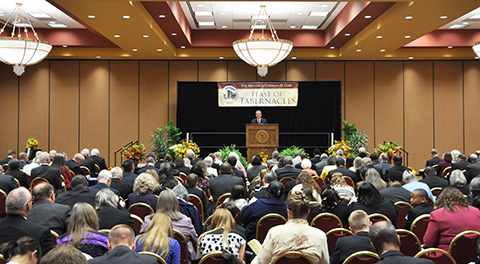
Some examples of Church-wide traditions include that we sing six hymns during Sabbath services (except when there is no sermonette, or the sermon is lengthy, in which case five hymns are appropriate).
Offertory music is traditionally followed by a hymn, but special music replaces the hymn before the sermon.
Bible studies after services begin with an opening prayer but do not end with a closing prayer.
We have a tradition to share a meal together after services, under the direction of the minister or his wife (Acts 2:46).
Churchwide fundraisers organized by Headquarters such as the August Loose Change Challenge or fundraising for AYC is another example.
We also traditionally call ministers and wives “Mr.” and “Mrs.” as a sign of respect.
A few examples of local traditions might include holding periodic combined services or socials among various congregations or pastorates.
Some congregations may have only snacks rather than a potluck, or no meal at all due to venue restrictions or other considerations.
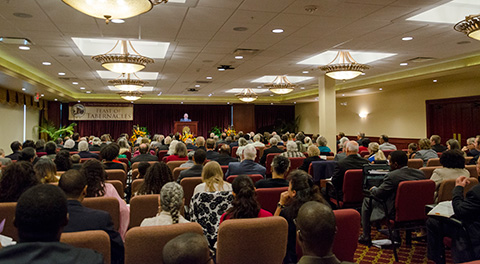
Sometimes brethren may sit around a table for services, rather than the traditional theater-style setup, due to meeting space limitations.
The local ministry may organize local or regional fundraisers for AYC, the Work, the local congregation fund, etc.
Whether churchwide or local, the way each minister implements these customs varies slightly depending on his leadership style and the characteristics of the region within his “measure of rule” (II Cor. 10:13).
Each minister—and by extension, each congregation—has unique personality traits and strengths through which God works. Yet these variations do not preclude us from “speaking the same thing” as a Church (I Cor. 1:10).
There is room for a little variety in how each pastorate administers Church traditions as we all serve the same God “which works all in all” (12:5-6). Guidance from the ministry is key to determining that balance.
Timely Refresher
Traditions link us to the past. They help ground us. In addition, we can learn godly wisdom by meditating on decisions and protocols enacted decades ago.
Many Church members today have not had prior exposure to the Worldwide Church of God and may be unfamiliar with Church traditions that have been in place for decades. In other cases, members who may have been exposed to these traditions can still benefit from reviewing their significance to not allow themselves to grow lax in upholding them. Also, God’s Church has needed to develop new traditions that were not necessary at the turn of the century.
Why are traditions so effective? A primary reason is that they help prepare the proper environment for doctrinal instruction and learning to take place.
School teachers can attest to this concept. Any grade-school teacher will tell you the importance of having clear routines (essentially classroom traditions) in place to help students learn. Some of the most successful teachers in the world maintain that establishing procedures is the only thing that should be done for the first weeks of the school year. Without this foundation, adequate learning will not happen throughout the rest of the year!
Think of how that principle applies to Sabbath services. Having a clear way of how each service should be run coming from Headquarters (rather than leaving it to each local congregation to decide) ensures everything operates smoothly.
Stand Fast and Hold!
Whatever Church traditions are in place today, our marching orders are clear: We must “stand fast, and hold” them (II Thes. 2:15). These are action words!
The word translated “stand fast” means “be stationary, that is, (figuratively) to persevere” (Strong’s).
“The word translated ‘hold’ means to have power, be powerful, be chief, be master of, to rule, lay hold of, take, seize, lay hands on one in order to get him into one’s power, not discard or let go, keep carefully and faithfully and retain.”—Thayer’s Greek Definitions
Meanwhile the word translated “hold” means to have power, be powerful, be chief, be master of, to rule, lay hold of, take, seize, lay hands on one in order to get him into one’s power, not discard or let go, keep carefully and faithfully and retain (Thayer’s Greek Definitions).
Both word choices give us a powerful picture of how God wants us to handle traditions in His Church.
Take note of how there is no instruction to necessarily understand or question exactly why each single tradition was established, but rather to stand firm and strongly uphold them. There are countless traditions needed for everything to run smoothly in the Church, and for a minister to have to justify or explain the reason behind each one of them would be paralyzing.
If we ever struggle with agreeing on why a tradition is necessary or a minister’s way of implementing it, review Hebrews 13:17 and simply take God at His word. Focus on the big picture of what God expects, and on how ministers have a responsibility to uphold these traditions. Determine to be of a ready mind to assist them in doing so.
If you are unsure how a tradition is supposed to be applied, ask your minister! He would be glad to help. Ladies, for example, can reach out to ministers’ wives with questions regarding dress traditions. Men can ask how they can help serve a congregation. God will ultimately bless our efforts to the degree we strive to stand fast and hold to it under the guidance of His government.
We have seen how traditions may not be doctrines, but having and obeying them is a biblical command. We must strive to stand firm and persevere in each tradition passed down to us and master implementing them—holding to them with a death grip, especially as we see Christ’s Return approaching.
Let’s apply these action words to our Church traditions and watch how much stronger our bond as a spiritual family becomes!