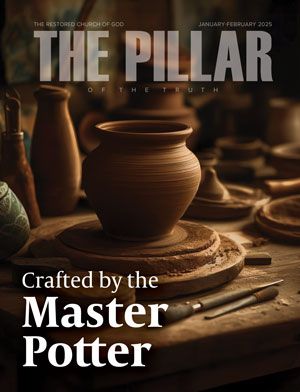
A potter is up early, making sure everything is ready for a productive day in his studio. He prepares a lump of clay to work with and places it in the center of the pottery wheel. As the clay spins to life, he begins the process of forming and centering the lump, adding water as needed. The movement of his skilled hands seems almost effortless, and a vessel soon begins to take shape. A familiar, earthy fragrance rises from the clay, reminding the potter that he is working with a fragile, temporary material.
Our Christian lives mirror the process of shaping a clay pot, starting as a lump of clay and slowly transforming into a useful vessel. The Bible tells us this directly: “But now, O Lord, You are our Father; we are the clay, and You our potter; and we all are the work of Your hand” (Isa. 64:8).
God, the Master Potter, is forming and shaping us spiritually. It is humbling to reflect on this truth. Our lives are not happening randomly—we are part of a much bigger process. Just as a potter must patiently apply his craft, God is slowly transforming us into something purposeful and valuable. He sees our potential and envisions what we can become through His guidance.
This analogy challenges us to reflect on our relationship with our Creator. Unlike physical clay, God’s work with us focuses on refining our inward character rather than shaping our exteriors. We must trust Him as He guides our lives and builds His holy, righteous character within us.
Proverbs 3:5 says we are to “trust in the Lord with all [our] heart.” We must not make the mistake of relying on our own understanding.
Are we workable in the Master Potter’s hands? Or do we resist, wanting to shape ourselves according to our own will? Knowing the qualities that make clay usable is vitally important.
Being Workable
The physical properties of clay mirror our own readiness to become workable.
Clay is soft, moldable and fragile. It requires preparation before it is ready for the potter’s wheel. Similarly, our lives involve experiences that mold and shape us, defining who we are right now.
The patriarch Job also understood God’s role as Master Potter. Job 33:6 says, “I also am formed out of the clay.”
Impurities can weaken the structure of clay and make the final product less durable. The clay a potter uses must be pure and may require a “seasoning” process to become ready to be worked with.
We need to rid ourselves of distractions, bad habits or negative influences to be ready for God’s loving hands to work with us. The apostle John wrote, “Every man that has this hope in him purifies himself, even as He [God] is pure” (I John 3:3).
Each experience in our lives can function as a step in this purification process, making us more open to God’s work in us.
An experienced potter must have a certain level of skill. God is the most skillful Being in the universe. He knows exactly what to do to bring us to our full potential.
“God is the most skillful Being in the universe. He knows exactly what to do to bring us to our full potential.”
How Trials Shape Us
The connection between the potter and clay becomes even clearer when we consider the significance of trials, which serve as a crucial step in God’s refining process.
By being open to challenges as opportunities for growth, we become more resilient and able to adapt to difficult situations.
James wrote: “My brethren, count it all joy when you fall into diverse temptations [trials]; knowing this, that the trying of your faith works patience. But let patience have her perfect work, that you may be perfect and entire, wanting nothing” (1:2-4). Trials are a key tool God uses to ultimately make us perfect.
Before making art, a potter must first address the condition of the clay with which he is working. Flaws can make clay unusable, but if they are removed, the clay can then be used. A potter wedges the clay, kneading and reworking it to eliminate imperfections.
Just as a potter applies pressure to the clay to prepare and shape it, we are given trials that apply pressure to us. These moments may feel like we are being “beaten up,” but they are essential for removing the human nature that we may be holding onto.
Think back to a time where you were challenged by a trial. How well did you deal with it? Looking at where you are today, how would you manage it differently?
Consider taking out a piece of paper and writing down all the times you can think of when God has delivered you from trials. Reflect on these, and also jot down the trials you are currently going through. This can be an informative process and will give you an idea of how far you have come. Take this list with you when you are praying to God. It can help your prayers become more focused and fervent.
Jeremiah 18 continues the spiritual potter analogy: “And the vessel that he made of clay was marred in the hand of the potter: so he made it again another vessel, as seemed good to the potter to make it. Then the word of the Lord came to me, saying, O house of Israel, cannot I do with you as this potter?...Behold, as the clay is in the potter’s hand, so are you in Mine hand, O house of Israel” (vs. 4-6).
When we make mistakes, God does not give up on us. He gives us chances to grow and improve and provides opportunities for repentance and growth. Psalm 103:14 says: “For He [God] knows our frame; He remembers that we are dust.” God’s compassion for us is unwavering.
Job’s story teaches us about the power of humility during difficult times. In chapter 42 of his book, Job said, “Wherefore I abhor myself, and repent in dust and ashes” (vs. 6). He was surrendering fully to God after going through many trials.
During our lives, we will go through various hardships. God expects us to glean lessons from these times. Ask yourself after a trial: What did I learn from this that will help me going forward? How you answer this question will help decide how much God is able to work with you.
Like clay that is reshaped after a flaw is discovered, we can emerge stronger after trials.
Every difficult time becomes an opportunity to move toward fulfilling the plan God envisions for us. We must submit to the process.
The Careful Guidance of God’s Hands
A potter plays a critical role in working clay into something useful and beautiful. Without the guidance of an expert potter’s hands, clay stays a shapeless lump.
God takes on this role in our lives, shaping and molding us into the people He intends us to be. We may not always understand the process or why certain experiences are necessary, but He always has a purpose. We need to become more mindful of this process and submit to it.
Making pottery requires precision, which mirrors the care that God uses while working with us. A vessel must have a clear shape and function, just as we are given purpose by God.
Jesus said, “No man can come to Me, except the Father which has sent Me draw him” (John 6:44). God pulls us in and toward Him so that we can be formed according to His will.
Romans 9:21 teaches that God can shape the same clay into different kinds of pots, each with its own purpose. God has a special plan for each of us. He is always ready to guide and help us each day.
Be receptive to His pokes and prods, welcoming the fact that the God of the universe is working with us. Our Creator can see the finished product even when we only see a mess of clay on the wheel.
Each step, whether joyful or challenging, is part of His plan to create something extraordinary.
Remaining Moldable
Clay that is ready to be worked with has the characteristic of being flexible. If clay becomes dry or hardened, it is difficult to shape into a finished vessel.
Isaiah 29:16 warns against becoming resistant to God’s guidance: “Surely your turning of things upside down shall be esteemed as the potter’s clay: for shall the work say of Him that made it, He made me not? Or shall the thing framed say of Him that framed it, He had no understanding?”
Do not neglect to communicate with God through regular prayer and Bible study. Create a schedule for both and stick to it. Take advantage of the various tools available on rcg.org that explain how to effectively wield these tools of Christian growth.
Keeping in close contact with your Creator every day will help you keep sight of becoming a finished work.
You must also remain open to receiving correction. Just as a potter might adjust the shape of a vessel to improve it, God corrects and guides us to ensure we are on the right path. These adjustments can be uncomfortable but are necessary for growth. Read Hebrews 12:1-13. Being refined over time is what leads to becoming a finished piece of pottery.
God’s Beautiful Finished Work
The physical act of making a finished piece of pottery takes time. Rushing it can ruin the result.
Similarly, God’s plan for our lives unfolds over time. Philippians 1:6 proves this: “Being confident of this very thing, that He [God the Father] which has begun a good work in you will perform it until the day of Jesus Christ.”
God is always at work, whether we are aware of it or not, refining us for His purpose.
Trusting God means believing that “we are His workmanship, created in Christ Jesus unto good works” (Eph. 2:10). God wants all of us to succeed. Your life is not random or accidental and is part of a much bigger work!
God’s timing is often one of the hardest parts of the process for us to understand. It is easy to grow impatient or question why things are not happening the way we expected or as quickly as we want.
Yet just as clay needs time to be shaped and fired, we need time to develop and mature spiritually. Each experience, no matter how small, contributes to the bigger picture.
Take a moment to reflect on your life and your journey so far. How are you doing? Are there areas where you need to be more flexible and open to God’s guidance, or more trusting in His workmanship?
Matthew 24:13 tells us that those who stay strong and faithful until the end will qualify for salvation. Through a lifetime of endurance and growth, we are becoming that perfect work of art, crafted by the hands of the God of the universe.
Every one of us has a special purpose. Just as no two pottery pieces are the same, we are each unique in how God shapes us.
Regularly reflect on Isaiah 64:8 and continue becoming more moldable in the Master Potter’s hands. God is working a “good work” (Phil. 1:6) in you right now, and He never makes mistakes. Trust the process and allow God to mold you into the person you are meant to be!