What do these two scenarios have in common?
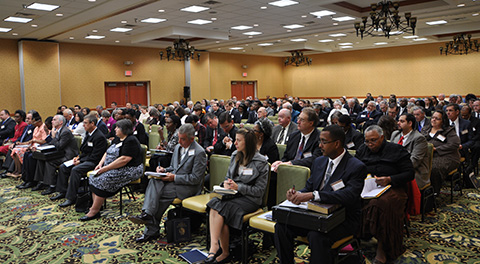
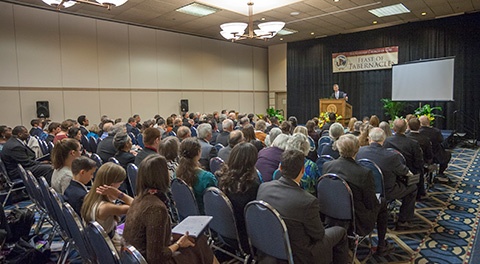
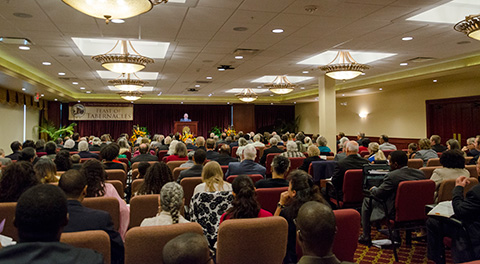
Number 1: Hymn music begins playing, signifying it is time for you to find your seat before Sabbath services begin. Soon enough, you rise and sing three hymns and then bow your head for the opening prayer. After about 45 seconds, the “amen” is spoken, and everyone sits back down.
At this moment, you wonder, What if I ever had to give an opening prayer? Would I be able to deliver one properly?
Going forward, you determine to listen closely to learn what should go into an opening prayer.
Number 2: You see two people greet each other at the entrance of the hall for services—one person is a designated greeter, and the other is attending his very first service. As you watch the interaction—from the handshake to the greetings to the introductory questions—you begin preparing to do the same for the new prospective member.
Both scenarios are examples of implementing a crucial leadership-training course called Observation 101!
This self-taught “class,” as well as its more advanced counterpart, Observation 202, are two study courses developed by our Pastor General, Mr. David Pack, early in his ministry. He credits this coursework for playing a major role in how he learned to be an effective leader.
Excerpts from Mr. Pack’s biography explain this. He stated that “most of my learning and development in this first [ministerial] assignment came by observation. I discovered that the ability—and necessity!—to observe what was going on around me was the single most vital element of my training. I learned to refer to this ‘coursework’ as ‘Observation 101.’”
“Because there was little or no active teaching going on with my training, such observation was necessary. I also learned that there is a second course called ‘Observation 202.’”
“Nothing from this first year in the field would be as important to the entire rest of my ministry as having learned to daily apply these two ‘courses.’”
Desiring to share this learning experience with potential leaders in The Restored Church of God, Mr. Pack also delivered an Ambassador Center orientation lecture on the topic. It is a fundamental skill for any leader, especially one God is preparing to rule with Him in His Kingdom.
We are all being developed right now for positions of authority—not just those training for the ministry or employment at God’s Headquarters. Revelation 5:10 says that God is “making” kings and priests—this includes all who have His Spirit!
Anyone desiring to be a king/priest in the Kingdom must see things differently. Observation 101 and 202 provide the tools to do this.
Introductory Class
University courses are numbered based on their level, with 100s (100, 101, 102, etc.) representing entry-level knowledge. The 100s must be completed before moving on to higher level studies, represented by higher numbers (200 for second-year, 300 for third-year, and so forth). The “courses” we have discussed on observation are no different.
Mr. Pack described the introductory course, Observation 101, this way: “Everywhere I looked there was something to learn—the way assignments by deacons and elders were carried out, the way a Spokesman Club was handled, how counseling was offered in regard to different needs and problems, the smooth flow of Sabbath services, how Passover was prepared for, and simply the general way that so many things were done—or not done.”
To summarize, Observation 101 is noticing something and studying it so that you can implement it yourself.
Most people in this world go through life with “blinders” on. They are generally unaware of what is going on around them. This is human nature. It is much easier and takes much less effort just to let someone else deal with “it,” whatever “it” is.
The average person also assumes there will always be someone to take care of things. Such people are wholly unprepared for times they may be forced to handle a problem or fulfill a task themselves.
On the other hand, a true leader desires to help and serve others and, therefore, must be watchful. One must grow “leader’s eyes” and always be aware, searching for opportunities to learn or fill needs—all without being asked and not being driven by a desire to take credit.
The apostle Paul confirmed this in Philippians 2: “Look not every man on his own things, but every man also on the things of others” (vs. 4). “Look” means to take aim at, to spy, to regard. In other words, keep a watchful eye on those around you. “On the things of others” refers to others’ situations, circumstances, needs and so forth.
Observe patterns. Study how things are done, especially things that help others. Memorize any method you think could be useful in the future.
Using the examples from earlier in the article, observe the proper way to deliver opening and closing prayers. This will ensure you can do it properly from the get-go. But even if you are never in a position to give prayers publicly, you can implement elements of what you learn in your private conversations with God.
Watch all the details of Sabbath set-up crews—where they place chairs and tables, how many chairs per table, and so forth. You could help in the future! Also, it will benefit you to see if something is missing and point it out to the appropriate person. The same goes for flowers, the kitchen and all the other functions that occur on the Sabbath.
Also, pay attention to how ministers conduct themselves—for instance, how they dress—and try to model yourself after them.
Another example: If you notice that each week, men only wear white or light blue dress shirts, you should conclude that other hues (purple, pink, red, black, etc.) are not the best for Sabbath services.
Outside of services, take note of all your surroundings. Learn new skills or improve your job performance by mindfully watching and imitating those who are more experienced. It could be as simple as watching how your neighbor plants a garden and takes care of his property, watching someone change your car’s oil, seeing how friends hold effective conversations or examining how a well-written email is formatted and worded.
You can also learn from observing bad examples. Note that the Bible showcases both good and evil characters and leaders—it is practically a textbook on Observation 101. Seeing the bad results of doing something wrong or poorly can spur you to do it properly.
Overall, learning from patterns and observing the details will help you avoid having to be approached or corrected. Better yet, it will allow you to better advise and help others.
Advanced Study
Once you are able to replicate scenarios properly, the next step is to seek ways to improve them.
This is where Observation 202 comes into play. Mr. Pack explained this more advanced course: “This consists of observing things that are NOT being done, areas where things should be taking place, but are either being neglected or ignored. I learned to think carefully about what I would do someday in my own pastorate, given the opportunity.”
In summary, Observation 202 is recognizing something that is not present that could be implemented to better a situation.
One thing to note is that you must have an idea of how things are properly done before seeking to improve them. Observation 101 coursework is a prerequisite for 202. Using Observation 202 is not a reason to go rogue and decide to do things the way you want without approval. Now for scenarios.
During Sabbath services, you see an elderly member who suffers from back problems struggling with the chair he is sitting in. You realize there is a need for a more comfortable chair for that member. Do you think, “That is a sad situation, but I am sure he will figure it out”? Or are you eager to improve the situation for that member and approach the minister or host to inquire about obtaining a more comfortable chair?
On another Sabbath, you see visitors from another congregation who are not familiar with anyone. You see them standing off to the side as everyone is focused on serving or just talking to others they are comfortable with. Do you take the leadership role, move out of your comfort zone, and go talk to them, making them feel more welcome and at ease? Or do you take the easy way out, assuming someone else will engage them?
Beyond seeing problems with situations that are present, think about those who are “not at the dance.” This phrase comes from the fact that it is natural to notice who or what is present at an activity, and it takes effort to realize who or what is missing.
A simple way to develop this skill is to think about who is not at services. Then plan to reach out to them via email, text message or phone call. Also, what kinds of activities are not being done that you could bring up with your minister and volunteer to organize?
Observation 202 does not only apply to Church services.
Find ways to be more efficient at your job to make processes quicker, come up with better quality products, and so forth.
If you find a method to better organize your tasks, share it with your supervisor! It may even end up benefiting your entire department as he may share your findings with others. If not, at least you applied Observation 202 and practiced leadership. Be ready to let your idea go if it is shot down. Do not be discouraged in such a situation.
Similarly, you may have ideas on how to improve certain situations, but it is not your place to bring them up. It is fine to note areas that could be improved and come up with solutions. But—if the issue is not in your sphere of influence—it is almost always best to refrain from saying anything. Learning when to speak up and when to stay silent is another essential leadership trait.
“There are many attributes of leadership we must develop. One of these, vision or observation, is crucial to someday teach the world the ways of God! To begin thinking and acting as leaders, we must see as leaders. We can do this with the principles outlined in this article.”
You can even continue to improve basic skills such as simple car fixes, organizing your home, and saving money (including for offerings). Constantly seeking to improve will put you in a position to better help others as you can share what you learn!
Look around your home. Perhaps it is thoroughly cleaned and organized (as you learned through Observation 101), but can you envision adding something to improve it? Would an impressionistic painting, a piece of furniture, a photo album, or some other additional touch enhance your abode?
If you are raising children, brainstorm what you can do to further augment their life experiences. Have they ever been to an art museum? Do they know how to exercise, swim, throw and catch a ball? Would they benefit from visiting a historical site or a geological landmark?
Observation 202 should also be applied on a personal level. In essence, with Observation 202, you are self-examining and taking steps to fill in what you recognize is missing.
You may pray daily and follow the outline in Matthew 6. But can you make your prayers more meaningful, more fervent (Jms. 5:16)? The same goes for the other tools of Christian growth.
In all these examples, one must focus on becoming more aware of his surroundings and circumstances and have the vision to attain a higher standard.
Make the Grade
When you consider all the “classes” we are taking during our spiritual schooling (biblical doctrine, Christian living, prophecy, fellowshipping, fundraising, trials, etc.), leadership training is near the top of the list.
Why are leaders so important? The world does not yet know God’s Way. The world is awash in mediocrity and error from the devil’s governance. This world is in dire need of true leaders, and we are those leaders now being carefully prepared.
There are many attributes of leadership we must develop. One of these, vision or observation, is crucial to someday teach the world the ways of God! To begin thinking and acting as leaders, we must see as leaders. We can do this with the principles outlined in this article.
The next phase of the eternal, global, dynamic Work of God is about to begin in the Kingdom of God. It will have leaders who are capable of “looking on the things of others” and improving them!
Make Observation 101 and 202 a priority in your life. Prepare to step into a leadership position—soon. The world needs us to pass Observation 101 and 202. All humanity is depending on it!