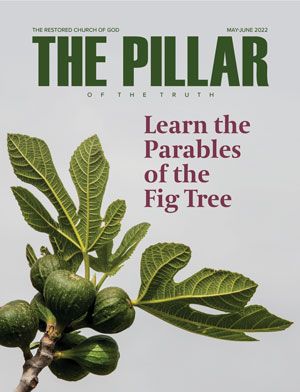
From Genesis to Revelation, one particular plant keeps getting mentioned: the fig tree. It is featured in the story of Adam and Eve (Gen. 3:7) and—about 1,200 pages later—used to describe the events of the sixth seal of Revelation (6:13). And then there are the dozens of other times it is referenced in between.
For those in the Middle East and southern Europe, figs are a staple. The world’s biggest producers are Algeria, Egypt, Greece, Iran, Morocco, Spain and Turkey. The tree plays a big part in these cultures, and pretty much everyone in these regions is familiar with how this fruit grows.
Not so much for those in the United States and a majority of the world. While California does grow figs commercially, most in North America are unfamiliar with this sweet fruit—except maybe for the snack Fig Newtons.
Yet Jesus used this plant to make an important point in Matthew 24: “Now learn a parable of the fig tree” (vs. 32).
Christ was using fig trees as a parable or similitude—a physical example to help us learn a spiritual lesson. His command was not exclusive to those standing there in front of Him in the first century. He was also addressing us, His disciples alive today. Verse 33 shows that, as with a fig tree shooting forth in the spring, God’s Kingdom would be “at the doors” when certain prophetic conditions occur.
Yet this was just one time Jesus used a fig tree as a lesson. He did it on a number of occasions. In addition, the Bible uses fig trees many other times to make a point. There is not just one parable of the fig tree—there are many!
The apostle Paul wrote “in all things I am instructed” (Phil. 4:12). God uses the fig tree as a teaching tool and the plant holds many spiritual lessons. Let’s learn some more…
Some Background
When Jesus used a fig tree as an example, everyone listening understood exactly what He was talking about. Fig trees grew everywhere—and many cultivated figs on their property. For most of us today, we need some basic information to reap all the spiritual lessons these trees can produce.
Ficus Carica, the common fig’s scientific name, boasts hundreds of varieties that are grown in various parts of the world. Fig leaves have been used for tea, fig seeds for oil, and fig latex for multiple purposes, including medicine, cheesemaking and meat tenderizing. Fig bark is used traditionally to produce clothing fabric in Uganda. This special bark cloth is costlier than leather. According to Encyclopaedia Britannica, figs are known as “the poor man’s food” due to their wide use throughout the Mediterranean region.
Some historians regard the fig as the first crop ever to have been cultivated by humans. Ancient fig remains excavated in the Jordan River Valley are understood to have come from “mutant trees” that do not require insect pollination. This rare find implies that people were selectively breeding the fruit over 1,000 years prior to domesticating wheat, chickpeas and barley—which were previously thought to be the earliest cultivated staples.
The 1901 book The Fig: Its History, Culture, and Curing added, “In the most ancient times of which we have record a considerable fig trade existed in Smyrna, and we are told that in the time of the earlier emperors of Rome, in the first century of our era, dried figs of the best quality were brought from Smyrna to Rome.”
Even earlier, King Solomon recorded this about the fruit-bearing plant: “Whoso keeps the fig tree shall eat the fruit thereof…” (Prov. 27:18).
Solomon knew growing fig trees took a lot of time and effort. Yet these would grow fruit if “kept” under the right conditions. This parallels the environment in which Christians can become spiritually fruitful.
Fruit-conducive Ground
Fig trees do well in soils with plenty of organic matter. Namely, they like humus, which is the dark part of the soil made from decayed plant and animal matter.
The word humility comes from the word humus. This is one aspect we can learn from fig trees. Humbleness is vital for Christians to bear good spiritual fruit. Yet there is much more to what kind of attitude is required to be fruitful.
In the Luke 8 parable of the sower, aside from its prophetic meaning, Christ underlined the importance of healthy soil. Of all the soil types He described, only seed that fell on “good ground” was able to “bring forth fruit with patience” (vs. 15).
Jesus defined people with “good ground” as those with three characteristics: they had “an honest and good heart,” “heard the word” and kept it.
The phrase “an honest and good heart” is rich in meaning. Honest means “genuine…beautiful by reason of purity of heart and life…affecting the mind agreeably, comforting and confirming” (Thayer’s). Mounce Concise Greek-English Dictionary defines the word as “useful.” The dictionary defines good as “profitable” and “generous.” Finally, heart means “the seat of feeling, impulse, affection, desire…the conscience.”
To summarize, fruit-conducive “good ground” implies a good attitude. To bear much fruit, we must receive what God says (“hearing the word”) and do (“keep”) it while grounded in a humble, honest, good-hearted attitude.
It helps to check our ground—attitude—regularly. Are we genuine? Pure? Comforting? Being useful to God and others at Sabbath services, at home, at work? Are we being generous with our time, our offerings for the Work, our service? Are we managing our emotions and impulses?
Think of how a farmer can run a test to check the soil for fertility. A test sample would be sent to a lab to analyze factors such as pH levels, mineral content, acidity and humic matter. The test results help determine if specific nutrients should be added to the ground to improve it. Similarly, we can test our attitude with self-examination. The weeks leading to the Passover should not be the only time we examine ourselves (I Cor. 11:28; II Cor. 13:5). Periodic self-examination coupled with fasting throughout the year is an effective way to identify attitude issues we need to address.
Our self-examination helps our prayers and personal Bible study. It may also reveal a need to seek ministerial counseling for specific issues. Though some of these areas can seem difficult to address, the resulting good fruit is well worth the effort.
Access to Abundant Water
Gardeners’ World Magazine had this to say about cultivating figs: “If your tree drops its fruit early, it could be a sign that your plant needs water.”
This is another aspect we can learn from the fig tree. Fig production involves plenty of water.
Christians are similar in a spiritual sense. Psalm 1:1-3 compares a person who avoids evil, delights himself in God’s Law and meditates on it “day and night” to “a tree planted by the rivers of water, that brings forth his fruit in his season.”
Jeremiah 17:7-8 adds that someone who “trusts in the Lord, and whose hope the Lord is…shall be as a tree planted by the waters” and will never “cease from yielding fruit.”
These actions—avoiding evil, meditating on God’s Law, trusting and hoping in Him—result in spiritual fruit because they make us tap into the river of God’s Spirit (John 7:38; Gal. 5:22-23).
Imagine wanting to plant a fig tree and knowing that it has better chances to thrive by the water. If given the option to either plant a tree close to a river or away from it, which would you choose? The answer is easy.
Learn to view your life choices the same way. As much as possible, strive to be closer to people, places and things that draw us closer to God’s Spirit. Steer clear of anything or anyone that tends to pull us away from fulfilling our goal as future member of the God Family.
Resourceful Roots
Figs are known for aggressive roots that allow them to find water even through seasonal drought. This feature allows them to grow on a variety of soil types. When not planted by water, fig roots will dig through anything to get to water. These invasive roots can be destructive for structures like sidewalks, walls and driveways, yet they are very instructive for us.
The proverbial tree in Jeremiah 17:8 also “spreads out her roots by the river.” Notice that the water does not automatically leap toward the tree. The tree has to exert resourcefulness to reach the water.
This is a more subtle fig-tree lesson—do not miss it. Having the Holy Spirit is not enough for Christians. We must follow its lead (Rom. 8:14). Like fig tree roots, we need to actively reach through whatever it takes to access and use that spiritual water. It is not automatic.
It takes resourcefulness to escape from sin when being tempted, to carve out time to study, pray and meditate when life is busy, and to always put others first in our lives. It takes work and resourcefulness to travel—sometimes hours—to Sabbath services to fellowship with others with God’s Spirit.
All of this helps us be deeply rooted in God’s Church.
“Deep spiritual roots will help us strangle the cares of this life—such as materialism, distractions and vain pursuits—instead of allowing them to choke our ability to produce fruit.”
A different species of fig tree serves to illustrate this principle: the strangler fig. The seeds of this unique plant can germinate high up on the branches of a giant tropical forest tree—after having been left there by an animal. The seedling manages to survive while its aerial roots slowly work their way to the ground.
Eventually, the strangler fig’s many roots are grafted together to wrap the host’s trunk. Though a long process, the host tree often dies and decomposes over time. A majestic, fruitful, giant fig tree is the final result. Instead of a trunk, it has a chamber of fig tree roots, with a hollow center in the shape of its former host.
The lesson here is that we should be as persistent as the strangler fig roots when it comes to exercising God’s Spirit. We should fellowship tightly with other brethren as much as possible, just as the fig roots graft themselves together to form a massive wall against the old tree host.
Just as the fig roots overpower the host tree, a deep connection with God and His Way will help us “mortify the deeds of the body” (Rom. 8:13).
Similarly, Colossians 3:5 tells us to mortify our “members which are upon the earth” and Romans 6:6 tells us that “our old man is crucified with [Christ], that the body of sin might be destroyed, that henceforth we should not serve sin.”
Learn this fig tree lesson! Deep spiritual roots will help us strangle the cares of this life—such as materialism, distractions and vain pursuits—instead of allowing them to choke our ability to produce fruit.
Sufficient Light
Most sources say figs need seven to eight hours of sunlight per day. Light gives a fig tree the energy to produce fruit.
For a Christian, light is also connected to spiritual fruit production. Ephesians 5:8-9 says we must “walk as children of light: (for the fruit of the Spirit is in all goodness and righteousness and truth).”
In John 8:12, Christ said, “I am the light of the world: he that follows Me shall not walk in darkness, but shall have the light of life.”
Psalm 119:105 explains how we can access this light: “Your word is…a light unto my path.” Proverbs 6:23 adds, “For the commandment is a lamp; and the law is light.” Think of Bible study as basking in God’s light. This element of the fig-tree lesson is plain. If we study our Bibles, we will have spiritual nutrients needed to produce spiritual fruit.
We must be enlightened by abundant, consistent Bible study on a daily basis. When we eat a fig, we eat its seeds. There is life in every seed. Likewise, every word of God gives us “the light of life”—eternal life—to produce fruit eternal (John 15:16).
Ancient Greek athletes and hemerodromos (military curriers) reportedly ate figs as part of their regimen for a source of energy. Figs are one of the foods believed to have helped sustain Pheidippides through his famous “first marathon” run. Likewise, we can carry “light snacks” to consume through the day, such as a copy of this magazine (in hard copy or digitally), a Bible (hard copy, digital or audio version), and sermons to listen to (video or audio). Prime yourself for constant biblical enlightenment and bask yourself in God’s truths regularly!
Unique Pollination Process
Certain fig trees require an exclusive tiny wasp that enters the fruit to pollinate them. These trees and their corresponding wasps need each other to survive. As a side point, this codependence is proof that the Master Designer made them inseparable.
Realize, however, that a fig is not considered fruit, scientifically speaking. “A fig is actually the stem of an inflorescence, very enlarged and fleshy, that surrounds the tiny flowers inside,” according to the U.S. Forest Service. “The crunchy little things that you notice when eating a fig are the seeds, each corresponding to one flower. Such a unique flower requires a unique pollinator.”
Several spiritual parallels can be drawn from this fascinating process as another facet of the fig-tree lesson.
First, the cluster of flowers inside a fig gives out an aroma. That begins the pollination process by attracting the characteristic female wasps. Likewise, our good fruits emit “an odor of a sweet smell” (Phil. 4:18). The background of this verse were Philippian brethren who helped provide for Paul in a time of need. In the previous verse, he explained that it was not that he desired “a gift: but I desire fruit that may abound to your account.” When we help one another, it begins a cycle that eventually results in abundant spiritual fruit.
Next, the wasp must enter the fig through a tight entrance. Think of how the Holy Spirit enters our mind through laying on of hands (John 14:17) but also by daily asking for more of it (Luke 11:13).
Once inside, the wasp pollinizes some of the flowers. Similarly, James 1:18 says we are begotten “with the word of truth, that we should be a kind of firstfruits of [God’s] creatures.”
Having lost its wings upon entry, the wasp dies inside the fig after it finishes pollinizing and laying its eggs. (God made it so there are zero wasp remains in the edible figs.) Think of how we were “planted together in the likeness of His death” and the old self must die every day so we can produce good spiritual fruit (Rom. 6:5-6).
Fruiting Takes Patience
A new fig tree normally takes three to four years before it is mature enough to start producing fruit that ripens properly. This requires patience. For a Christian, spiritual fruit also involves patience. Recall what Luke 8:15 said about those in good ground. They “bring forth fruit with patience.” Galatians 6:9 states that we should “not be weary in well doing: for in due season we shall reap, if we faint not.”
This facet of our fig-tree lesson does not always come naturally to us living in the 21st century. Most people are unfamiliar with the concept of nurturing and waiting for a tree to bear fruit—in the case of figs, for years! Today, if we want to enjoy figs, we go to the store and buy them already dried and conveniently packaged for us. Patience with others—and with ourselves—is essential, as spiritual fruit can take a lifetime in some areas of Christianity. “Behold, the husbandman waits for the precious fruit of the earth, and has long patience for it” (Jms. 5:7).
God intended the fig not just to be rich in fruit, but also in meaning. Earlier in the epistle of James, a fig tree appears as a symbol of how Christians should bear fruit. The apostle asked, “Can the fig tree, my brethren, bear olive berries? Either a vine, figs?” (3:12).
In other words, what we do should always match who we are. While the passage’s context are words we utter, the principle applies to any area of our conduct.
Think of a clump of sweet, nutritious figs. Though you may not actually see which tree it came from, you know it must be a good tree from its fruit. In the same way, our godly spiritual fruits point to our Creator. Christ said in John 15:8 that we are His disciples, and the Father is glorified by our “much fruit.” Arguably, spiritual fruit is God’s favorite kind!
One final fig tree parable helps put everything in perspective. Jesus said this in Luke 13: “A certain man had a fig tree planted in his vineyard; and he came and sought fruit thereon, and found none. Then said he unto the dresser of his vineyard, Behold, these three years I come seeking fruit on this fig tree, and find none: cut it down; why cumbers it the ground? And he answering said unto him, Lord, let it alone this year also, till I shall dig about it, and dung it: and if it bear fruit, well: and if not, then after that you shalt cut it down” (vs. 6-9).
Again, most fig trees can take three to four years before they bear fruit. In this parable, the owner of the vineyard was frustrated that there was not fruit after the third year. He was ready to give up and cut down the tree!
It is easy for Christians to fall into a similar attitude. We want to be perfect right away. When we are not bearing enough fruit immediately, we can want to give up.
Notice what this parable is saying. God will give us time. He will continue to fertilize our soil so we may bear fruit in time.
Yet this does not mean we should rest on our laurels. The end of this parable is clear. Anyone who does not stay close to God and produce fruit will ultimately be cut down.
The lesson here is to put ample effort into spiritual growth. But it is also to be patient with ourselves, just as God is patient with us.
This is one of the most important parables of the fig tree.
We can learn so much from this tree of God’s Creation. Soon the Kingdom of God will be here, in which “they shall sit every man under…his fig tree; and none shall make them afraid: for the mouth of the Lord of hosts has spoken it” (Micah 4:4).
As we continue to look forward and prepare for that amazing time—now closer that ever—let’s keep learning and applying the lessons of the fig tree so that, in due time, we may “eat the fruit thereof.”