No Bible figure embodies the godly definition of work more than the apostle Paul. He labored not only for himself but tirelessly for the Church and all the brethren. His example is one we should all strive to copy.
Because Paul had violently persecuted Christians before he was called, he decided to never take a salary from the brethren—though he could have (I Cor. 9:6-7, 13-15).
To secure an independent income, Paul worked as a tentmaker. More than just making temporary dwellings, this meant the apostle was a skilled craftsman who also made goods made from leather, cloth from goat’s hair, linen, rope and sails for ships. He would have designed and manufactured a wide variety of goods—and often be called on to repair items. Think of all the specialized skills he would have needed to learn and keep sharp. He would have also had to actively promote himself as a craftsman in the communities he traveled.
That is a lot of work! Yet he was no slouch as an apostle either.
In Acts 20, we see an example of Paul burning the midnight oil, quite literally. He was preaching to Christians during his travels. In this instance, his hectic schedule had him preaching all night until daybreak. He then set off on foot—with no sleep!—for his next destination.
Paul’s stalwart example would have been on the minds of the Thessalonians when the apostle wrote to them. Some brethren there were idle, refusing to work. Paul took this very seriously.
Notice what the apostle said: “For we hear that there are some which walk among you disorderly, working not at all…” (II Thes. 3:11).
Paul had a sure-fire fix to the problem, saying that “if any would not work, neither should he eat” (vs. 10).
Realize these are part of God’s Word. It states: If anyone refuses to work, they should not be able to eat. This reveals God’s mind on the importance of hard work!
Christians should strive to never take advantage of others. There are times when sickness, disability or extenuating circumstances keep us from working, but we should generally work to ensure we are not a burden on others.
If we do find we have become lazy in an area of our lives, here is Paul’s admonition: “Let him that stole steal no more: but rather let him labor, working with his hands the thing which is good, that he may have to give to him that needs” (Eph. 4:28).
God’s Way is the way of give. The same is true with work ethic. If possible, we should be working to the point where we have enough to help others.
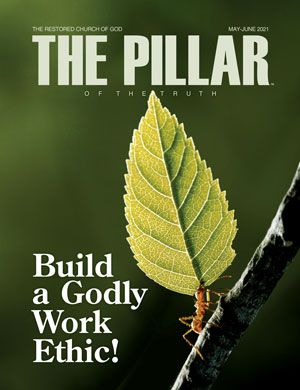
King Solomon also had an admonition for those who have fallen into laziness: “Go to the ant, you sluggard; consider her ways, and be wise” (Prov. 6:6).
Much can be learned from the industrious ant. Yet for our purposes know that this insect instinctually works hard. God created ants to be busy! He did the same for us.
Ecclesiastes 3:13 states: “That every man should eat and drink, and enjoy the good of all his labour, it is the gift of God.”
It is a gift from God—it is built into us—to enjoy the fruits of our labor. Similarly, Proverbs 13:19 says that a “desire accomplished is sweet to the soul.”
God made it so we feel good when we work hard. This should be no wonder because the Father and Christ are hard workers as well. Jesus put it simply: “My Father works hereto, and I work” (John 5:17).
The dictionary definition of “work ethic” is that labor is intrinsically virtuous or worthy of reward. How much truer is this of a godly work ethic!
But how can you build this all-important trait?
A Christian’s Work
Most miss that hard work is tied to the Sabbath command to rest on the seventh day: “Six days shall you labor, and do all your work: but the seventh day is the sabbath of the Lord…” (Ex. 20:9-10). Yes, we are to keep the Sabbath, but we are also commanded to work during the rest of the week!
God emphasized work from the very beginning. After making Adam and Eve, He placed them in the garden to “dress and keep it” (Gen. 2:15). They were to work that land!
Yet the standard for Christians is incredibly high. Luke 17:10 states that if we do the bare minimum of what is commanded of us, we are in the category of an “unprofitable servant.” In other words, we must go above and beyond in all we do!
We are to focus on character growth, physical and spiritual productivity, and overcoming weaknesses. We must diligently meditate, fast, exercise the Holy Spirit and study God’s Word.
Read II Timothy 2:15: “Study to show yourself approved unto God, a workman that needs not to be ashamed, rightly dividing the word of truth.”
Are you a workman when it comes to Bible study? Do you toil in the scriptures? This is just one area in which we must exercise diligence.
“Work” in the eyes of God is all-encompassing. Our most important work and duty is to obey God (Ecc. 12:13). He desires for us to work hard with the time He gives us.
This goes beyond earning a living. It involves ordering and managing all aspects of our lives, being good stewards of all that God provides.
Yet this all takes time. The rest of this article shows how to take your work ethic to a higher level so you can be useful in every area of your life.
Develop Focus
We have all been there. We determine to accomplish something but then become distracted. The initial project then falls by the wayside.
Hard workers have developed the ability to focus and see through a task to the end. They have perseverance, which can also be called stick-to-it-iveness. This trait is crucial for success because distraction is the enemy of productivity. If you flit from one thing to the next, it is practically impossible to accomplish anything, let alone develop a stronger work ethic.
There is a spiritual application here as well. In Matthew 6:22 and Luke 11:34, Jesus commanded us to ensure our “eye is single”—keeping our sights on our Christian calling and fulfilling God’s will in everything we do.
So how do we develop laser focus on any task at hand?
First, we need to remove distractions that cause interruptions. These are different for each individual. Yet some of the most common culprits are social media, texting, playing games and watching television.
Avoiding interruptions requires building self-discipline. If you need to, put your phone in a different room or stay offline to minimize distractions. Working alone in a quiet environment, if feasible, will make you more focused and able to concentrate.
Develop deeper focus by making a to-do list that ranks tasks by their level of importance and then methodically work through your tasks. This can decrease any feeling of being overwhelmed by how much you need to do.
You can also train your mind to focus by doing something you enjoy. Examples include learning a new language, practicing guitar, and doing crossword puzzles or sudoku. With each of these, make sure to stay on task—do not let your mind or attention wander!
Be sure to complete one thing before moving on to the next. Planning your day will help you complete your work more efficiently and stay on top of it all. If time management is an area in which you need to grow, make researching this topic one of your top priorities.
Do It Now, Not Later
Benjamin Franklin famously said, “Never leave that till tomorrow which you can do today.” It is far from outdated advice.
If you struggle with motivation at work, seek the root of the problem. Procrastination is linked to our difficulty managing duties we do not like. We put off doing something when we view a task in an unpleasant manner. It will be difficult, boring or painful, we may think.
Yet avoiding these disliked tasks causes more distress in the long run. Putting them off causes stress, subpar performance, and even health issues. Procrastinators tend to have poorer sleep quality and experience more regret than non-procrastinators. This is a vicious cycle that hinders self-esteem by bringing guilt, shame and self-criticism—feelings that result in putting off even more tasks.
By contrast, being industrious leads to a very different frame of mind. Ecclesiastes 5:12 states, “The sleep of a laboring man is sweet.” Such a person knows he did a good job and his mind is at ease.
It helps to weigh the meager short-term gains of avoiding a task to the abundant long-term results of tackling them head on. When you want to put something off, push through and do it now!
It could be something small such as washing the dishes in the evening. I’m not really in the mood. I’ll do them tomorrow…
It could be something big such as a fitness program you have been avoiding. I really need to start that. Maybe next month…
For each of these, look at the positives of tackling them now. For the dishes, think of the feeling of waking up to a clean kitchen. For exercise, think of how you will be more energetic, more confident, and a positive example for your children.
Do not let flimsy excuses stop you: “I will wait until I have time.” “I work better under pressure.” “Tomorrow will be more convenient.” “I need such and such to happen before I can start.”
Be honest with yourself: These are not valid excuses. It may be nice to “be in the mood,” but waiting for that to happen almost always means you never start your project. That “right” time will likely never come.
Stay Healthy and Balanced
Having a good work ethic does not imply keeping your eyes glued to your computer monitor all day or pushing yourself to the brink of physical and mental exhaustion. It includes knowing how to take care of yourself. Having a godly work ethic also requires actively working on all aspects of your health.
Exercising regularly stimulates your brain and keeps it fresh. It is also proven that physical activity improves memory capacity and overall concentration. Not only will this help you stay energized to continue working, but it will also give you the extra boost needed to stay on task. Strengthening our bodies through exercise builds the mind’s capacity to work more effectively.
Doing important work when exhausted will risk us doing less than our best and making mistakes. Often, this means redoing something and further exacerbating the workload.
Avoid burnout by sleeping eight hours a night and scheduling time for yourself. Proper sleep and rest increases attention span, work quality and allows you to better focus when you are back to work.
Exercise, drinking enough water, getting enough sleep and proper eating habits are all essential for a strong work ethic. Use the advice found in God’s Principles of Healthful Living and keep in mind that nothing will work well unless your body does!
Learn from Others
“The way of a fool is right in his own eyes: but he that hearkens unto counsel is wise” (Prov. 12:15).
Those with a strong work ethic know they cannot do everything themselves. People who try to do this accomplish less at a lower quality than those who seek out the help and advice of others.
Even Moses had to learn this lesson. He was selected to lead ancient Israel. This involved making decisions as well as directing and disciplining the nation. He carried this massive load of responsibility and did almost everything himself.
When his father-in-law Jethro visited, he saw Moses was pushing himself to the point of burnout. He saw his son-in-law close to the breaking point and bluntly said: “The thing that you do is not good” (Ex. 18:17).
The advice continued in verse 18: “You will surely wear away, both you, and this people that is with you: for this thing is too heavy for you; you are not able to perform it yourself alone.”
Moses took his father-in-law’s advice and learned to delegate, allowing others to help.
We must learn from this lesson: Sometimes we must admit we cannot do everything ourselves. Personal pride needs to be put aside to allow others to help.
Doing everything ourselves will “wear away” our physical and spiritual health. But notice that it also affects others. For Moses, continuing to go it alone would have also harmed “this people that is with you.”
When facing a huge amount of work, get help from others. Around the house, this should be our children! Put them to work with chores. This will lower your workload and at the same time teach them valuable skills and habits.
Built to Work!
God wants servants who are productive and diligently complete assigned tasks. The same goes for any employer. As Christians, we should strive for dedication, honesty, integrity and professionalism in every aspect of our lives.
Ecclesiastes 9:10 should be burned into our character: “Whatsoever your hand finds to do, do it with your might.” We should go above and beyond in all we do.
Colossians 3:23 brings this standard to a whole other level: “And whatsoever you do, do it heartily, as to the Lord, and not unto men.”
Whatever we do should be done as if we were directly serving the Father. Imagine if He personally asked you to do something. You would make sure to do it correctly and eagerly look for ways to improve your work!
A godly attitude will generate more purpose and enjoyment on and off the job. No more nine-to-five drudgery, just waiting for the weekend. This will translate into a longer, healthier, happier life all seven days of the week, as God intended.
All this will positively impact others as well. Our employers, spouses, children, friends and the Work of God will reap benefits.
There are also eternal implications. Being more productive, diligent and effective will help us develop the character needed in this life and later in God’s Kingdom.
Yet do not forget one more crucial benefit of hard work. It feels good. Read Ecclesiastes 3:13 again: “And also that every man should eat and drink, and enjoy the good of all his labor, it is the gift of God.”
Each time a task is complete, make sure to meditate on it. Relish your accomplishments. Sit back and admire a job well done.
That feeling is a “gift of God.” Each time you finish a task—whether big or small—remember what your Creator has given you. Allow that good feeling to motivate and spur you on to do even more in your life!