“I can’t believe I did it again!”
Some version of this phrase has likely crossed your mind since you were called. Often, we think something like this when an old sin returns that we thought we grew out of. This reality can become troubling to the point that some wonder whether they are truly converted.
But we must never forget that battling the pulls of the flesh is part of being a Christian.
The apostle Paul documented his personal struggle in Romans 7: “For that which I do I allow not: for what I would, that do I not; but what I hate, that do I” (vs. 15). The English Standard Version renders this verse: “I do not understand my own actions. For I do not do what I want, but I do the very thing I hate.”
That was Paul’s way of saying, in effect, “I can’t believe I did it again!”
His letter concludes with a pointed instruction: “I would have you wise unto that which is good, and simple concerning evil” (16:19).
What did Paul mean by this? The apostle knew striving to be good and abstaining from evil does not come naturally to people. Before God called us, we were wise concerning evil—we were highly skilled sinners. At that time, we were simple concerning good—we did not know how to do it. We specialized in “works of the flesh” (Gal. 5:19-21) and “reaped what we sowed” (6:7). We knew our craft well after having honed it for decades, in most cases.
In order for us to turn around and walk the path that leads to life, God had to grant us the desire to reverse our carnal expertise. That ability is called repentance (II Tim. 2:25).
The gift of repentance, however, is just a starting point.
Those who came to be baptized by John the Baptist were not just told to “repent.” Luke 3:8 shows that the prophet urged those baptized to bring forth “fruits worthy of repentance.”
Paul also explained to King Agrippa in Acts 26:20 how he taught people to “repent and turn to God, and do works meet for repentance.”
These passages describe a process that starts at repentance and ends in specific “fruits” or works.
The point: It is not enough to repent from sin. We must overcome it to remain on the path to entering God’s Kingdom!
Of course, there is so much that happens between point A to point B in the Christian walk. There are countless challenges and setbacks. In order to overcome, particularly with issues that may seem impossible to conquer, we must plan for it.
Think back to Paul’s statement: “I would have you wise unto that which is good, and simple concerning evil.” The Greek term translated “wise” can mean “skilled, expert…learned…forming the best plans and using the best means for their execution” (Thayer’s Greek Definitions).
Becoming “wise unto good” involves learning to plan for it. As the old saying goes, if we fail to plan, we are planning to fail. A spiritual rendering of this would go: If we are not planning to overcome, we are planning to sin. Or, as Proverbs 29:18 puts it, “Where there is no vision, the people perish.”
Having a clear action plan for the entire process—from repentance all the way to overcoming—will give us direction and help propel us forward to its fulfillment.
It puts us on the path to victory!
Starting Point
First, let’s review the point all Christians begin their walk—with repentance.
Peering into the Greek language adds depth to any doctrine. This is especially true of repentance, which in the New Testament is translated from two Greek words. The first is metanoeo, which Strong’s and Thayer’s define as to think differently, reconsider, morally to feel compunction, to change one’s mind. The second Greek word used is metanoia, meaning reversal of a decision, a change of mind.
“Repentance means to have a change of thinking and a desire to turn our lives around.”
Notice the prefix “meta” in both Greek words. That means to change or transform. Think of the process of metamorphosis such as when a caterpillar changes into a butterfly.
For Christians, repentance requires attitude adjustment. At the point of being called to the truth, and at many points throughout our lives, we undergo a transformation of mind—from a stubborn, self-righteous mindset to a contrite attitude.
In short, repentance means to have a change of thinking and an earnest desire to turn our lives around.
We saw what John the Baptist and Paul preached about repenting. Jesus Christ also said to “repent you and believe the gospel” (Mark 1:15). In Luke 13:5, He showed that a change of heart is of utmost importance: “Except you repent, you shall all likewise perish.”
These verses make clear that repentance is the first step on the path toward a Christian’s ultimate victory—overcoming sin and entering the Kingdom of God.
End Point: Overcoming
Paul taught in Romans 12:21: “Be not overcome of evil, but overcome evil with good.”
The Greek word translated “overcome” both times in this verse means “to subdue (literally or figuratively): conquer, overcome, prevail, get the victory” (Strong’s).
To have overcome means we have moved beyond a desire to turn away from sin. Overcoming means we are now dominating sin. This is the result of consistent repentance and acting on those changes of heart throughout our lives. It also means we have graduated to being “simple concerning evil.” Simple means “unmixed, pure as in wines or metals…of the mind, without a mixture of evil, free from guile, innocent…” (Thayer’s).
We all wish to have this in all parts of our lives!
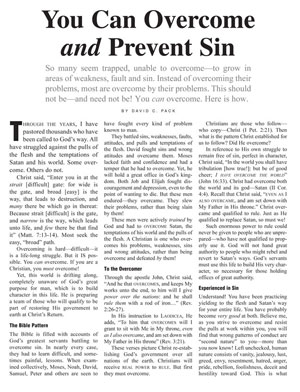
Our article “You Can Overcome and Prevent Sin” illustrates what overcoming looks like in action: “You will notice that, after being offered all the kingdoms of the world, Christ rebuked Satan [Matthew 4:10], stating, ‘Get you hence, Satan.’ This is a nice way of saying Christ told the devil to ‘get out.’ At this point, the temptation ended and the devil departed. Christ had successfully resisted!
“Be prepared to tell Satan to ‘get out’ of your life as often as you have to. Successfully resist him by submitting to God completely—in all things!
“Christ passed a very real test! He overcame the world, His flesh and the devil in overcoming sin and qualifying to pay for the sins of the world.
“Recall, when speaking of having overcome the world, Christ said, ‘Be of good cheer.’ You can overcome in the same way that Christ did.”
Both repentance and overcoming are required to qualify for rulership in God’s Kingdom.
In application, overcoming involves acting on a repentant attitude until obedience becomes second nature. You know you have overcome something when you do not have to think about it. You just do it right—there is no temptation!
It is comparable to how we breathe. Although it is an incredibly complex process to exchange oxygen and carbon dioxide for every one of the trillions of cells in your body—you generally do not think about it. Your ribcage muscles just expand and contract on their own and blood circulation takes care of the rest.
Another example is tithing. When we are first granted repentance after learning the tithing command, it hits us that we have been stealing from God Himself (Mal. 3:8). We then step out in faith to adjust our finances accordingly—we repent—though it may be difficult. After continuing to send in the portion of income that belongs to God, eventually it ceases to be a struggle. It is at this point we have overcome the sin of stealing tithes. After this we can experience the happiness that comes with pleasing God.
Repent and Overcome!
Both repentance and overcoming are required to qualify for rulership in God’s Kingdom.
Recall that Romans 12:21 says we “overcome evil with good,” and that becoming “wise unto good” (16:19) can mean to devise a plan toward that end.
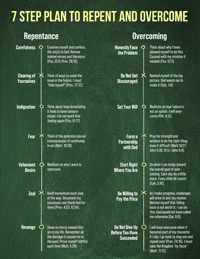
To help you develop these strategies, refer to the inset “7 Step Plan to Repent and Overcome.” It covers the seven steps toward repentance that are found in II Corinthians 7:11 and points to attitudes needed to begin changing. It also lists seven parallel steps toward overcoming from the article “You Can Overcome and Prevent Sin.” The inset includes specific actions you can take—think of the “fruits” and “works” John the Baptist and Paul spoke about.
Use these as starting points to come up with your own plan to overcome sin.
Leading up to the spring Holy Days, we go through an intensive process of examining our character. We become aware of habits we never knew were there. Driven by godly sorrow (II Cor. 7:10), we repent and develop a plan of action to change course.
But, if we are not careful, we can easily slip into failing to plan to overcome.
If we find sins still needing to be addressed, we should not shove them under the rug until next pre-Passover season in the hopes they will just disappear. Plan now to deal with them for however long we have left in this age.
We have seen that the overcoming process begins with repentance and ends with fruits that signal we have eradicated sin. It is crucial to recognize that this is not a linear process—where repentance occurs once. We must continue to ask for the gift of repentance and identify the fruits of overcoming.
Consider this. God is willing to forgive any sin that someone can repent of (Acts 17:30). But we are granted forgiveness of our sins so that we have time to overcome them. God wants us to finish what we started building at repentance (Luke 14:29-30). He expects a return on His investment!
The Reward for Overcoming
Revelation paints an awesome picture of the rewards for those who overcome their carnal nature. See them as God’s incentives to endure the difficult, lifelong process of repentance and overcoming.
God says that those who overcome will…
- “eat of the tree of life, which is in the midst of the paradise of God” (Rev. 2:7).
- “not be hurt of the second death” (vs. 11).
- “eat of the hidden manna, and…[receive] a white stone, and in the stone a new name written, which no man knows saving he that receives it” (vs. 17).
- be given “power over the nations” (vs. 26).
- “be clothed in white raiment; and I will not blot out his name out of the book of life, but I will confess his name before My Father, and before His angels” (3:5).
- “make a pillar in the temple of My God, and he shall go no more out: and I will write upon him the name of My God, and the name of the city of My God, which is new Jerusalem, which comes down out of heaven from My God: and I will write upon him My new name” (vs. 12).
- “sit with Me in My throne, even as I also overcame, and am set down with My Father in His throne” (vs. 21).
- “inherit all things; and I will be his God, and he shall be My son” (21:7).
Eternal life. Inheriting the universe. And most important, partaking in God’s perfect character and never again having to suffer the ill effects of sin. These rewards far outweigh the sacrifice required to let go of our own ways. We simply cannot afford not to overcome!
Be sure to have a post-Passover follow-up. This does not have to be a daunting task. Visualize what overcoming would look like in those areas.
If you “did it again,” it means it is time to “rise up again” (Prov. 24:16) until your character is so strong that you “cannot do it again.” Slipping means you must rethink how to move forward to overcoming. “Shake it off” (Phil. 3:13-14), find your way back into your plan and stick to it.
Proverbs 2:11 says, “Discretion shall preserve you.” Discretion here can also mean a “plan” (Strong’s) or “plot” (Outline of Biblical Usage). As the saying goes, plan your work and work your plan! Do not stop until you have reached the ultimate victory: “For whatsoever is born of God overcomes the world: and this is the victory that overcomes the world, even our faith” (I John 5:4).
With God’s help and a solid plan, turn yourself into a skilled overcomer!