Before you start reading this article, you are going to prove to yourself that everything you see is not always real…
To begin, hold the image above at eye level so that the diagram is at least 12 inches away. (If this exercise does not work for you, search “blind spot test” on the Internet to find a similar experiment.)
Cover your right eye. With your left eye, look directly at the plus sign in the middle of the teal background. Slowly move your head closer to the image, continuing to keep your focus on the plus sign.
Notice what happens to the yellow dot to the right at a certain point. It changes color.
Pull the diagram back away from your face, and then bring it close again. It goes from a distinct yellow to the same red as the dots surrounding it.
Why does this happen?
This simple test reveals a blind spot in your field of vision. A blind spot is naturally occurring in human eyes, caused by the optic nerve and blood vessels passing through a layer of the retina. Because of that tiny gap—which is the size of just a pinhead—the retina is not able to process information from the eye in that spot. But instead of blacking it out, the mind uses contextual clues to fill in what it thinks is there.
Without tests like this, no one is naturally aware that parts of their vision are blank.
“Our perception of the world depends, to a surprising degree, on intelligent guesswork by the brain,” Scientific American stated in an article about this phenomenon. “An oval-shaped white image exciting your retina could be produced by an egg, a perfectly circular, flat tilted disk, or an infinite number of intermediate shapes each angled to the right degree. Yet your brain ‘homes in’ instantly on the correct answer. It does this by using certain unconscious assumptions about the statistics of the natural world—suppositions that can be revealed by visual illusions.”
Again, the brain must rely on assumptions to fill in physical blind spots.
Similarly, the human heart or mind—which Jeremiah 17:9 reveals is “deceitful above all things”—makes assumptions about a person’s character to fill in spiritual blind spots.
Most people in society think they are good and do not see any problems in themselves. Yet they are completely unaware that they are stumbling around in jet-black spiritual darkness and practicing sin. If asked, however, they would tell you they can see perfectly—and be quick to point out some of your flaws.
This common spiritual malady also creeps into the Church. We see others’ faults before our own. We downplay fixes we need to make, and we think we can handle certain issues in the future when we “have more time.”
True spiritual vision is especially important when approaching the Passover. Notice I Corinthians: “But let a man examine himself, and so let him eat of that bread, and drink of that cup” (11:28). The original Greek word for “examine” means “to test, examine, prove, scrutinize” and “recognize as genuine after examination.”
Before we take part in the Passover, we must take a long, hard look at ourselves: “Where am I falling short in my Christian walk?” “Is my whole heart in God’s Work?” “Am I making time for quality prayer and Bible study every day?” “How much have I grown since last year?”
The only way to receive honest answers to these questions is to have clear spiritual eyesight. Like a person with blind spots, human nature can cause us to think we automatically have 20/20 spiritual vision and inadvertently take the Passover lightly.
The next verse in I Corinthians shows the danger of lax self-examination: “For he that eats and drinks unworthily [Greek: in an unworthy manner], eats and drinks damnation [judgment] to himself, not discerning the Lord’s body” (11:29).
Whether this is your first Passover or you have been baptized for decades, clear spiritual vision is vital while you scrutinize your life. A Christian must approach the task of self-analysis with utmost sincerity. If not, spiritual blind spots will block you from truly examining yourself, and can lead to taking the Passover in an unworthy manner.
Blind to the Facts
Pre-Passover examination begins with understanding the extent human nature is capable of self-deception. A person receives only a small part of God’s Spirit at baptism, meaning he or she will still have sinful tendencies.
Proverbs 30 describes people in this “natural” condition as “pure in their own eyes” and “not washed from their filthiness” (Prov. 30:12). The Hebrew word for “filthiness” means “filth” and “excrement.” Those in this condition feel as though they are doing fine, yet they are likened to people covered in excrement!
Jeremiah wrote about this spiritual syndrome of human nature: “The heart is deceitful above all things, and desperately wicked: who can know it?” (17:9).
Jesus used an analogy to show how a person can easily miss huge problems in his life: “And why behold you the mote [speck] that is in your brother’s eye, but perceive not the beam [of wood] that is in your own eye?” (Luke 6:41).
Imagine this absurd scenario: a person has a giant log jutting out of his eye. He would have to stick the beam out an open car window during his commute to work. When walking, he would likely knock people over. Think of what it would take to ride in an elevator!
Still, he focuses on a tiny speck in someone else’s eye. This perfectly describes the natural mind.
When beginning Passover examination, a person must realize that human nature can cause him to believe he is pure, without knowing that his heart is deceitful above all things. He is unable to see “beam-sized” problems in his life. The carnal mind makes a person naturally blind to his faults.
If we are to properly examine ourselves before taking the symbols of unleavened bread and wine, we must first remove the blinders and recognize our sins!
Approved vs. Unapproved
Chapter 3 of Revelation describes a terrible form of spiritual blindness: the final Church era, Laodicea, and the prevailing attitude of those with God’s Spirit at the end of the age.
This passage ties in to self-examination before Passover.
Note Christ’s reaction to these brethren: “I know your works, that you are neither cold nor hot: I would you were cold or hot. So then because you are lukewarm, and neither cold nor hot, I will spew you out of My mouth” (Rev. 3:15-16).
These people have the Holy Spirit, yet they take a lackadaisical approach to their calling.
Revelation 3 continues: “Because you say, I am rich, and increased with goods, and have need of nothing; and know not that you are wretched, and miserable, and poor, and blind, and naked” (vs. 17).
Those with a Laodicean attitude will say, “I have everything I need spiritually. My life is just fine.” Yet they are stumbling about, spiritually speaking, bumping into walls and tripping over chairs—all while naked!
In verse 18, Christ counsels these brethren to “anoint your eyes with eyesalve, that you may see.” These people, who are in danger of losing God’s Spirit altogether, must “anoint their eyes,” regain their sight, and return to the Body of Christ.
Realize this important distinction. While The Restored Church of God is a remnant of the sixth Church era, Philadelphia, every Christian today is in danger of taking on the lukewarm characteristics of Laodicea, the seventh and final era.
To maintain clear spiritual eyesight, a Christian must apply II Timothy 2:15: “Study to show yourself approved unto God, a workman that needs not to be ashamed, rightly dividing the word of truth.”
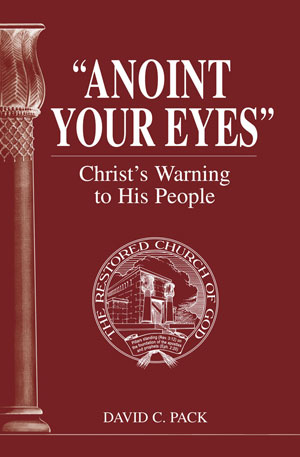
In his book “Anoint Your Eyes” – Christ’s Warning to His People, Mr. Pack outlines this verse’s importance: “This passage almost explodes with meaning. First, the Greek word for ‘approved’ is dokimos. Its meaning is fascinating, and vastly more important than most (of those few who even know of it) have realized. It is the central window into what Christ means by ‘anoint your eyes.’ Dokimos means, literally, ‘to put to the test by trial in order to produce truth and genuineness; without alloy.’”
Mr. Pack goes on to describe the connection of Bible study to pre-Passover examination: “Let’s briefly return to the Days of Unleavened Bread, this time focusing on what should always be done before Passover. I Corinthians 11 contains two statements that shed more light on precisely how to apply dokimos in our lives.
“Before Christians may take the Passover, Paul instructed, ‘But let a man examine himself…’ (vs. 28) so that he did not eat ‘unworthily.’ The Greek for ‘examine’ here is dokimazo, from the same root as dokimos. This shows that God intends the pre-Passover examination to be far more intensive than most have probably ever recognized. It also means that without this kind of examination, one is not even approved by God to take the Passover.
“This examination is that vital! Did you know this?”
How to Examine
Only through careful and regular Bible study, combined with prayer, fasting and meditation, can a person begin to see his true self.
To begin self-examination, first recognize “that the way of man is not in himself: it is not in man that walks to direct his steps” (Jer. 10:23). Then ask God to correct you through His Word “but with judgment; not in [His] anger” (vs. 24). As has been said many times, it is always better to pray for correction than have God send it Himself because you neglected proper examination!
One way to approach the process of self-examination is to use a particular part of scripture to create a list of areas you need to analyze.
Consider reading Jesus Christ’s Sermon on the Mount found in Matthew chapters 5 through 7. For example, use the “beatitudes,” or the “beautiful attitudes,” to determine where you could be falling short.
Review Matthew 5:3-11. Notice how each verse ends with an explanation of how having these attitudes will qualify a person to enter into God’s Kingdom.
Deeply contemplate the verses and their meanings. Perhaps with a concordance or Bible dictionary, read each verse carefully and look up the definitions of certain words. Consider that each of the beatitudes contains the word “blessed,” meaning “supremely blessed” or “well off.” In effect, Christ stated that those who possess the qualities mentioned after the word “blessed” are extremely well off. Therefore, we should actively strive to obtain such characteristics.
The first few verses of Matthew 5 state: “Blessed are the poor in spirit: for theirs is the kingdom of heaven. Blessed are they that mourn: for they shall be comforted. Blessed are the meek: for they shall inherit the earth.”
Based on the original Greek, “poor in spirit” describes a person who has humbled himself and is receptive to God’s teaching. He humbly looks to God for answers to guide his life.
Coming off these verses, ask yourself: Am I trying to fit in with the world through the way I am living? Do I feel pride about what I have during this life? Do I mourn with those who are mourning by sending cards or reaching out to them in their time of need?
The last few verses of the beatitudes also offer points for self-examination: “Blessed are they which do hunger and thirst after righteousness: for they shall be filled. Blessed are the merciful: for they shall obtain mercy. Blessed are the pure in heart [those with a clean mind]: for they shall see God. Blessed are the peacemakers: for they shall be called the children of God. Blessed are they which are persecuted for righteousness’ sake: for theirs is the kingdom of heaven. Blessed are you, when men shall revile you, and persecute you, and shall say all manner of evil against you falsely, for My sake” (Matt. 5:6-11).
Ask: Am I growing in mercy and learning to be peaceful, one of the fruits of the Spirit of God (Gal. 5:22)? Do I have a “clean mind” and always strive to think on things that are true, honest, just, pure, lovely and “of good report” (Phil. 4:8)?
If you answered yes to any of these questions, ask yourself how you are growing in each. Make a list of things you have begun to overcome and areas in which you need to improve.
Another passage to use for self-examination is the list of sinful attitudes in II Timothy 3, which can unwittingly enter our lives.
Read the words, “lovers of their own selves, covetous, boasters, proud, blasphemers, disobedient to parents, unthankful, unholy…” (vs. 2). Ask yourself: Which of these am I blind to? How could I knowingly and unknowingly show these attitudes at work, school or home? What do I need to do to defeat them? Answer each question honestly and truthfully.
Continue through verse 5, focusing on each characteristic and how it applies to your life. Although you may not want to see your faults, strive to have a teachable, meek attitude and yearn to learn more of God’s mind.
These are only two examples of passages that could be used for self-examination, but there are many others. Take time to find scriptures that apply to your life and add them to your list. Reviewing literature such as “Anoint Your Eyes” or listening to Mr. Pack’s sermon series “How to Examine Yourself” will also assist with this process.
Most important, while examining, remember that your goal is to become “perfect, even as your Father which is in heaven is perfect” (Matt. 5:48). The Greek word for perfect is teleios, which means “complete (in various applications of labor, growth, mental and moral character…)” This high goal—of being perfect as the Father and Christ in all areas of our lives—is one we should approach with utmost desire.
Take It Seriously!
The Days of Unleavened Bread is one of the busiest times of the year. While striving to obey God’s Law by throwing out leavening agents and scavenging for breadcrumbs in your refrigerator, kitchen cabinets and car (Ex. 12:19), it is possible to lose sight of the crucial meaning of this exercise.
Instead of overly focusing on physical cleaning and deleavening, you must put most of your effort into thoroughly examining the spiritual dark corners and hard-to-reach places of your life.
Throughout the busyness, realize that only through prayerful examination and effective use of God’s lamp—the Bible—can we properly shed light on where we need to change (Psa. 119:105). Also notice John 3:20-21.
As these days approach, ask God to remove any blind spots, allow the Bible to illuminate the dark places in your life, and let the importance of I Corinthians 11:28 weigh on your mind: “But let a man examine himself”—test, scrutinize, prove!—“and so let him eat of that bread, and drink of that cup.”