There are a number of attributes people associate with success—perseverance, patience and determination. Drive, willpower and passion. Creativity, social skills and sheer hard work.
Certainly, all of these characteristics are crucial to achieving goals. But one trait many fail to zero in on is the ability to focus.
Consider an example from the world of business. Bill Gates, co-founder of Microsoft, explained: “My success, part of it certainly, is that I have focused in on a few things.”
Because Mr. Gates focused on a few things instead of scattering his attention, he is able to enjoy unprecedented success—for one being among the richest people alive.
The concept of leading a simple life with just a few deep areas of focus is something that many other leaders, thinkers, philosophers and entrepreneurs have found is a crucial secret for achievement.
Yet this not just a secular principle. It is something that we can apply as those who are seeking ultimate success—receiving eternal life and entering the God Family. How can we ensure we make it to this goal?
Compared to those who are successful in this world, we actually have it even simpler! Christ revealed that we should only focus on one point. He summed this up concisely in Matthew 6:33: “Seek you first the kingdom of God, and His righteousness; and all these things shall be added unto you.”
Homing in our lives, thoughts and actions on God’s Kingdom will ensure success in our spiritual goal.
Jesus expounded on this in the same chapter: “The light of the body is the eye: if therefore your eye be single, your whole body shall be full of light. But if your eye be evil, your whole body shall be full of darkness. If therefore the light that is in you be darkness, how great is that darkness!” (vs. 22-23).
The Greek for the term “single” means “properly, folded together, i.e. single (figuratively, clear)” according to Strong’s Exhaustive Concordance of the Bible. It can also mean “simple.”
To better understand this concept, think of how an eye works. Generally, this organ can only focus on a single point at a time. The more we try to take in a lot of visual information all at once, the less we are able to focus.
For instance, trying to drive a car while looking at a road sign out of the corner of your eye will create a blurry image. You will not be able to make an appropriate driving decision if you cannot read the sign—and you could potentially distract yourself from the road. You must look at it directly to make the image clear and recognizable, and to make adjustments to your driving as needed.
Keep it simple! Fixate your eyes on the one thing Christ said will truly benefit you: “Lay up for yourselves treasures in heaven, where neither moth nor rust does corrupt, and where thieves do not break through nor steal” (vs. 20).
Let’s explore other actionable ways to increase spiritual focus. Doing so will help you to achieve your goal of being ready for Christ’s imminent coming.
The Feast Rehearsal
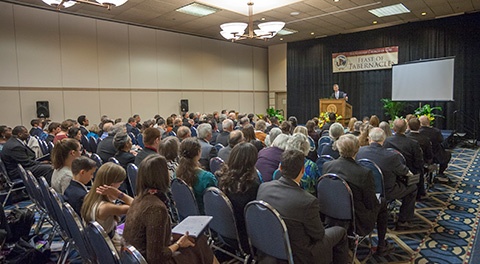
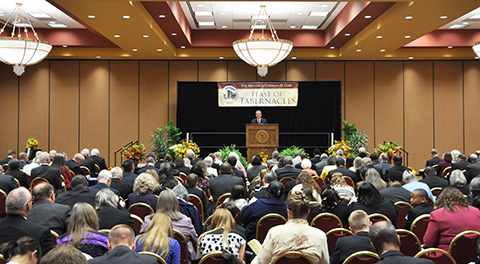
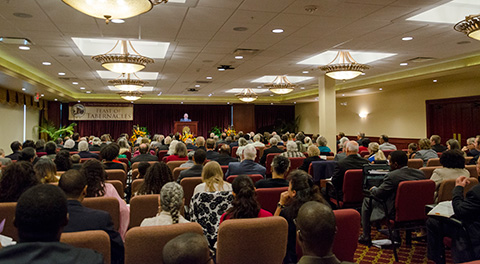
Think of the Feast of Tabernacles. During the fall festival, it is much easier to maintain spiritual focus.
Why? We traveled to a beautiful and awe-inspiring part of the world. We left behind our work and our daily lives and were able to focus on God and His people. We attended services daily—a built-in Bible study—and were encouraged to develop our relationship with the Creator. We had more than a week packed with well-planned activities and surrounded by brethren.
In such a structured environment, it is much more natural to be “on fire” and to almost constantly think about God’s soon-coming Kingdom.
Going back home, however, it becomes more difficult to maintain that momentum. We return to our routines, jobs and all the demands of our busy lives. Bills need to be paid and family responsibilities command our attention.
All of this, plus no longer having a built-in schedule encouraging spiritual growth, makes it easier to fall back into old habits. Instead of overcoming and growing, our focus can shift elsewhere.
The problem with falling into a spiritually distracted state is your momentum breaks, your energy drains, and you waste precious time. It becomes easier to be influenced by the three enemies of Christian character development: Satan, self and society. Thus, a distracted Christian can more easily fall into temptation, become discouraged, and potentially fall away altogether.
To avoid this and maintain spiritual focus, use everything you gained at the Feast! Keep up the habit of daily Bible study. Review your Feast notes. Stay in contact with brethren with whom you bonded.
This will ensure you do not lose the spiritual muscle developed during that period.
Leaders’ Examples
Also, think of the apostles as an example of singular focus on the Kingdom of God. Paul, for instance, had to keep it in mind at all times to allow him to sustain a very large workload, a grueling travel schedule to visit congregations throughout the Mediterranean region, and being responsible for writing the most books in the New Testament.
The apostle Paul was able to do this because his “eyes” were fixed on the ultimate purpose for man. He stated in Philippians 3:14: “I press toward the mark for the prize of the high calling of God in Christ Jesus.”
Other leaders of God’s Church have had similar duties requiring undistracted focus.
The Church’s 20th-century leader, Herbert W. Armstrong, had a method by which he could ensure he remained centered on God’s Kingdom. Mr. Armstrong included “Ten Daily Questions” in a co-worker bulletin dated February 14, 1941.
(See the inset in this article to read those questions.)
10 Daily Questions
- Did I awake spiritual, in a happy prayerful attitude, and was I watchful to keep my mind from wandering this morning? (Psalm 118:24, John 16:20, 22-24)
- Have I this day kept my mind clean, my thoughts and contemplations on “the things above,” in a continuous happy, positive, prayerful attitude? (Philippians 4:8, I Thessalonians 5:17, Colossians 3:2)
- Have I, as a “babe in Christ,” partaken three times today of spiritual food, by submissive Bible study and earnest prayer ALONE with God? Have I grown closer to God? Have I GROWN today in grace and knowledge? (James 4:7, Deuteronomy 8:3, II Peter 3:18)
- Have I walked by FAITH, asking God for wisdom and guidance in all things, committing every little problem to Him, trusting Him with it? (II Corinthians 5:7, Hebrews 10:38)
- Have I exercised self-discipline, denying impulse, doing what God’s Word shows I ought to do instead of what I WANTED to do? (Luke 8:15, Galatians 5:23, Proverbs 16:32)
- Was my speech and conversation today kind, cheerful, soft? (Colossians 3:8)
- Have I exercised patience today? Have I been charitable toward others, showing tolerance and love, or resentment, jealousy, anger? (Hebrews 10:24, Luke 21:19, I John 3:18)
- Have I, while putting spiritual interests FIRST, been diligent in performing regular material duties today, doing my VERY BEST? (Matthew 6:33, Colossians 3:23, Ecclesiastes 9:10)
- Have I made the most of my time, or been weakened by unwatchfulness? (Ephesians 5:14-16)
- What have I done for God’s Work and for others? Have I spent anything today to please self that might have been saved for God’s cause? (John 4:34, Matthew 6:19-21)
In a sermon addressing the 10 daily questions, Mr. David Pack stated that people tend to focus on “what’s next” in life. They think about whatever they are doing at a given moment of time, whether that is a meal, a TV program, or what clothes to wear. They do not necessarily think about how each day accumulates toward an ultimate goal.
Christ recognized this about people and admonished His followers to take “no thought [Greek: anxious] for the morrow” (Matt. 6:34).
He then encouraged them to live their lives on a daily basis, by saying, “Sufficient unto the day is the evil thereof.”
Again, a Christian’s primary focus is to seek the Kingdom of God. This means growing and examining his life on a daily basis. In II Corinthians 4:16, we learn that the “inward man is renewed day by day.”
To be spiritually focused, make a list of spiritual tasks you must accomplish daily—and check them off! Let them become so ingrained that it becomes habitual.
Also, in order to better focus on these daily spiritual tasks, we must identify and remove what is unimportant.
Declutter
We live in crucial times—close to the coming of Christ. God expects us to be ready for the huge opportunity that lies before us.
Christians with a Laodicean attitude live in a lukewarm state—distracted by the world, its traditions and ways. This leads them to be become spiritually blind. God tells such individuals to anoint their eyes with salve so that they can see clearly and focus on what is just ahead (Rev. 3:18).
The Laodicean attitude is prevalent among God’s people today. Therefore we must actively strive against it.
To do this, identify and remove anything that wastes your time, energy or focus. It might bring short-term pain to actively change your situation, but you can design an environment that is conducive to your spiritual goals.
Here are some examples of how to do this:
- Distance yourself from friends in the world who drag you into wrong attitudes or question your beliefs (I Cor. 15:33).
- Consider changing jobs if the one you have makes it difficult to take time off to keep the Sabbath and Holy Days. This can include a job that makes you so busy or the commute is so long that you are left without time or energy to study and pray.
- Remove items from your life that tend to steal your attention, such as books, movies, music, video games, too many cable channels, and so forth (Matt. 5:29-30). Ridding them from your environment can even save you some money.
- Create a personal “do not do” list. Christians can benefit from a daily “to do” list. But another way to develop focus is to decide what things you are not going to do. This can further help you stay on track.
- An example on your “do not do” list could be not staying up too late at night. Going to bed early can help you wake up early and refreshed for tasks such as Bible study, prayer or spending time with your family.
- Learn to manage all aspects of your life—finances, relationships, work, living arrangements, health, etc. Simplifying and balancing these areas will give you space and time needed to focus on your ultimate purpose. Listen to Mr. Pack’s sermon “Manage Your Life” for more advice.
Overall, ask yourself: Is this activity, thing or relationship bringing me closer to or putting me farther from my spiritual goal?
Train Your Spiritual Attention Span
The effectiveness of modern marketing and attention-grabbers like portable electronic devices make it more difficult to focus on certain things. Many have a hard time finishing what they start or staying committed to what they begin especially if it is difficult.
There is a way out of this mindset. You can work toward increasing your attention span by doing things such as engaging in physical exercise and drinking enough water. Reducing time spent watching television and avoiding mindlessly searching the internet will also help.
These are ways to increase your ability to mentally focus and they are a good start. But how do we increase our spiritual focus so that we can grow, overcome and develop God’s mind?
Contrary to what you may think, building your spiritual attention span does not require monk-like discipline. God has given us tools to build and maintain spiritual focus. Incorporating each of these tools will help.
Prayer: Starting your day with a heartfelt conversation with God sets the tone for the rest of the day. Praying often in a thankful attitude also keeps your day in a spiritual perspective. Paul exhorted believers in I Thessalonians 5: “Pray without ceasing. In everything give thanks: for this is the will of God in Christ Jesus concerning you” (vs. 16-18).
Meditation: This involves thinking deeply about an important topic or decision. In doing so, you train your mind to spend ample time thinking through a topic instead of in a shallow, distracted way.
God’s instruction to Joshua reveals a connection between regular meditation and success: “This book of the law shall not depart out of your mouth; but you shall meditate therein day and night, that you may observe to do according to all that is written therein: for then you shall make your way prosperous, and then you shall have good success” (1:8).
Study: If you are lax with regular Bible study, other things will fill up that time. Being diligent in study will help you make a routine of it. It is work, but has a great reward: “Study to show yourself approved unto God, a workman that needs not to be ashamed, rightly dividing the word of truth” (II Tim. 2:15).
Fasting: Nothing focuses your mind on God like abstaining from food and water for at least 24 hours. We understand clearly that without God and His providence, we are nothing and would wither away quickly (Psa. 39:4-5).
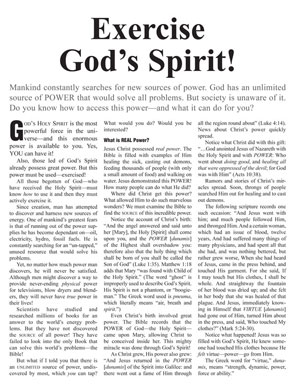
Exercising God’s Spirit: Christians have God’s power in them. It is a vital tool to use and will dramatically develop your focus as you exercise it. Ways to exercise the Holy Spirit include serving and fellowshipping with brethren and sacrificing for the Work. The other tools of Christian growth—regular prayer, Bible study, meditation and fasting—also are important in this regard. You can learn more about this by reading the article “Exercise God’s Spirit!”
What Is Most Important?
Many things compete for our attention and focus. What should matter most to us?
The book of Ecclesiastes sums this up very simply. The book starts by telling us that everything in this world is vain—empty.
“Vanity of vanities, says the Preacher, vanity of vanities; all is vanity” (1:2).
Vanity also means “transitory and unsatisfactory” according to Strong’s. This qualifies that we do need to use the things in this world. But we must understand that they will not last forever.
King Solomon lived a full life of activities and, you could say, distractions. He spent his life trying to find out what is truly lasting and important.
His conclusion reveals what our priority and focus should be: “Let us hear the conclusion of the whole matter: Fear God, and keep His commandments: for this is the whole duty of man. For God shall bring every work into judgment, with every secret thing, whether it be good, or whether it be evil” (12:13-14).
Another way to say this: Live your life aiming to please God. See everything else as temporary and remove it if necessary.
Make better decisions with how you spend your time while you still can. This will keep you on the path toward the ultimate success that God has called you for: to be part of the group who will help usher in God’s Kingdom.
Let’s put all our energy into focusing on and being ready for it!