Scientists are baffled. Why are human beings hardwired to be musical? An NPR special on the power of music reported that “music stimulates more parts of the brain than any other human function.”
Robert Zatorre, psychologist at the Montreal Neurological Institute, told The Boston Globe that music triggers the same “motivation and reward system” as food, water and other major physiological drives.
Music can relieve stress and facilitate the healing process. In some cultures it is used to ease pain. Doctors in the West use music therapy to help stroke patients recover more quickly and fully.
This innate sense of musicality befuddles scientists, but it should not perplex Christians. Genesis 1:26 shows man was created in God’s “image” and “likeness.” In doing so, the Creator designed humans to be musical, as He is.
There is evidence throughout God’s Word of how important this art form of rhythm and melody is to Him. After the creation of the Earth, all the angels “sang together” (Job 38:7). The longest book in the Bible is Psalms, which contains 150 songs written by King David and others. Also, Song of Solomon is an extended musical composition.
More lyrics are sprinkled throughout the Bible. For example, the entirety of Habakkuk 3 is a song. By one count, there are 1,150 references to musical terms in the Bible such as “play,” “sound,” “sing,” “mirth,” “trumpet,” “timbrel” and “psalm.”
A telling example of music’s significance is found in Revelation 5:8, which describes the 24 elders who sit around the Father’s throne. Each of these heavenly beings has a harp. How important is music to God? He has 24 musicians at His disposal at all times!
God wants those living His Way to enjoy the benefits of harmonious sounds as well. But the power of music can be lost today, when songs, symphonies and singing are everywhere. Musical tunes are constants in grocery stores and gridlock traffic jams, fancy restaurants and hometown coffee shops, subway platforms and hotel lobbies. People wake up to it every day on their clock radios, headphones pipe it into eardrums, and cellphone ringtones chime it.
With music so commonplace, it can be easy to forget the vital role God intended music to play in a Christian’s life. It was created to enliven, enrich, teach and comfort His people—physically and spiritually.
Music is important to God. Ask yourself: How do I view music?
Spiritual Element
One way to look at music’s impact is that it “goes through the ears and straight to the heart.” This illustrates how a song or psalm can affect us on an emotional, even spiritual, level.
But this should not be a touchy-feely, syrupy sort of “religious experience.” As with anything spiritual, there is a true version and a counterfeit. We must learn to discern what is acceptable.
The mind behind the vast majority of music today is Satan. As Lucifer, he was created with innate musical genius (Ezek. 28:13). As “prince of the power of the air” (Eph. 2:2) and a musical mastermind, he has had a hand in corrupting music, both religious and secular.
Christian music should not bring a shallow emotional “high.” Rather it should invigorate, excite, bring joy, help someone through a trial, and allow us to better understand God’s mind.
Godly music has parameters. It (1) should be edifying and enjoyable, (2) should be high quality, and (3) should be an outlet for proper emotions.
Scrutinize the music you listen to. Does it edify you and draw you closer to your Creator? This is especially important on the Sabbath. You dress in your very best on that day. Your music should be the same.
Summed up, listening to corrupt music will pull you away from God, and proper music will strengthen your bond with Him.
This is an area where you can develop godly judgment: “But strong meat belongs to them that are of full age, even those who by reason of use have their senses exercised to discern both good and evil” (Heb. 5:14).
After God’s Own Heart
King David’s example provides a “gold standard” in terms of music for those striving to live God’s Way. He was skilled at administration, war, planning, organizing religious services, and displaying correct emotions. He did make some big mistakes, but he repented big as well.
As a man after God’s own heart (Acts 13:22), David’s view on music should be instructive to Christians.
From an early age, he played the harp. He would have practiced to master the instrument. (Many professional pianists today practice eight hours a day to stay in top form.) David’s effort paid off. Word of his skill spread to the point that when King Saul was prone to foul moods after being rejected by God as ruler of Israel, his servants searched for a skilled harpist to calm him. They passed over all Saul’s court musicians to select David, a shepherd boy. His playing quickly gave Saul comfort. (Read the full account in I Samuel 16.)
Later, David had a crucial role in the music played by the Levites: “And the priests waited on their offices: the Levites also with instruments of music of the Lord, which David the king had made to praise the Lord …” (II Chron. 7:6). In addition, he organized musicians in preparation for the Temple being built (I Chron. 25). He assigned 288 men and women as singers and instrumentalists! This makes clear that music was an integral part of Temple service.
He was also a prolific songwriter, with the lyrics of many of these preserved in the Psalms. Any composer knows how long it takes to pen a song. Writing music and words requires a long process of working and reworking until it is in a polished, finished form. For example, Ludwig van Beethoven’s Fifth Symphony took four years of tinkering, experimenting and revising to complete.
King David led a busy and balanced life, making sure to keep up with prayer, study, fasting and meditating, all while ruling Israel, leading construction projects, and pursuing other educational endeavors. To round things out, music played a big part.
He passed this love on to his son Solomon: “And he spoke three thousand proverbs: and his songs were a thousand and five” (I Kgs. 4:32).
David, a man after God’s own heart, and Solomon, the wisest man who has ever lived, both had a healthy interest in music.
Harness Music’s Power!
Listening to music seems pretty straight forward: you hit play and allow the melody to flow into your ears. Maybe it makes you tap your foot or feel happy or sad. Some tunes you like, others you do not. You may play something peppy as you do household chores, sing along to the radio to reinvigorate you during a road trip, or turn on slower jazz to add ambience to a dinner party. All of these are fine and can provide a sort of soundtrack for life.
Yet gaining a deeper understanding of good music, especially if it is a genre you are not particularly familiar with, demands active listening.
Music has the power to create visuals, spark memories, and enhance feelings. To fully harness this requires a person to limit distractions by setting aside time to truly listen, concentrate and think.
A good place to start is a song with Scripture-based lyrics, which can be a powerful Bible study and meditation tool. Put to a melody, God’s Word comes to life, meaning it becomes entrenched in your memory and you can understand it on an emotional level.
George Frederic Handel’s masterwork The Messiah can be a great place to start. It contains dozens of solos and choir pieces that bring to life a host of scriptures on a variety of topics. Covering prophecy is “Rejoice Greatly, O Daughter of Zion” (Zech. 9:9), “For, Behold, Darkness Shall Cover the Earth” (Isa. 60:2-3), and “Hallelujah!” (Rev. 11:15; 19:6), among many more. Leading up to Passover, selections such as “He Was Despised” (Isa. 50:6; 53:3), “And with His Stripes We Are Healed” (53:5), and “Thy Rebuke Hath Broken His Heart” (Psa. 69:20) can help you more fully understand the suffering of Jesus Christ. These are just a handful. There are many other passages covered that can supplement your Bible study.
For those new to classical singing, know that The Messiah contains oratorio-style singing, which has some elements in common with opera. Often, many unfamiliar with this type of music will quickly decide they do not like it after listening for just a short time.
This brings up another important principle of listening to music: do not make knee-jerk reactions when declaring you do not like something. Force yourself to analyze why. Make sure you give a piece ample time before passing judgment—especially in the case of well-respected compositions that have stood the test of time. Also, if one musician’s rendition of a piece does not strike your fancy, try another. Often the reason a person does not like something is due to how it is played rather than the composition itself.
What about instrumental music? It can also paint powerful pictures and tie sounds to specific themes or images. Yet, unlike songs with lyrics, this time you have to provide the thoughts and pictures. If a piece evokes the countryside or rolling pastures, such as Beethoven’s Sixth Symphony, you can meditate on the beauty of God’s Creation or worldwide conditions during Christ’s coming millennial reign. If something sounds stately, such as Aaron Copland’s “Fanfare for the Common Man,” contemplate the royalty and formality surrounding Christ and His saints receiving power and authority on Earth.
Music can also help with the grieving process. If you have lost someone close to you, thinking of memories of that person while listening to Frederic Chopin’s Prelude in E-minor, for example, can provide a healthy emotional release.
Painting mental pictures will help make instrumental music work for you. You will connect with the pieces in a way that you never have before. Next time there is special music during Sabbath services, you now know what to do!
Another way to appreciate music is to realize the level of work that goes into crafting a musical performance. Any piece, whether a 30-second commercial jingle or a three-hour oratorio, is a work of art. A writer can labor for hours over just five seconds of music—sometimes just to rewrite or scrap it when it does not convey his ideas effectively. After the piece has been completed, professional instrumentalists and vocalists spend weeks—up to eight hours a day—rehearsing it to perfection. Keep all this in mind when listening!
Musical appreciation can be supplemented further by analyzing the basic elements of musical language. These points, adapted from an Open University lecture, include…
Tempo: the speed of the music.
Pitch: the way in which notes appear higher or lower in relation to one another.
Rhythm: the length of certain notes, from short to long.
Melody: the “tune,” created by combining rhythm and pitch.
Harmony: when different pitches are played together at the same time to form what are called chords.
Texture: the ways in which different lines of music interweave.
Timbre: the sound qualities of different voices and instruments.
Dynamics: different levels of volume, from soft to loud.
Understanding and using these terms can help you better pinpoint and explain why you enjoy certain pieces of music. Yet, if words like pitch, texture and timbre seem intimidating, realize they are not needed to appreciate a composition. The most important part of listening to music is that you enjoy it.
A final point: push yourself to expand your musical tastes. Know that not all classical music is good, and not all pop music is bad. Try listening to jazz, Latin, folk, film soundtracks, and rhythm & blues. Strive to be balanced.
Apply all these principles in your life and you can harness the awesome gift of music!
Potent Tool
Have you ever wondered how a Psalm can so perfectly fit a set of circumstances or trial you may be going through?
This goes back to the fundamentals of songwriting. When crafting the words of a musical composition, a writer must intensely study and meditate on the topic he is covering. The power of Psalms comes from divine inspiration, as well as from the labor that went into their creation.
This process increases the potency of the words. While we no longer have the melodies, the power of the lyrics written by the psalmists is still evident today.
Adding to this effectiveness is music itself. When words are set to a fitting melody, an emotional response is triggered. Most everyone has been brought to tears by a song, experienced the pure joy that can arise from the right tune, or experienced the release that can come from a somber song heard at the right time.
Music is a tool that has a vast array of uses.
Relieves stress: When a wicked king of Israel was in the desert and his army had no water, he went to Elisha to ask for God’s help. The prophet took the ruler to task.
“What have I to do with you?” Elisha retorted. “Get you to the [pagan] prophets of your father, and to the [pagan] prophets of your mother” (II Kgs. 3:13).
After some pressing, and due to the presence of a righteous king of Judah, the prophet finally conceded. But his blood was still boiling over the sinful practices of Israel, and rightfully so.
Elisha then made an interesting request: “Bring me a minstrel.”
Once a musician (most likely a harpist) was found and played some calming music, the prophet sought God’s instruction. (You can read the entire exchange in II Kings 3.)
In a stressful situation, listening to relaxing music can help clear your mind and aid in rendering a sound judgment.
Helps with the mourning process: After the death of King Saul and his son Jonathan, David composed the “Song of the Bow” and ordered it to be taught throughout Judah.
Some of what David sang included, “The beauty of Israel is slain upon your high places: how are the mighty fallen!…Saul and Jonathan were lovely and pleasant in their lives, and in their death they were not divided: they were swifter than eagles, they were stronger than lions. You daughters of Israel, weep over Saul…I am distressed for you, my brother Jonathan: very pleasant have you been unto me…How are the mighty fallen, and the weapons of war perished!” (The entire song can be found in II Samuel 1:19-27.)
Also, God recorded a lament (a “dirge,” or mournful song) about Satan’s rebellion. God was grieved that one of the three archangels rebelled.
Ezekiel 28 states, “Son of man, take up a lamentation upon the king of Tyrus [Satan], and say unto him, Thus says the Lord God; You sealed up the sum, full of wisdom, and perfect in beauty…You were the anointed cherub that covers; and I have set you so: you were upon the holy mountain of God; you have walked up and down in the midst of the stones of fire…”
“Your heart was lifted up because of your beauty, you have corrupted your wisdom by reason of your brightness: I will cast you to the ground…” (vs. 12-17).
Comforts amid terrible trials: After being beaten with “many stripes” and with their “feet fast in the stocks,” Paul and Silas were left in a dank inner prison (Acts 16:22-24).
What was their response? “And at midnight Paul and Silas prayed, and sang praises unto God: and the prisoners heard them” (vs. 25).
After prayer, singing hymns was the first thing on their minds!
Ask yourself: how often do hymns, Psalms and encouraging songs come to mind during a trying time?
Jesus Christ did this on the night He was betrayed by Judas. Just before He went to the Garden of Gethsemane to pray, He and the disciples sang hymns together. According to many historical sources, Psalms 113-118 were usually part of the Passover supper at the time. The last song Christ sang before His trial, scourging and crucifixion may have been Psalm 118.
Think of the tremendous encouragement this Psalm would have given Jesus over the next few hours: “O give thanks unto the Lord; for He is good: because His mercy endures forever…The Lord is on my side; I will not fear: what can man do unto me?…The Lord is my strength and song, and is become my salvation…The stone which the builders refused is become the head stone of the corner…This is the day which the Lord has made; we will rejoice and be glad in it…O give thanks unto the Lord; for He is good: for His mercy endures forever.”
This song would have helped Christ look forward to His ultimate goal of defeating death, allowing Him and the saints to rule the earth.
Go to the hymns and Psalms when you need the strength to make it through a hard time. For example, singing about God’s Old Testament miracles puts in perspective trials such as job troubles due to the Sabbath, financial woes, or loneliness. God parted the Red Sea to save Israel—we should not doubt that He will come to our aid in smaller matters.
These inspired songs have many other uses, such as helping you wait for an answer to a prayer (Psa. 25), when you are asking for forgiveness and repentance from a grievous sin (Psa. 51), and when you are joyful (Psa. 33).
Start Where You Are
“But I can’t sing.” “I don’t know how to play any instrument.” “I don’t have the time.” These are common excuses for those who do not include music in their lives. Yet, with music having a place in the minds of Moses, David, Solomon, Jesus, Paul—and the Father Himself—what excuses really hold up to scrutiny?
Everyone must start where they are. Some have more musical talent, others less. But everyone can improve, and in so doing enrich their lives.
All Church members sing at weekly Sabbath services. At this time we are singing praises to God. But what does the word “praise” mean?
The Hebrew term most often translated “praise” in the Psalms is halal. (This is part of the word “hallelujah.” The second half comes from Yah, meaning God. Whenever you see the phrase “praise ye the Lord” in the Psalms, it could be replaced with “hallelujah.”) Strong’s Exhaustive Concordance of the Bible defines it as “to make a show” and “to boast.”
Boasting about yourself is obviously wrong, but we can and should boast about God!
Notice Psalm 44: “In God we boast [halal] all the day long, and praise Your name forever” (vs. 8).
When singing hymns, recognize what you are doing. In most cases, you are boasting (in a positive sense) about, or giving thanks for, God’s miraculous power. In addition, you are rejoicing! This should be your mindset while singing many of the hymns. Without diligent effort, the human mind will wander to other things.
In addition, is your singing joyful? Imagine Jesus Christ walking into Sabbath services. Think of how you would react: a big smile on your face, singing with expressive emotion, and striving to hit all of the notes.
Yet God’s presence is always there! (Read Matthew 18:20.)
Another benefit: meditating on the lyrics can help you internalize the meaning of Scriptures being sung. It is a great way to memorize God’s Word and the principles of His way of life.
When singing during services, the congregation is fulfilling a command of God: “Let the word of Christ dwell in you richly in all wisdom; teaching and admonishing one another in psalms and hymns and spiritual songs, singing with grace in your hearts to the Lord” (Col. 3:16).
Even if you do not consider yourself a singer, you can improve. Here are a few points:
- Each time you take a breath, make sure it is deep and expands your abdomen more than your rib cage. Then relax your neck muscles and vocal cords and sing from your abdomen. (If you are unsure how to breathe correctly, lay flat on your back, which automatically helps one inhale and exhale more properly.)
- Make sure to stand up straight when you sing. Visualize someone pulling a string straight up from the middle of your chest.
- Sing with energy and emotion. Make sure to clearly enunciate words.
- Work to listen to those around you and blend with them, making sure your singing sounds pleasing alongside theirs.
- Listen to professional choirs and imitate their singing.
- Ask others how you sound or record your singing if you are able.
- Most important, do not be discouraged. Remember, we are not all solo singers, with some sounding more literally like a “joyful noise” (Psa. 95:1).
Some brethren may feel they are completely unmusical and do not raise their voice above a whisper. Others never sing at all. This should not be! While you should strive to improve, there is only one baseline stipulation for vocalizing during Sabbath services—be joyful!
Look at it another way. Think of the list of things that righteous men and women do: diligently pray, faithfully pay their tithes, keep all the commandments—they live God’s Word. They strive to constantly grow in these areas.
But add one more item to the list: they sing! Notice Psalm 33: “Rejoice in the Lord, O you righteous: for praise is comely for the upright” (vs. 1). Verse 3 shows the righteous should praise through song.
Also, “Praise you the Lord: for it is good to sing praises unto our God; for it is pleasant; and praise is comely” (Psa. 147:1).
Not Under a Bushel
While all Christians can and should include proper music in their lives, some have natural talent. The same rules apply here as to any God-given characteristic: “Neither do men light a candle, and put it under a bushel, but on a candlestick; and it gives light unto all that are in the house” (Matt. 5:15).
If you sing well or play an instrument, use it! As was the case for David and Solomon, it is a worthwhile investment of time. For those who may have not played an instrument for years, get it out and start practicing. The importance of the “don’t hide it under a bushel” principle is repeated for emphasis in Mark 4:21 and Luke 11:33.
Notice the next verse in Matthew 5: “Let your light so shine before men, that they may see your good works, and glorify your Father which is in heaven” (vs. 16). This is the key—we are to glorify God, not to draw attention to the self. To serve effectively in this area, ego and vanity must be swept out of the way.
One large way the Worldwide Church of God let its “light so shine” to the public was through music. By hosting prominent musicians’ performances at Ambassador Auditorium, God’s Church became a vital part of the community and allowed many people to witness God’s quality and way of life.
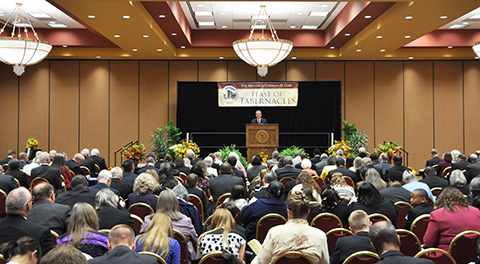
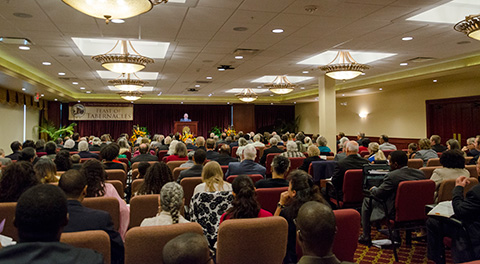
This is part of the “grand pattern” we are following today. In the coming months and years, music will become an increasingly important part of Church socials, fundraisers, the Feast of Tabernacles, and Sabbath services.
To make this a reality, everyone must do their part!
Musicians, do not feel like practicing music is a misuse of time or resources. Never let it crowd out prayer and Bible study, but do not ignore the talents given to you.
Parents, if your child displays musical aptitude, channel it toward vocals or an instrument, if possible. Piano is especially helpful, as it is the instrument that is most often heard at services, and also serves as a “stepping stone” instrument for children, often enabling them to pick up other instruments more easily.
Musical Calling
Take a step back and look at the incredible calling offered to Christians—to be kings and priests in the Family of God.
While we often ponder being “kings” who rule cities and rebuild a ruined Earth, the “priest” side of a Christian’s calling is equally important. The God Family will be in charge of both physical governing and spiritual duties.
Have you ever thought about what music in your cities will be like? How will the music sound at Sabbath services when you are ruling? What sort of concerts will you hold? How will your “auditoriums” be designed?
Further proof of the importance of music to the Christian calling is found in Revelation, and can be viewed as a musical event each of us should earnestly strive to attend: “And they sung as it were a new song before the throne…and no man could learn that song but the hundred and forty and four thousand, which were redeemed from the earth” (14:3). Those who qualify to rule in God’s kingdom will learn an exclusive “new song.”
The Bible is filled with examples of the importance of music to God. As one learning to be like Him and after having read this article, ask yourself again: How do I view music?