After staying up too late, you sleep through your alarm and rush out the door for school with no breakfast. No big deal, right? Yet by your second class of the day, you are starving, distracted and counting the minutes until the lunch bell rings.
Times like these show us that small choices about our health affect us more than we realize. Yet health is about more than feeling better or having more energy. It is part of learning to care for what God has given you.
I Corinthians 6 provides a perspective on health you may not have considered: “What? Know you not that your body is the temple of the Holy Spirit which is in you, which you have of God, and you are not your own? For you are bought with a price: therefore glorify God in your body, and in your spirit, which are God’s” (vs. 19-20).
Our bodies are not simply our own to use however we want. They were created to be a temple for God’s Spirit at baptism.
As a teen, you are preparing for that future. Learning to care for your health now is one way to show responsibility for what God has given you—and to prepare for Him to work in and through you in an even bigger way.
That responsibility shows up in everyday choices, especially in three areas: what you eat, how you move and how you rest.
What You Take in Matters
One of the clearest ways we demonstrate responsibility for our health is through our diets. We choose what we eat or do not eat.
For example, you might get home hungry, open the cupboard and grab whatever is easy. Maybe it is potato chips or cookies. In that moment, you are not trying to be irresponsible. You are just really hungry and not thinking very far ahead.
But being responsible for our health means not always doing what is easiest. We need to make wise choices. Instead of just grabbing whatever is convenient in the moment, ask: “Is this actually a good choice for me? Will this give my body the energy and nutrients I need?”
As a young man, Daniel faced a much more serious choice about what to eat. In Daniel 1, he and his friends, Shadrach, Meshach and Abednego, were taken from their home and brought into the king’s palace in Babylon where the royal food and wine were offered to them (vs. 3-6).
It would have been incredibly easy to just eat what was offered. But what did Daniel do? Notice verse 8: “But Daniel purposed in his heart that he would not defile himself with the portion of the king’s delicacies, nor with the wine which he drank; therefore he requested the chief of the eunuchs that he might not defile himself” (New King James Version).
We do not know exactly what was on the table to make up the “king’s delicacies.” But Daniel realized there was something wrong with what was being offered to him. He requested healthier alternatives in verse 12, “Please test your servants for ten days, and let them give us vegetables to eat and water to drink” (NKJV).
Daniel and his friends chose not to eat the king’s food.
While we will not face the exact situation Daniel did, this is a powerful example of a young person determined to take care of his health and follow through. He refused to just go with the flow.
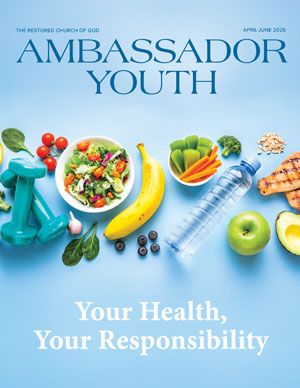
That same principle applies to the choices we make today. A healthy diet is built on foods that actually help your body: protein, fruits, vegetables, whole grains. Highly processed snacks, sugary drinks and skipped meals may be easy in the moment, but they often leave you hungry, sluggish or distracted.
“A healthy diet does not mean every snack or meal has to be perfect. But we should regularly pause to consider: ‘Is what I am about to eat or drink helping me to be responsible with what God has entrusted to me?’”
Hydration is also key: “Your body needs water to survive. Water makes up about 50% to 65% of your body weight. It’s in your cells, muscles and organs. It’s even in your bones. Water also is around your cells in blood and tissue. Cells, tissues and organs in the body need water to work as they should” (Mayo Clinic).
Focus on drinking plenty of water throughout the day. If you are thirsty, find it hard to concentrate, or have a headache, these are signs you may not be drinking enough water.
Think back to the opening example. Rushing out the door without breakfast may not seem like a big deal, but it can affect your energy and focus. Preparing something simple the night before—a hard-boiled egg, fruit, yogurt, nuts, cheese or peanut butter-filled celery sticks—can make the next day easier.
Keep those healthy choices going throughout the day. Instead of grabbing a bag of chips from the cupboard, you might take a little extra time to make something more nutritious such as a chicken wrap or a fruit smoothie. Thinking ahead takes more effort, but it pays off. You will feel full longer and have more energy—energy you can use at school, to help around the house or to participate more fully in activities.
A healthy diet does not mean every snack or meal has to be perfect. But we should regularly pause to consider: “Is what I am about to eat or drink helping me to be responsible with what God has entrusted to me?”
Getting Up and Moving
One of the biggest challenges today is how easy it is to be sedentary. Hours can disappear while scrolling through videos, watching shows or gaming. Before long, sitting for extended periods becomes normal.
Strangely, even after all that sitting, you can still end up feeling tired and drained. Why? Because our bodies were not designed to stay inactive for long periods of time. They were designed to move, exercise and be used.
An article from the American Council on Exercise states: “It is important to realize that the human body contains more than 600 muscles, which is an indication that the body was constructed for amazing physical capabilities…Further proof that the human body was designed to move, are the consequences of not moving.”
The article goes on to list some of the bad effects of inactivity:
- Loss of bone density
- Stiffening of joints
- Weakening of muscles
- Weakening of the heart and lungs
- Degeneration of the cellular energy systems.
God created our bodies to be active!
Being inactive can leave you feeling sluggish, unfocused and with little stamina. But compare that to a day when you got up and exercised. Maybe you played a sport, worked outside or went for a walk. Your body worked harder, and you felt better afterward.
The U.S. Centers for Disease Control and Prevention suggests that those ages 6-17 get 60 minutes or more of moderate to vigorous physical activity each day with most of it being activities that make the heart beat faster like walking or running.
That may sound like a lot, but it does not all have to happen at once. You can build movement into your day through simple choices: walking, biking, taking the stairs, helping with yard work, playing basketball, swimming, jogging or doing a short workout.
I Timothy 4 says, “Bodily exercise profits little: but godliness is profitable unto all things” (vs. 8). While it cannot measure up to godliness, exercise does profit you. It gives you more energy to handle busy school and work schedules, motivates you to take part in activities and helps you enjoy the great outdoors.
Exercise also builds discipline. Staying active often requires doing what you do not feel like doing: getting up when you would rather sit, putting your phone down and going outside, or sticking with a workout, practice or activity after the excitement wears off.
That kind of discipline carries over into other areas of life. Learning to stay active helps teach you not to let comfort, laziness or entertainment dominate your schedule.
The key is to find something active you can stick with. You do not have to become an athlete overnight. Start with something simple: take a walk, ride your bike, shoot some hoops, hike, stretch, do push-ups or follow a guided workout. Even short periods of movement are better than none, and they can help you build stronger habits.
Taking care of your body through exercise is one way to show responsibility for what God has given you.
Sleep: Finding the Right Balance
We all know what it feels like to say, “I’ll go to bed in five minutes,” only to realize an hour has passed and we are still up. Getting the proper amount of sleep can be challenging.
Yet sleep is not wasted time. God designed your body to need rest. Ecclesiastes 3 says, “To every thing there is a season, and a time to every purpose under the heaven” (vs. 1). That includes not just time for school, work, entertainment and friends, but also time for proper sleep.
Psalm 127:2 adds, “It is vain for you to rise up early, to sit up late, to eat the bread of sorrows: for so He [God] gives his beloved sleep.” We should not burn the candle on both ends and shortchange ourselves of sleep, which this verse says is a gift from God.
The CDC recommends that people ages 13-18 get 8 to 10 hours of sleep each day.
Why do many fall short of that? Often, it is because we do not prioritize it. Sleep becomes something we sacrifice instead of a valued area of our health. Even when life is full and productive, we still have limits. Ignoring those limits does not make us stronger. Rather, it makes us unbalanced and less effective in the long run.
Building better sleep habits starts with small, practical decisions. You know what time you need to get up in the morning for school or work, so work backward 8 to 10 hours to see what time you should be going to sleep. Then build an evening routine that helps you get there. You may want to charge your phone across the room instead of keeping it next to your bed, avoid heavy snacks or sweets before bedtime, stop screen time well before you sleep, and do something quieter—such as reading a book—to help your mind slow down.
Being active during the day can also help you sleep better at night. Your daily habits work together: what you eat, how much you move and when you rest all affect each other.
There is another extreme to avoid: sleeping too much. Summer break may give you more freedom to sleep later, but that does not mean snoozing until the afternoon should become normal. Too little sleep can leave you drained, but too much sleep can waste time and make it harder to keep a balanced routine.
Philippians 4:5 says, “Let your moderation be known unto all men.” There is a time to work, a time to be active and a time to rest. Learning that balance is part of living responsibly.
Bringing It All Together
One place where these principles come together is Ambassador Youth Camp. Preparing for camp is not just about packing your bags and showing up. It also means preparing yourself physically.
At camp, you quickly see how food, exercise and sleep work together. Eating well gives you energy. Staying active helps build stamina. Getting proper rest helps you stay focused, patient and ready to participate.
AYC is right around the corner. As you prepare, challenge yourself to make one intentional change in each area. Choose one better food habit, one way to get more exercise and one way to get better sleep.
Small health choices may not seem like a big deal, but they are one way to practice responsibility. If we learn to handle small matters faithfully now, we are preparing to handle greater responsibilities later.
Do not get discouraged if you struggle. Nobody gets everything right. The point is not perfection—it is learning to keep making better choices.
Remember, your body is made to be a temple of God’s Spirit. The habits you build today are laying a foundation for God to work with you as you grow. Each choice is an opportunity to show responsibility and glorify God with what He has given you.