Have you ever felt like you were doing the right thing—but no one seemed to notice?
Maybe you resisted joining a conversation in a school hallway that drifted into gossip. Or you gave your full effort in a group project while others seemed to tune out. Maybe you quietly obeyed your parents when it would have been easier to argue or complain.
You did what you knew was right—but it did not draw attention or recognition.
At times, living God’s Way is like that. You may be striving to obey God at school, at Sabbath services and at home, yet feel overlooked. Others may seem more outgoing, more visible or more impressive, while your faithfulness is quiet and out of sight.
The Bible shows that God often works through people like you. Many of the individuals whose stories are recorded in Scripture were not kings, prophets or apostles. They were ordinary people who did the right thing in ways that seemed small at the time.

Obadiah hides 100 prophets from Jezebel’s wrath (I Kgs. 18:4).
Yet God made sure their accounts were preserved. The apostle Paul wrote, “Now all these things happened unto them for ensamples: and they are written for our admonition” (I Cor. 10:11).
You can see yourself in these unsung heroes, and learn from them.
God included lesser-known characters in Scripture to show what living His Way looks like in everyday life—not just in dramatic moments, but in ordinary decisions. Their stories make one thing clear: Faithfulness does not have to be noticed by people to matter to God.
Heroes Who Showed Courage
Character is often tested when emotions run high. In the Old Testament, a woman named Abigail faced a situation like that when her husband Nabal—whose name literally means “fool”—insulted David. The future king reacted in anger and was ready to take revenge (I Sam. 25:13).
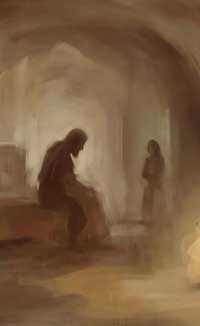
An Israelite servant girl works in Naaman’s house (II Kgs. 5:1-2).
Abigail had not caused the conflict, yet she acted decisively and went out to meet David.
She approached David with humility, saying, “Upon me, my lord, upon me let this iniquity be” (vs. 24). Abigail appealed to David’s conscience and future, warning him not to shed blood unnecessarily, and reminding him that God would establish his house (vs. 28-31).
David recognized that God had intervened through this ordinary woman. He said: “Blessed be your advice, and blessed be you” (vs. 33). Her calm, thoughtful words stopped David in his tracks.
Abigail’s courage saved the life of her husband and kept David from doing something that could have disqualified him from God’s Plan.
You too may face situations where emotions rise quickly. Maybe you are in a group chat with friends and they start arguing.
Like Abigail, you can respond thoughtfully and de-escalate. Anyone can apply Proverbs 15:1: “A soft answer turns away wrath.” Finding common ground, or helping to change the subject, could be what is needed to keep your friendships intact.
Another example comes from the Hebrew midwives of Exodus 1. Pharaoh had commanded them to kill Hebrew baby boys at birth. Yet instead of obeying that command, “the midwives feared God, and did not as the king of Egypt commanded them, but saved the men children alive” (vs. 17).
They chose obedience to God over fear of punishment. The impact of their courage became clear only after a long time.
Because Hebrew children were spared, a baby named Moses survived and later led Israel out of slavery (2:1-10). We do not even know the midwives’ names, but what they did made a difference.
Today, we do not face life and death decisions driven by a king’s command. But maybe a popular classmate pressures us to post something on social media we know is inappropriate, or a teacher strongly hints that if we do not participate in a school event on the Sabbath, we could be in trouble.
Do we do the right thing?
Every time you resist pressure to do wrong, you show courage. The midwives’ story shows these decisions matter.
The prophet Obadiah provides another example of courage under pressure. He served in the household of King Ahab. When Jezebel, Ahab’s evil wife, sought to kill the prophets of God, he acted: “Obadiah took a hundred prophets, and hid them by fifty in a cave, and fed them with bread and water” (I Kgs. 18:4).
If discovered, Obadiah could have lost his position and his life. Yet he did not shy away from doing what God wanted. This required time, effort and planning. Imagine how hard it would be to feed a cave of 50 people without the queen or one of her servants finding out.
Not every act of courage is a decision in the heat of the moment. Sometimes we show our courage through small actions.
Think of explaining—again—to your boss that you need time off for the Feast of Tabernacles after you already explained it the past two years you have worked there. The irritated look on their face and hearing the guilt trip of how shorthanded they will be while you are away are not things to look forward to. But you continue to keep the Feast and manage your commitments because that is the right thing to do.
This principle applies to many things in life. Declining an invite to a party from the same person for a third time. Making time for prayer and study when you could be doing something else. These acts all add up.
Courage often means choosing to live the right way under pressure, even when obedience is uncomfortable, risky or misunderstood. Our character is revealed by the choices we make when situations push us in the opposite direction.
Heroes Who Influenced Others
The Old Testament story of Naaman is a great example of how to influence others. Yet Naaman, a respected commander in the Syrian army, was not the one doing the influencing.
There was a young Israelite servant girl in his household—a captive, far from home (II Kgs. 5:1-2). The girl noticed that Naaman suffered from leprosy and wanted to help him.
She told Naaman’s wife: “I wish my master would go to see the prophet in Samaria. He would heal him of his leprosy” (vs. 3, New Living Translation). She knew that God offered healing, and she spoke up. She also wisely observed that giving this information to Naaman’s wife was the best way to get him to take it seriously.
Naaman acted on her words. He traveled to Samaria, met Elisha and followed God’s instructions: “Then went he down, and dipped himself seven times in Jordan, according to the saying of the man of God: and his flesh came again like unto the flesh of a little child” (vs. 14).
The servant girl is not mentioned after this point in the story. Yet if she did not speak up, Naaman would not have been healed. She did not want recognition. She simply wanted the best for others, and God worked through her.
Being an unsung hero is not just choosing obedience over disobedience. It also involves being a good example.
You may not know everything or have every answer, but you can still encourage others to do the right thing, just as this servant girl did.
We do not influence by preaching to others or loudly telling them they are wrong. Instead, we do this through gentle positive actions. Showing genuine concern, remembering to say thank you and encouraging people to do things that are good for them are all ways to follow this example.
One of Jesus Christ’s apostles further shows us how to do this. Andrew, the brother of Simon Peter, was among the first disciples called. When he became convinced that Jesus was the Messiah, “He first finds his own brother Simon, and says unto him, We have found the Messiah” (John 1:41).
Andrew then brought Peter to Jesus and stepped back, allowing Christ to work with him directly (vs. 42).
If Andrew had not provided this encouragement, perhaps Peter would still have taken notice of Jesus on his own. We do not know. But it was Andrew who pointed Peter in the right direction.
This was the first small step in Peter’s journey to becoming the lead apostle over the New Testament Church. It all started with a gentle nudge from his brother.
Later, when a large crowd needed food, Andrew noticed something small but important. He told Christ: “There is a lad here, which has five barley loaves, and two small fishes” (6:9). Being observant and speaking up led to Jesus performing a powerful miracle. The story of Jesus feeding the five thousand is well-known, but many overlook that it was Andrew who pointed out what the boy had.
Andrew’s example shows that influence can come from noticing what others do not see and being willing to act.
Maybe you have a classmate who is pursuing something they are passionate about but lacks confidence. A well-timed nudge of encouragement could make the difference between them shying away from using their gift and signing up to sing a solo in the next school talent show.
Unsung heroes do not seek the spotlight. Our impact on others comes through timely words, good conduct and obedience.
Heroes Who Persevered
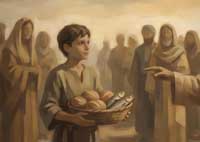
Andrew points out a young boy with loaves and fishes (John 6:8-9).
An unsung hero is not a hero part-time. It requires sticking with it. We need to develop perseverance. There are other people in the Bible who give us examples to follow.
Baruch was the scribe of the prophet Jeremiah. God commanded Jeremiah to record His words in a scroll, and that task naturally fell to his scribe. Baruch faithfully wrote them down and read them publicly, even though the message was unpopular (Jer. 36:4-8). The scroll was eventually brought to King Jehoiakim.
The king was angry when he heard God’s message. As the words were read, Jehoiakim cut the scroll apart and threw it into the fire until it was completely destroyed (vs. 23). Imagine the horror Baruch felt. Many hours of careful handwritten work were reduced to ashes. Baruch had every reason to feel discouraged.
God instructed Jeremiah to take another scroll and write the words again—and Baruch did exactly that (vs. 28, 32). Scripture records no complaint or hesitation. Baruch simply continued doing what God had asked him to do.
Sometimes doing the right thing feels repetitive or unnoticed—getting ready for Sabbath services week after week or saving second tithe year after year. Or maybe you are working to change something in your life—avoiding procrastination, being kinder to your parents, or being more careful with your media choices—and then you mess up. When that happens, it can feel just as frustrating as Baruch watching the scroll burn.
Baruch’s example shows that we must persevere, even when earlier effort seems undone.
Jesus Christ highlighted that same kind of perseverance in a quiet moment at the Temple. He observed from afar a poor widow who gave two small coins—an amount so small it went unnoticed by everyone else (Mark 12:42). Yet Jesus noticed.
Calling His disciples to Him, Christ explained that the widow had given more than all the others because she gave “even all her living” (vs. 44).
Giving an offering was not a one-time act in those times, just as it is not today. We give offerings throughout the year on God’s annual Holy Days. What this elderly woman gave here would have been in addition to her other offerings throughout the year. Jesus would not have highlighted her example if she came before God empty.
She persevered with honoring God with her finances, and sacrificed more than those who were much wealthier. What she gave reflected trust in God.
You may sometimes feel that what you contribute is small. Maybe you take the time to send a direct message to someone you met at camp who lives in another continent. You share your life with them, and you let them know they are cared about through your questions and concern. If you do not hear from them for a while, you check back in to let them know you are thinking about them.
That may seem small. But the story of the widow’s mites shows that God values heartfelt commitment more than flashy displays.
A woman named Dorcas, also known as Tabitha, further illustrates how perseverance can be expressed through consistent service to others. She lived in the city of Joppa and was known for helping those in need. Scripture describes her as “full of good works and almsdeeds which she did” (Acts 9:36).
When Dorcas died, those she had helped assembled, showing the coats and garments she had made for them (vs. 39). Her service had touched many people over time.
Dorcas did not seek attention, but her steady care for others left a lasting mark on her community.
You may serve in similar ways—sending a card to a shut-in, watching young children at Sabbath services to give their parents a break, helping an elderly member, or quietly assisting in other areas. Those actions may feel ordinary, but they matter.
God values perseverance in well doing. Your effort is not wasted.
Be an Unsung Hero Today
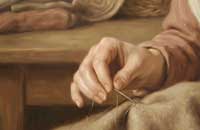
Dorcas serves others by making coats and garments (Acts 9:39).
The stories of these and other unsung heroes of the Bible show that God does not measure faithfulness the way people do. What He looks for is quiet effort, steady obedience and humble service.
Hebrews 6:10 shows this plainly: “God is not unrighteous to forget your work and labor of love, which you have showed toward His name.” Even when no one else notices, God does.
Scripture also shows that, one day, God will give us the recognition we did not get in this life.
The apostle Peter wrote, “Humble yourselves therefore under the mighty hand of God, that He may exalt you in due time” (I Pet. 5:6). Galatians 6:9 adds, “Let us not be weary in well doing: for in due season we shall reap, if we faint not.”
Courage is choosing to do what is right when pressure pushes you the other way. Influence comes from setting the right example, even without attention. Perseverance means continuing in well doing even when it feels routine or unnoticed. God values all three, not as isolated traits, but as a way of life. If we live them, God will exalt us.
Take time to study the lives of each of these characters we have examined. There are additional inspiring details to their lives beyond what could fit in this article. Have fun learning more on your own.
When the Kingdom of God is here, the unsung heroes of today will be told: “Well, you good servant: because you have been faithful in a very little, have you authority over ten cities” (Luke 19:17). Being “faithful in a very little” means a lot to God.
God sees what others miss, and He remembers what others forget. We do receive blessings now, but the greatest reward lies ahead.
As you continue to live God’s Way at school, camp, work and home, consider how you can serve God faithfully right where you are. Through courageous choices, quiet influence and steady perseverance, be an unsung hero.
The Kingdom of God will be filled with people overlooked by the world—but never by God.
Meet More Unsung Heroes
Scripture includes stories of many other men and women whose actions mattered deeply to God and whose brief accounts are rewarding to study. Each of these accounts reinforces the same lesson: God notices our good works, even when people do not.
Aquila and Priscilla—Helped Apollos understand God’s truth more accurately without correcting him publicly or seeking recognition (Acts 18:24-26).
Hilkiah the priest—Discovered and preserved the Book of the Law during the reign of King Josiah, helping restore obedience to God in Judah (II Kgs. 22:8-13).
Shaphan the scribe—Faithfully read God’s Law to the king, enabling national repentance (II Kgs. 22:10).
The boy with the loaves and fishes—Offered what little he had, which God multiplied to feed thousands (John 6:8-13).
The faithful remnant in Elijah’s day—Seven thousand who refused to bow to Baal, though they are never individually named (I Kgs. 19:18).
The unnamed woman who anointed Christ—Quietly honored Jesus in a moment He said would be remembered wherever the gospel is preached (Matt. 26:6-13).
Ebedmelech the Ethiopian—Courageously intervened to save Jeremiah’s life and was later protected by God (Jer. 38:7-13; 39:15-18).
Jonathan’s armor bearer—Followed faithfully and courageously without recognition during a decisive moment (I Sam. 14:6-7).
The sons of Jonadab—Obeyed their father’s instruction over generations and were praised by God for their faithfulness (Jer. 35:1-19).
The faithful women at Christ’s crucifixion—Remained near Jesus when most of His disciples fled (Matt. 27:55-56).