
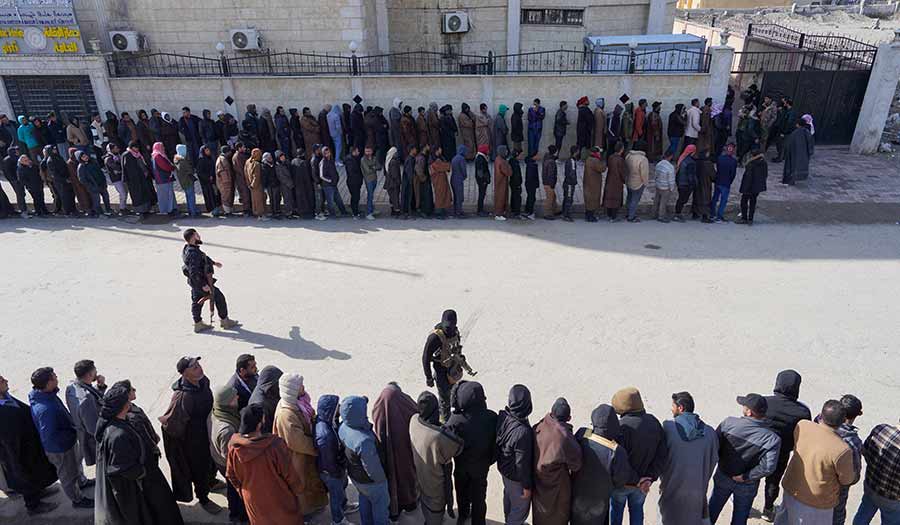
 REUTERS/Karam al-Masri
Article
Learn the why behind the headlines.
Subscribe to the Real Truth for FREE news and analysis.
Subscribe NowThe Syrian government and Kurdish forces declared a ceasefire deal on January 30 that sets out a phased integration of Kurdish fighters into the state, averting a potentially bloody battle and drawing U.S. praise for a “historic milestone.”
The sides announced the agreement after government forces under President Ahmed al-Sharaa captured swathes of northern and eastern Syria from the Kurdish-led Syrian Democratic Forces (SDF) group, forcing the Kurdish forces to retreat into a shrinking enclave in the northeast.
The fate of the SDF, which once held a quarter or more of Syria, had been one of the biggest issues looming over the country since Islamist fighters led by Sharaa toppled President Bashar al-Assad over 14 months ago.
U.S. envoy Tom Barrack, who has been closely involved in mediation efforts, declared the agreement “a profound and historic milestone in Syria’s journey toward national reconciliation, unity, and enduring stability.”
The SDF was once Washington’s main Syrian ally, playing a vital part in the fight against Islamic State. But its position grew weaker as President Donald Trump built close ties with Mr. Sharaa, a former al Qaeda commander who has now brought almost all of Syria back under the authority of Damascus.
What Triggered the Syrian Army Advances?
Tensions had been simmering between the government and the Kurdish-led Syrian Democratic Forces for months.
Damascus had demanded the SDF merge fully into the security forces and that governing bodies in the Kurdish-run regions also be integrated.
The Kurdish-led forces resisted, aiming to preserve their regional autonomy and expressing concerns that the Islamist-led administration in Damascus seeks to dominate Syria.
The Syrian government forces advanced in the provinces of Raqqa, Deir al-Zor and parts of Hasakah province.
The territories include Syria’s biggest oil fields, a major hydroelectric dam, agricultural regions, jails holding Islamic State militants, and a camp where Islamic State-linked civilians are held.
The SDF had captured much of the territory from Islamic State when it was the primary U.S. partner fighting the jihadists in Syria. The captured areas are majority Arab.
U.S. Envoy Praises ‘Courageous Steps’
Under the agreement, forces that had amassed on front lines in the north would pull back and Interior Ministry security forces will deploy to the center of the cities of Hasakah and Qamishli in the northeast, both held by the SDF.
The agreement includes the formation of a military division that will include three SDF brigades, in addition to a brigade for forces in the SDF-held town of Kobani, also known as Ain al-Arab, which will be affiliated to the governorate of Aleppo.
Governing bodies set up by the Kurdish-led groups in the northeast are to be merged with state institutions.
Damascus and the SDF first struck an integration deal last March, but made scant progress towards implementation before a year-end deadline, paving the way for government forces to go on the march.
Mr. Barrack, in his statement on X, said: “Both sides have taken courageous steps: the Syrian government in extending meaningful inclusion and rights, and the Kurdish communities in embracing a unified framework that honors their contributions while advancing the common good.”
Kurds have been on high alert for a potential government push into their remaining enclave, mindful of last year’s violence against minority Alawites and Druze.
Noah Bonsey, senior adviser with the International Crisis Group think-tank, said the deal was “a potentially historic turning point.”
“It looks like both sides have succeeded in defining a middle ground that works for both of them on some incredibly difficult questions,” he said.
“It spares northeast Syria what could have been a really ugly military showdown. Implementation will be tricky. There are a lot of challenges ahead,” he said, adding that he was waiting to see all the terms.
Turkey said it was closely reviewing the agreement. Foreign Minister Hakan Fidan said “genuine integration is in Syria’s interest, and the parties are already aware of its conditions.”
Turkey has sent forces into Syria several times since 2016, deeming the SDF an extension of the Kurdistan Workers Party, which took up arms against the Turkish state in 1984 but has been in a peace process with Ankara since early 2025.
Unifying Syrian Territory
Syrian Kurdish politician Elham Ahmad thanked the United States and France for their mediation efforts. “We hope they will play the guarantor role in the integration process,” she wrote on X.
An SDF statement said the deal “aims to unify Syrian territory and achieve full integration in the region by strengthening cooperation between the concerned parties and unifying efforts to rebuild the country.”
Syrian state-run broadcaster al-Ikhbariya published an almost identical statement, citing a government official.
A senior Syrian government official told Reuters the deal was final and had been reached late on the night of January 29, and that implementation was to begin immediately.
The statements did not address control of the last remaining SDF-controlled border crossing to northern Iraq, known as Semalka. The Syrian official said the Syrian state would take over all border crossings.
The Syrian official said the military division in the northeast would include “groups from the SDF within brigades, alongside other brigades.”
The official said that fighters would join such brigades as “individuals” and that the whole division would be under the authority of Syria’s Defense Ministry.
This article contains information from Reuters.
- Real Truth Magazine Articles
- POLITICS
 Missing: True Leadership
Amid deepening problems—domestic and global—nations require strong leaders. Where can they be found?
More on Related Topics:
- India’s ‘Cockroach’ Movement Ends Protests After Education Minister Resigns
- India’s Youth-led Cockroach Movement Vows to Keep Demanding Reforms After Police Crackdown
- Japan Scraps a Ban on Lethal Weapons Exports in a Change of Its Postwar Pacifist Policy
- Food Assistance Slashed for Hundreds of Thousands of Rohingya Refugees Trapped in Bangladesh Camps
- In Cambodia, Thousands Flood Out of Scam Compounds and Find Little Help
Suggested Reading
More on Related Topics
Latest News
-
September 15, 2026
- U.S. Acknowledges for the First Time that It Has Deployed Weapons in Space
- Some Russians Are Fleeing Abroad, Citing Draft Fears and a Loss of Freedom September 11, 2026
- Americans Mark 25 Years Since September 11 Attacks amid Enduring Grief, Reflection
- Yemen’s Iranian-Backed Houthis Seize an Island in a Key Strait, Opening a New Front in the Iran War September 10, 2026
- The Push to Remove Lead Pipes Is On. Thousands of Water Systems Still Don’t Know Where Theirs Are September 9, 2026
- Family Interest in Education Falls as Test Scores Drop
- The Poorest in the U.S. Can’t Find Housing Even as Low-Income Units Sit Empty September 1, 2026
- In U.S. West, Drought Pits Farms Against Industry
- Why Christians Must Watch the News
- Teach Your Children to Be Active
- What Comes After America 250? August 31, 2026
- How Brexit Broke British Politics
- How to Keep the Sabbath
- Aliens and the Bible?
- Building Character in a Crooked World August 28, 2026
- U.S. Declares Drought Disaster for Parts of Puerto Rico as Dry Conditions Persist August 27, 2026
- UN and Red Cross Step Up Call for International Rules on ‘Killer Robot’ Weapons Systems August 26, 2026
- Explainer: What Are Iran’s Options to Escalate Further in Face of U.S. Economic Threats?
- U.S. Removes Syria from Terrorism Sponsor List August 24, 2026
- A Trade War Between Canada and the U.S. Further Ruptures a Once-Close and Durable Alliance