When the pandemic shut schools two years ago, Scott Losavio faced a problem afflicting students, administrators and communities everywhere: What happens when all the student volunteers disappear?
As service coordinator at a high school in Baton Rouge, Louisiana, Mr. Losavio helps students fulfill the school’s requirement to perform community service hours. Juniors must do 40 “Type A” volunteer hours, where they have direct contact with the people being served, and seniors must do 20.
All of that became nearly impossible when the coronavirus pandemic sent students home in the midst of the 2019-2020 school year and kept them home for the following year as communities shut down and people were told to avoid direct contact.
Now with the pandemic fading, school administrators are anticipating returning to the pre-COVID-19 days of unhindered volunteerism. Across the U.S., the pandemic forced school administrators like Mr. Losavio to slash or eliminate student volunteer requirements. Students either abandoned volunteering or strained to find safe ways to serve their communities in a time of isolation and crisis.
The pullback hurt broadly. For communities, thousands of dependable volunteer hours vanished at a moment of spiraling need. And the students lost out on the kind of empathy-building experiences that such requirements were designed to create.
“There’s thousands of hours of work that’s not getting done and the community is not being served,” said Adam Weiss, community service coordinator for Oceana High School in Pacifica, California. For students, volunteering “gives them work experience and gives back to the community and helps them get out of their teenage bubble.”
Not every school chose to reduce its community service requirements in the pandemic. At Lick-Wilmerding High School in San Francisco, administrators retained the school’s 40-hour requirement for 10th graders. But keeping the requirement in place in a mostly shuttered country meant getting creative.
“Suddenly we had to accommodate and adapt to students who couldn’t leave their homes,” Alan Wesson Suarez, the school’s public purpose program director, said.
In some cases, the students themselves came up with new forms of public service. One started transcribing old historical documents for the Smithsonian Institution and soon several other students had joined in.
“I had never seen a student do that before,” Mr. Suarez said.
This report contains information from The Associated Press.
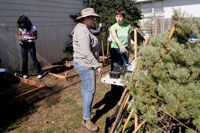
A high school senior and junior talk as students work during a garden maintenance session at a high school in San Francisco (March 9, 2022).
Source: AP/Jeff Chiu