I have a confession to make: It’s been a really long time since I have read a book for fun.
This was not always the case. I remember fondly the times when I got lost in the pages of a good read. In any spare moment, I would crack the book open and turn page after page. Everything else faded away as I inhabited the world created by the words on the page.
That all seemed to change over the last few years. It happened slowly, imperceptibly. It was not until I was assigned this article that I gave it serious thought.
Do not misunderstand—I read all the time. I read news every day. Magazine articles weekly. And skim helpful content from the internet often. But reading books for pleasure has fallen by the wayside.
Maybe you feel similarly. You used to tear through a favorite series of novels, but now it is hard to get interested in any book. What happened?
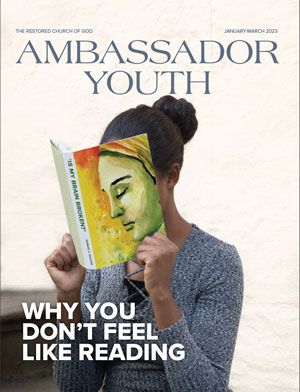
Are our brains broken?
If you are like me, you want to read. You may make a valiant effort from time to time only to fail to get past the first few pages.
To test this, I determined to read an entire book while researching and writing this article.
During my experiment, I would take notes of how I felt while I read. I picked up a novel that I had purchased two years ago. I got my pen and notepad ready. All I had to do was open the book and start.
But that is not what happened.
Before I knew it, I had watched a 22-minute YouTube video titled “Why You Stopped Reading.” It gave me comfort in knowing I am not alone in this struggle.
Once I got through the video and reviewed a few sources it mentioned, I decided to take another crack at starting my book.
While my eyes read the first few lines—the ideas still humming in my mind from the YouTube video—I had an idea for the article’s title. I brainstormed on this for a bit using my notepad. Soon after, I entered a longer discussion with the graphic designer for this piece. It was a productive talk, but I was still not reading my book!
Finally, I cloistered myself away and cracked open the novel. I got through the first few pages! Slowly. Although it was difficult to tune out the many distractions of modern life, I started to get sucked in. I found that if I stood up and paced the room, away from my computer and phone, it was much easier to become immersed.
Over recent decades, there has been a seismic shift in how we get information. You can get a lot of education and entertainment from YouTube. Want to know how to do something? There is an article for that. There are a bazillion podcasts, Reddit groups for everything and webinars to learn any skill under the sun. What gets lost in this shuffle is reading longer books for fun. Our brains can seem to have changed forever. Will we ever again be regular readers with noses nestled in novels?
Yet my experience may be different from yours. You could feel that your brain has always seemed “broken” when it comes to reading—you see others devouring books and just do not see the point. Reading has never really grabbed you.
Some of this may be because school can make reading less enjoyable. Required reading can be a grind. (I still remember slogging through all 856 pages of An American Tragedy in Mrs. Acker’s English class. I can relate!)
Yet reading is crucial and has myriad benefits.
Think of the Bible. God decided to preserve His Word in written form. God’s servants over millennia sat down and penned all 66 books of Scripture. And there were many other texts that contained valuable information but were not canonized such as the Book of the Wars of the Lord (Num. 21:14), the Book of Jasher (Josh. 10:13) and the Book of the Acts of Solomon (I Kgs. 11:41). These were lost to time but show that the written word has always been a big part of God’s plan for mankind.
Consider that we read during every Sabbath service. You do the same every time you study your Bible. Also, magazines and literature are a primary way the Church does the Work.
Regular reading is important, and so is reading for pleasure. You will see it is a crucial tool to improve your life. So how do you regain a love of reading? And if you have never really been interested in reading, how do you start to enjoy it?
Sneaky Learning
The first step to getting into reading is to recognize all the sneaky benefits that come from regularly getting lost in a book. Sitting down with a page-turner novel or breezy nonfiction work is far from a waste of time.
Reading for fun will help you become a better communicator and develop a more effective personality. While your eyes scan the words and paragraphs of a book, you are building your vocabulary, understanding grammar better, developing your writing skills and improving your spelling.
These skills will help you in school but also when you enter the workplace—or any time you have to communicate.
See reading for pleasure as a communications class without having to think about it. Just enjoy the book while reaping the rewards.
I can attest to these benefits. A big part of my job at the Church’s Headquarters is being a writer. I know that when I am reading good writing, it improves my own writing. If I am not reading as much, I struggle to get words on the page. Reading, even when not thinking about grammatical structure or turns of phrases, makes words seem to enter my brain by osmosis. It is much easier to bring variety and panache to the articles I am working on.
Even if you are not writing much, reading will help you. It seeps into your brain to make you better.
Inspire and Enrich
Beyond improving verbal and written communication, reading will inspire you and enhance your life. The words will stick with you and provide encouragement in times of need.
Look at Hannah’s prayer in I Samuel 2. She clearly knew the Bible, as her words recorded in verses 1-10 contain allusions to Psalms 5 and 75, Exodus 15 and Deuteronomy 32. Those familiar words poured out of Hannah in a powerful prayer.
Yet Hannah’s own words also lived on. Jesus’ mom, Mary, quoted Hannah in a prayer in Luke 1:46-53.
Think about what happened here. Recorded Bible verses inspired Hannah, and her words were then preserved in written form. Then, Mary quoted Hannah many years later. The letters on a page can live on and inspire long after the person who recorded them is gone. Through the tunnel of time, one woman’s words comforted another.
Such enrichment goes well beyond the Bible. You will find inspiring tidbits sprinkled throughout the books you read for enjoyment.
I really enjoy Sherlock Holmes mysteries. Arthur Conan Doyle’s writing is filled with wit and intrigue. (I admit, though, that his writing can get a little flowery!) But my deeper enjoyment comes from the stories’ detailed descriptions of how to be more observant—and how to focus one’s mind to perfect a skill.
In A Study in Scarlet, Sherlock describes his mind as a “brain-attic” where he keeps everything needed to be the world’s greatest detective. He ejects anything that does not relate to solving mysteries to keep this proverbial crawl space clean. Sherlock summarized: “It is of the highest importance, therefore, not to have useless facts elbowing out the useful ones.”
The brain-attic idea has stuck with me for many years. It even helps me with my job.
As an editor and writer for the Church’s magazines, I need to know a little bit about everything. There is certain information I need handy to do my job—that stays. Over the years, I have learned to habitually discard irrelevant info—I do not need that cluttering my brain!
What could be seen as a silly mystery story helps me every day.
Nonfiction can be even more inspiring. One of my favorite reading experiences ever was Garlic and Sapphires: The Secret Life of a Critic in Disguise. It is the true story of a food journalist moving from Los Angeles to New York City. Before she arrived, restaurants citywide put out her picture and offered free meals to whoever pointed her out. Because of this, the author had to don different disguises to review restaurants without them giving her special treatment.
This process had the author inhabit the shoes of an elderly woman, a sassy socialite and a frumpy wallflower. The book reminded me not to make assumptions about others, and it also taught me culinary factoids such as how steaks are aged and what color high-quality wasabi should be. There is a lot in that book that will always stick with me.
But that is just me. You will find the books and concepts that connect with you. Everyone should have their own mental library of quotes and experiences from the texts they have read.
Connect with Others
Beyond enriching yourself, reading can help you better connect with others. Sharing your favorite books or quotes can teach others about you. After reading the two examples above, you now know a little more about what makes me tick. And if others read and enjoy your recommendations, it creates bonds between you and them.
Yet the connection with others can go even further. Reading popular works can unite you with many others—call it the “cultural collective.” This is why there are certain works you are required to read in high school and college. They may seem outdated at first—but they can help you understand the world in a deeper way. They can also help you relate to many different types of people.
The apostle Paul demonstrated this often. He was highly educated and was himself quite the reader. How do we know? He quoted Greek poets often and adapted their words to fit godly teachings.
One example is I Corinthians 15:33, which states, “Be not deceived: evil communications corrupt good manners.” The italicized words were taken from the playwright Meander, written hundreds of years before Paul’s time. Likely, it was a common saying in the first century—but it is an example of using the written word to better connect with whomever you are addressing.
Paul did something similar when talking with the people of Athens. In Acts 17:28, he quoted some of their own poets to make a point. Notice: “For in Him we live, and move, and have our being; as certain also of your own poets have said…” He goes on to quote an astronomical poem by Aratus. He referenced these well-known ideas to better make his point.
This was a preaching technique, but you can also apply this principle yourself. Knowing the plots and characters from famous books can help you better make a point.
This is exactly what a journalist did in a recent Telegraph article about Brexit. The topic of the United Kingdom leaving the European Union can seem dated and dull. But a literary reference spiced up the piece.
“Let’s not beat about the bush. Brexit has become the madwoman in the country’s attic. Demonized, its spirit crushed, it looms over the UK like Mr. Rochester’s wife, Bertha Mason, in Jane Eyre. Of course, Bertha—who sets fire to her husband’s bed and rips up Jane’s wedding veil—cannot be blamed for all the chaos that she causes. A rebellious force of nature, she is driven to insanity by repression and neglect. So, too, has Brexit been turned into a national psychodrama. With no plan to unleash its potential, it can only fester, stoking tensions in Northern Ireland and strangling small firms with red tape.”
Brexit is brought to life here through the shorthand of the iconic book Jane Eyre.
Learn About the World
Reading for pleasure helps us understand humanity in a way that no other medium can. In good writing, we get inside the thoughts and motivations of people. This is done over hundreds of pages. How do autistic people think? What did it feel like to survive the Holocaust? Were teenage girls different in the early 1800s? (On the last one, not really!)
Ultimately, you want to read widely. That way, you can dig into unfamiliar cultures, ancient time periods and diverse viewpoints.
Yet do not worry so much about this while getting back into reading or getting into reading for the first time. Now is the time to capitalize on your favorites.
If you gravitate to historical fiction, make that the next book you read. If action/adventure is your thing, crack one open. If you tend toward true stories, find a memoir of a person you admire.
The bottom line: Search for a book that is an easy win. You do not want your first novel or memoir back to be a dense tome with thousands of pages.
Science fiction is my go-to. That is the type of book I picked up while researching this article.
My appreciation for this genre started in an English class in high school. I distinctly remember reading a short story that showed how time slows when flying near a black hole. How would it feel to have only a few weeks pass for you while everyone you know had decades pass?
Geeking out about astrophysics was fun, but there was another reason I was drawn to science fiction. It creates an interesting scenario and puts human beings into it. In other words, it puts human nature into a situation and plays out how it would react.
This is perhaps the greatest reason to read for pleasure. You can learn so much about what makes people tick. This goes far beyond sci-fi. Every genre can provide a window into the world—both the good and the bad.
This is a double-edged sword. Through reading, you can understand where people are coming from, but you must be careful to avoid being drawn into wrong thinking. This is why it is essential to choose what you are reading carefully.
King David’s words will guide you in this regard. Psalm 101:3 states, “I will set no wicked thing before mine eyes.” When picking a book to reinvigorate your reading, be careful of foul language, fornication and any time sinful acts are painted in a good light.
Sometimes you must make tough decisions. You may personally be drawn to a book or series, but it is not good for you to read. Thankfully, so many books are available that it is not hard to fill that void.
Put It in Perspective
At this point, you are probably starting to piece a few things together. Finding or reinvigorating your love for reading will not happen overnight. It is going to take some time.
Start where you are. As you go, consider how big a relationship you would like to have with books in your life. Some of us will naturally be more voracious readers, devouring page after page, while others will be picky-eater readers—occasionally getting into a book. Both are fine. Yet never forget why it is important to make reading a regular part of your life.
Apply Philippians 4:5: “Let your moderation be known unto all men.” Use moderation to know how often to read, what other things in your life to cut out so you can fit in a book now and again—and especially remember moderation when selecting what you are reading.
The word moderation in this verse can also mean to be seemly. Things that we are reading should be edifying and not pull us toward sinful desires.
When approaching your next book, remember that it should be pleasurable. You may decide to tackle a denser novel that will take more brain power to get through, but that is your choice.
If you do not like a book after the first 20 pages or so, you can stop reading it. No one is forcing you to finish it. If you move on, do not let that deter you. Find another book that looks interesting and try again!
Look at different books to find ones that click with you. Ask your friends what they are reading. There are inexpensive and free e-books you can find online. Also, consider your local library.
Just remember: The only way to reap the many benefits of reading for pleasure is to read.
One last confession: I did not quite meet my goal of getting through a book before this article went to print. (I told you this process takes time!) Yet I am on page 133 and am looking forward to doing some reading this evening…