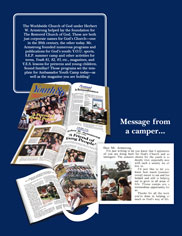
“Dear Mr. Armstrong,” a girl from Winnipeg in Canada wrote to the pastor general of the Worldwide Church of God—the predecessor of The Restored Church of God.
“Thank you so much for feeling that we are important enough to have such a super [summer camp] facility. You let so much money, time and effort be put into camp just so that we can enjoy ourselves. Thank you for caring about us so much and for taking time out of your busy schedule just to come and speak to us for a while. You enabled us to make lasting friendships and to create wonderful memories. It is those treasured memories that we will hold tightly to until the Kingdom of God arrives.”
This letter was quoted in the Church’s magazine for teenagers, titled Youth, after Mr. Armstrong died in January 1986 at the age of 93. It was part of a tribute to the man who during a 52-year ministry dedicated much of his service to helping teenagers become more devoted to God’s Way.
You have undoubtedly heard about Herbert Armstrong and the Worldwide Church of God in sermons, literature and conversation among members. You may have seen pictures of its headquarters campus in Pasadena, California, or heard members tell stories of their experiences in the summer education program (S.E.P.), after which Ambassador Youth Camp is modeled.
To help you understand why Mr. Armstrong’s ministry was so crucial to Church history, this article details the life of this 20th-century servant of God.
An Advertising/Business Executive
Mr. Herbert W. Armstrong was born July 31, 1892, in Des Moines, Iowa. As a little boy, he was inquisitive and craved understanding—he wanted to learn about the world around him.
Instead of attending college after graduating from high school, Mr. Armstrong entered the advertising profession, gaining a college-level education through on-the-job training and experience. He developed into a dynamic “idea man” who mastered the art of weaving eye-catching headlines and compelling text into effective advertisements and magazine articles. By the time he reached his late 20s, Mr. Armstrong ran his own downtown Chicago advertising business, earning an annual salary equivalent to hundreds of thousands of dollars in today’s currency.
Married to the love of his life and highly respected by his peers, Mr. Armstrong’s life was riding high—until God used a series of humbling business setbacks to grab his undivided attention.
Mr. Armstrong wholeheartedly responded to God’s calling, and grew in biblical knowledge and spiritual understanding. Combining these with his advertising, marketing and business expertise, he took the gospel—the good news of the soon-coming Kingdom of God—across the globe through The World Tomorrow radio (and later television) program and The Plain Truth magazine. (Today, The World to Come program, presented by Mr. David C. Pack, and The Real Truth magazine are their successors.)
An Educator
Unlike this world’s religious leaders, Mr. Armstrong possessed the unique ability to explain the truths of God in simple, easy-to-understand language. Time after time, he taught that there are opposite ways of life, symbolized by the two trees in the Garden of Eden: the way of give, of outgoing concern for others (the fruits of which are described in Galatians 5:22-23)—and the way of get, of selfishness, covetousness and greed (described in verses 19-21).
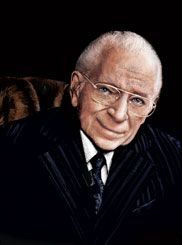
Herbert W. Armstrong
Source: RCG illustration
As an educator, Mr. Armstrong also founded Ambassador College, which provided young minds a sound education based on the right foundation.
Mr. Armstrong wrote, “Curricula, generally, have become wholly materialistic, putting the emphasis on the purely technical and intellectual, at sacrifice of spiritual, moral and cultural development; on curriculum rather than on character; on earning a living, at the neglect of learning how to live!
“The Ambassador policy is based upon the recognition that true education is not of the intellect alone, but of the whole personality—not alone of technologies, sciences and arts, but an understanding of the purpose of life, a knowledge of the spiritual laws which govern our lives, our God-relationship and human relationships.
“Ambassador College knows and teaches the purpose and true meaning of life—the true values that pay off—and the way to peace, happiness and abundant well-being. How do we know? We have it on authority. The Bible—God’s revealed Word—is that authority. It is the foundation of all knowledge, and the approach to acquirable knowledge” (“Founder’s Statement,” The Envoy, 1980).
An Ambassador Without Portfolio
From 1970 until his death in 1986, Mr. Armstrong appeared before more than one-third of the world’s heads of state: India’s Indira Gandhi, Israeli prime ministers Golda Meir and Menachem Begin, the president of Indonesia, the president of the Philippines, King Hussein bin Talal of Jordan, Prince Mikasa of Japan, Egyptian presidents Anwar el-Sadat and Hosni Mubarak, United Kingdom Prime Minister Margaret Thatcher, the king of Thailand, the king of Swaziland, and numerous other dignitaries.
Mr. Armstrong came to be viewed as “an ambassador without portfolio,” a representative of world peace. Instead of pleading for kings, presidents and prime ministers to “just accept Jesus,” Mr. Armstrong presented Christ’s gospel message in simple, practical terms. He taught the difference between the ways of give and get, explaining that the only way mankind will achieve universal peace, security, prosperity and happiness is through the way of giving, helping and cooperating with others.
A Friend of Young People
In November 1979, Mr. Armstrong began writing a book that was published serially in The Plain Truth. In what later became the book Mystery of the Ages, he wrote that the world was in a “babylon of religious confusion”—and, “Out of this spiritual wilderness, a voice cries out in clarity and power, decrying this world confusion, with the reassuring TRUTH of the world’s only and SURE HOPE!”
In the book, Mr. Armstrong taught that John the Baptist was a voice crying out in the physical wilderness, preparing for the human physical Jesus’ First Coming to a material temple in Jerusalem. But John was a type, or forerunner, of a later voice to be “lifted up” and crying out in the midst of a spiritual wilderness of religious confusion, announcing the imminence of Christ’s Return.
The Pastor General added, “He came, over 1900 years ago, to announce the FUTURE Kingdom of God. He’s coming this time to ESTABLISH that Kingdom…It’s going before kings, emperors, presidents, prime ministers of nations—and to their peoples, on all continents of the earth!”
Mystery of the Ages ended up being Mr. Armstrong’s final book, published in 1985, mere months before his death.
Mr. Armstrong saw in the scriptures an emphasis to “cry aloud” (Isa. 58:1) to physical Israel (the United States, Britain and other nations of the West) and “restore all things” (Matt. 17:11) to spiritual Israel, the Church (Acts 7:38). He also saw that God emphasized the importance of family. For example, Malachi 4 contains an instruction to “turn the heart of the fathers to the children, and the heart of the children to their fathers” (vs. 6). Seeing this, Mr. Armstrong established special programs and publications for God’s youth: Y.O.U. sports, S.E.P. summer camp and other activities for teens, Youth 81, 82, 83, etc., magazines, and Y.E.S. lessons for preteens and young children. (Note that the ultimate fulfillment of the “cry aloud” prophecy is yet ahead.)
His ministry of reinforcing the bonds of the family unit and teaching the importance of recapturing true values continues today through Ambassador Youth Camp, Ambassador Youth magazine, and the vast library of literature, World to Come broadcasts, sermons, articles, reports, lessons, books and booklets produced by The Restored Church of God.
A Misunderstood Servant
More than three decades since his death, the vast majority who once followed Mr. Armstrong greatly misunderstand and no longer appreciate his amazing life and ministry.
Nonetheless, a tiny few do properly remember this great end-time servant—whose life can ultimately be summed up as: He believed God. He feared God. He obeyed God.
Want to learn more? Read our biography Herbert W. Armstrong – His Life in Proper Perspective.