
 GRAPHICAARTIS/GETTY IMAGES
Article
God has clearly blessed the United States. But those blessings do not tell the whole story.
Learn the why behind the headlines.
Subscribe to the Real Truth for FREE news and analysis.
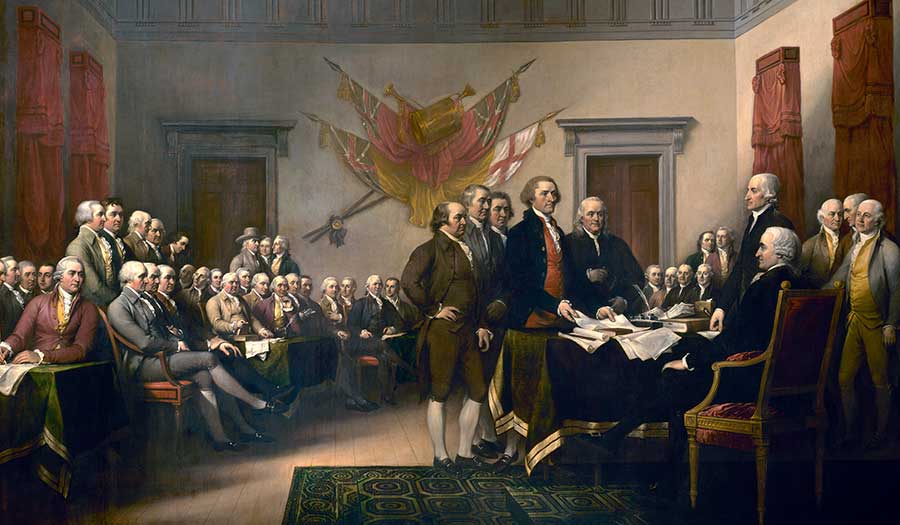
Subscribe NowAn 81-year-old Benjamin Franklin rose to address the Constitutional Convention in 1787. The elder statesman spoke to a room filled with tension as delegates struggled to form a government for the fledgling United States.
Reflecting on his decades of life, he said: “I have lived, sir, a long time, and the longer I live, the more convincing proofs I see of this truth—that God governs in the affairs of men. And if a sparrow cannot fall to the ground without His notice, is it probable that an empire can rise without His aid?”
Franklin had lived through the events leading up to and through the Revolutionary War and witnessed the birth of a new nation in 1776. He was convinced God’s hand had been involved.
Looking back 250 years after America began, we can see this far more clearly than Franklin could. The United States rose from a fragile cluster of colonies to the most powerful and influential nation in the modern world.
God’s hand in American history is clear, and the nation’s 250th anniversary is a perfect time to reflect on all He has done. The story of the United States is not just remarkable, it was inevitable.
Unexpected Revolution
On June 9, 1776, Founding Father John Adams wrote: “We are in the very midst of a Revolution, the most complete, unexpected, and remarkable of any in the History of Nations.”
It certainly was unexpected. The colonial leaders had not begun by seeking independence. For years, they actively worked to avoid it. They wanted to remain within the British Empire while securing what they believed were their rights as Englishmen.
In 1765, Parliament passed the Stamp Act, placing direct taxes on the colonies. The backlash was immediate. Yet independence was still not on the table.
The following year, Franklin traveled to London to testify before Parliament during the crisis. For hours, he patiently answered questions about the colonies’ mindset and intentions.
He said this about the colonists: “They consider themselves as a part of the British empire, and as having one common interest with it…they are zealous for the honor and prosperity of this nation, and, while they are well used, will always be ready to support it…”
As tensions escalated in the years that followed—through new taxes, protests and an increased military presence—most colonial leaders still desired reconciliation over separation.
When fighting finally broke out at Lexington and Concord in April 1775, even the start of the war was unclear. A shot rang out, often called the “shot heard round the world,” but to this day, historians do not know which side fired first. What is clear is that neither side had fully intended to begin a war that day.
Even after blood was spilled, colonial leaders desired peace. In July, the Continental Congress sent the Olive Branch Petition directly to King George III: “We…beseech your Majesty that your royal authority and influence may be graciously interposed to procure us relief…and to settle peace through every part of your dominions…”
A day later, the leaders wrote “The Declaration of the Causes and Necessity for Taking Up Arms”: “We have not raised armies with ambitious designs of separating from Great Britain, and establishing independent states.”
The king refused even to receive the petition and instead declared the colonies to be in open rebellion.
The Unthinkable Becomes Obvious
Most in the American colonies were still not ready to break with the crown.
That began to change in January 1776.
An inflection point came with the publication of Thomas Paine’s pamphlet Common Sense. Writing in plain, direct language, he said: “In the following pages I offer nothing more than simple facts, plain arguments, and common sense…”
Paine wrote of independence not as a distant possibility but as an unavoidable conclusion.
He said that “the period of debate is closed.” And also, “Every thing that is right or reasonable pleads for separation.”
To Paine, the question was no longer whether the colonies should separate from Britain, but whether they would accept what had already become inevitable.
He even drew on the Bible, framing the cause in moral and divine terms.
The message spread rapidly. The pamphlet sold more than 100,000 copies in just a few months among a population of roughly 2.5 million. It was read aloud in taverns, debated in town squares and reprinted in newspapers across the colonies.
What had once seemed radical now felt obvious.
In the Declaration of Independence, adopted July 4, 1776, Jefferson expressed this new certainty in unmistakable terms: “We hold these truths to be self-evident, that all men are created equal, that they are endowed by their Creator with certain unalienable Rights.”
The Declaration also appealed “to the Supreme Judge of the world for the rectitude [righteousness] of our intentions…”
It concluded: “And for the support of this Declaration, with a firm reliance on the protection of divine Providence, we mutually pledge to each other our Lives, our Fortunes and our sacred Honor.”
Divine Providence
Providence—the belief that God directs the affairs of men and intervenes in the course of history—became central to the revolution.
The Continental Congress repeatedly called on the nation to seek God’s favor. In March 1776, it proclaimed a national day of fasting, urging the people to humble themselves before God. The following year, it declared a day of Solemn Thanksgiving and Praise, calling on the nation to seek His help “to secure for these United States the greatest of all human blessings, independence and peace.”
The declaration stated: “It is the indispensable duty of all men to adore the superintending providence of Almighty God.”
George Washington, who would go on to become the nation’s first president, saw providence at work in his life even before the Revolutionary War. Writing in 1755 after battle during the French and Indian War, he said that “by the All-powerful Dispensations of Providence, I have been protected beyond all human probability and expectation; for I had four Bullets through my Coat, and two Horses shot under me, yet escaped unhurt…”
Years later, during the Revolutionary War, he wrote: “The hand of Providence has been so conspicuous in all this, that he must be worse than an infidel that lacks faith.” In other words, he saw evidence for God’s intervention all over the events of the Revolution—you would have to be blind to miss them.
One such moment came in the summer of 1776, during the Battle of Long Island. Washington’s forces had been defeated and trapped by the British. Capture or death seemed inevitable.
Under the cover of night, the Americans began a desperate evacuation across the East River. Over the course of hours, thousands of troops—along with their artillery, horses and supplies—had to be quietly ferried across the water. At dawn, the operation would be exposed.
Instead, a dense fog settled over the area, concealing the final movements of the army and allowing it to escape. Washington and others saw this as God’s clear intervention.
Yet while they recognized the hand of providence in what was happening, they did not understand the real reason God was involved.
Written Long Before 1776
American leaders were looking to the Bible to understand their future long before independence.
In 1630, as a group of settlers prepared to establish the Massachusetts Bay Colony, John Winthrop described the kind of community they hoped to build in his sermon “A Model of Christian Charity.” If the people obeyed God, he said, others would look at their society and say: “May the Lord make it like that of New England.”
Winthrop adapted that saying from a verse in the Bible book of Genesis, directed toward the descendants of Joseph’s sons: “In you shall Israel bless, saying, God make you as Ephraim and as Manasseh” (48:20).
The meaning of this verse is that the descendants of Ephraim and Manasseh would become so prosperous and prominent that others would ask God for the same blessings.
Winthrop sensed that something like this could happen. He believed God could bless their efforts. The early settlers hoped to build a nation that reflected God’s favor.
But the Bible provides something more than hope. It records promises—made long before America existed—about nations that would rise to greatness.
God first made these promises to the ancient patriarch Abraham: “I will make of you a great nation, and I will bless you, and make your name great” (Gen. 12:2).
Those promises were passed down to Abraham’s son Isaac and then to Isaac’s son Jacob: “A nation and a company of nations shall be of you” (35:11).
From one family would come both a single great nation and a group of nations.
Near the end of his life, Jacob passed those promises to his grandsons Ephraim and Manasseh: “Let my name be named on them, and the name of my fathers Abraham and Isaac” (48:16).
Jacob explained that Manasseh would grow into a single “great” nation, while Ephraim would become “a multitude of nations” (vs. 19).
Realize what these words mean. They describe real nations that would emerge on the world stage.
History plainly reveals that this was the rise of the British Empire and the United States of America.
The British Empire, from Ephraim, became a company of nations that ruled territories across the globe. The United States, from Manasseh, emerged as a single dominant nation—unmatched in wealth, military strength and global influence.
When Winthrop alluded to Manasseh in the fledgling days of the American colonies, little did he know what he was saying!
The rise of the United States was not simply the result of geography, resources or political ideas. It was the fulfillment of promises God made to Abraham—passed down through generations and culminating with the descendants of Ephraim and Manasseh.
To learn more about how the birth of the United States fulfilled Scripture, read America and Britain in Prophecy.
National Blessings
While the founding of the United States showed the signs of providence, the nation’s rise in the decades that followed showed God continuing to fulfill specific promises He made to Abraham, Isaac and Jacob—down to the detail.
What began as 13 colonies stretched along the Atlantic Coast rapidly expanded across an entire continent. In 1803, the Louisiana Purchase doubled the size of the young nation—adding more than 800,000 square miles of land for just $15 million. It included vast fertile farmland that would become some of the most productive agricultural regions in the world.
By 1853, the contiguous United States was completed from the Atlantic to the Pacific—“from sea to shining sea.”
This expansion mirrors what had been promised centuries earlier: “Therefore God give you of the dew of heaven, and the fatness of the earth, and plenty of corn and wine” (Gen. 27:28).
The United States contains an extraordinary range of natural wealth and beauty—from the depths of the Grand Canyon to the geysers of Yellowstone, from the granite cliffs of Yosemite to lush plains, dense forests, deserts and even rainforests. Few nations combine this level of geographic variety with such abundant natural resources within a single border.
But the promises did not stop with land.
God said Abraham’s descendants would rise to greatness among nations. That promise is reflected in the economic rise of the United States. By the late 19th century, it had become the world’s leading industrial power. In the 20th century, it emerged as the world’s largest economy—a position it has maintained ever since.
That national strength was especially evident during World War II. In what became known as the “Arsenal of Democracy,” American industry outproduced the Axis powers on a staggering scale. The United States produced more than 300,000 aircraft during the war, along with tens of thousands of tanks, ships and vehicles—a pace no other nation could match.
That dominance extended beyond industry to innovation. From the lightbulb and the airplane to the computer and the internet, American ingenuity has shaped the modern world. Its economy, influence and technological leadership have reached every corner of the globe.
Once again, God has clearly blessed America. But to what end?
God’s Purpose
Recall Benjamin Franklin’s simple conclusion from earlier: “God governs in the affairs of men.” He had watched colonies become a nation and a revolution begin to shape the course of history. To him, it was clear that God had been involved.
Looking back after 250 years of American history, this should also now be clear to you.
The rise of the United States unfolded according to promises God had made thousands of years before—promises passed from Abraham to Isaac to Jacob, and then to Ephraim and Manasseh.
For those promises to be fulfilled, the descendants of Joseph could not remain together. They had to become distinct national powers. Manasseh could not remain within Ephraim’s company of nations. It needed to become a separate nation just as God foretold.
This is why the rise of the United States was inevitable.
God had already declared what He would do, and He always brings His word to pass. Numbers 23:19 says: “God is not a man, that He should lie; neither the son of man, that He should repent: has He said, and shall He not do it? Or has He spoken, and shall He not make it good?”
The rise of the United States stands as proof of this. The promises made to Abraham were not symbolic. They were literal and fulfilled by God.
And yet, even with those blessings, the United States is not perfect.
Its history, like that of every nation, is marked by division, conflict and human weakness. The same nation that rose to unmatched power has also struggled to solve the deepest problems facing society. This reality reveals an important lesson God wants the world to learn: Even a nation richly blessed cannot bring lasting peace, stability or righteousness.
But because God has fulfilled His promises to Abraham—across centuries, through nations and down to the details—we can know His other promises are just as certain. And He has foretold something far greater: A time when He will finally and completely intervene in world affairs and establish His own government over all nations.
The Bible calls this the Kingdom of God.
Revelation describes what will happen: “The kingdoms of this world are become the kingdoms of our Lord, and of His Christ; and He shall reign forever and ever” (11:15).
God will not leave the world to continue under human rule. He will replace it with His own—a government that will finally bring the lasting conditions that human systems have never been able to produce.
As we reflect on America’s 250 years, we should all be thankful for the blessings this nation has received. But those blessings were never meant to be the end of the story.
They are a preview—only the smallest glimpse—of what God will soon bring to the whole world. Just as He fulfilled His promises to Abraham in the rise of the United States, the coming Kingdom is no less certain.
It is inevitable.

More on Related Topics:
- Violence Has Displaced Members of More Than Half a Million Mexican Households in Past 5 Years
- Americans Mark 25 Years Since September 11 Attacks amid Enduring Grief, Reflection
- The Push to Remove Lead Pipes Is On. Thousands of Water Systems Still Don’t Know Where Theirs Are
- The Poorest in the U.S. Can’t Find Housing Even as Low-Income Units Sit Empty
- What Comes After America 250?
Suggested Reading
More on Related Topics
Latest News
-
October 8, 2026
- UN Health Agency Wants More Details from Russia on Suspected Pneumonic Plague Case
- Ukraine Claims to Have Taken Out More Than Half of Russia’s Oil Refining Capacity
- Violence Has Displaced Members of More Than Half a Million Mexican Households in Past 5 Years
- As Iran War Smolders, Shunned Eritrea Looks to Come in from the Cold September 15, 2026
- U.S. Acknowledges for the First Time that It Has Deployed Weapons in Space
- Some Russians Are Fleeing Abroad, Citing Draft Fears and a Loss of Freedom September 11, 2026
- Americans Mark 25 Years Since September 11 Attacks amid Enduring Grief, Reflection
- Yemen’s Iranian-Backed Houthis Seize an Island in a Key Strait, Opening a New Front in the Iran War September 10, 2026
- The Push to Remove Lead Pipes Is On. Thousands of Water Systems Still Don’t Know Where Theirs Are September 9, 2026
- Family Interest in Education Falls as Test Scores Drop
- The Poorest in the U.S. Can’t Find Housing Even as Low-Income Units Sit Empty September 1, 2026
- In U.S. West, Drought Pits Farms Against Industry
- Why Christians Must Watch the News
- Teach Your Children to Be Active
- What Comes After America 250? August 31, 2026
- How Brexit Broke British Politics
- How to Keep the Sabbath
- Aliens and the Bible?
- Building Character in a Crooked World August 28, 2026
- U.S. Declares Drought Disaster for Parts of Puerto Rico as Dry Conditions Persist