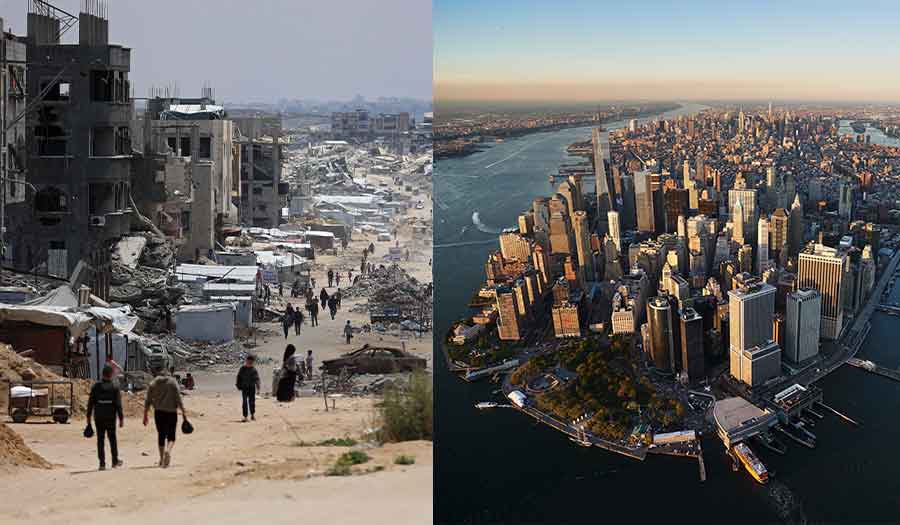
 LEFT, OMAR AL-QATTAA/AFP VIA GETTY IMAGES; RIGHT, GETTY IMAGES
Article
A new UN report on global poverty highlights mankind’s efforts to solve problems and the limits of financial solutions.
Learn the why behind the headlines.
Subscribe to the Real Truth for FREE news and analysis.
Subscribe NowThe world has never had more wealth, more institutions devoted to development or more public commitments to ending poverty. Yet the gap between rich and poor nations continues to widen.
A recent United Nations report concluded that commitments made by many countries last year to address the financial divide remain largely unfulfilled. Released ahead of spring meetings of the International Monetary Fund and the World Bank, the report assessed progress on the Seville Commitment, adopted by many world leaders at a conference in Seville, Spain, in June 2025.
World leaders are working to close a financial gap between nations, yet a deeper gap remains—the gap between mankind’s solutions and God’s way of producing lasting prosperity.
Growing Financial Divide
The Seville Commitment was intended to help close the $4 trillion annual financing gap the United Nations says is needed to achieve global development goals by 2030. Among its ambitious objectives were increasing investment in developing countries and reforming the international financial system, including the IMF and World Bank.
According to the report, progress has been slow.
Li Junhua, the UN undersecretary-general for economic and social affairs, said geopolitical tensions are making it increasingly difficult for developing nations to attract financing. He described the current environment as “an extremely perilous time for international cooperation, as geopolitical considerations are increasingly shaping economic relations and financial policies.”
The report also cited rising trade barriers and repeated climate-related shocks as contributing factors in the widening gap between nations.
Compounding the challenge is growing uncertainty in the global economy. IMF Managing Director Kristalina Georgieva said the institution had been preparing for stronger global growth, but conflict involving Iran has clouded that outlook.
Aid is also shrinking. According to UN officials, 25 countries reduced assistance to poorer nations in 2025, resulting in an overall 23 percent decline from 2024—the largest annual drop on record. The United States accounted for the largest decrease, with assistance falling by 59 percent. A further overall decline is expected in 2026.
Tariffs have added another strain. The report said average export tariffs on the world’s poorest nations increased from 9 percent to 28 percent in 2025. For developing countries excluding China, average tariffs rose from 2 percent to 19 percent.
Supporters of the Seville Commitment argue that expanding investment and improving access to financing could help developing nations build infrastructure, strengthen economies and improve overall living conditions.
The UN report on implementing the Seville Commitment said it represents “the best hope” to close the widening financial gap.
These reform efforts are understandable. Poverty remains a daily reality for billions. Many lack reliable housing, healthcare, sanitation, food security and economic opportunity. The goals of many national leaders and international organizations are sincere: reduce suffering, improve living standards and help people live better lives.
Yet the report also highlights a recurring challenge in human affairs. Nations often agree on common goals, but conflicts, competing interests and changing priorities can make cooperation and progress difficult to sustain.
Human suffering may be easy to recognize, but finding lasting solutions has proven far more difficult.
More Than Money?
Can financial resources alone solve humanity’s problems?
Money builds roads, schools and hospitals. It creates jobs, expands opportunities and provides relief during crises. Financial assistance can ease suffering and improve lives.
But money cannot solve everything.
Even as world leaders debate aid levels, trade policies and financial improvements, scarcity continues to affect billions of people.
And this hardship is not limited to poorer nations. Many living in so-called rich countries also face increasing pockets of homelessness, addiction, crime, family breakdown and social instability. Portions of their populations also struggle with poverty.
Yet poverty should not be measured only through the assumptions of wealthier societies. People in prosperous nations can mistakenly assume that those with fewer material advantages must be unhappy simply because they would feel deprived in the same circumstances. Human well-being is shaped by more than income. Family, community, purpose and stability all matter.
Many of the problems that weaken nations are rooted not in a lack of resources, but in how people and societies use them. Corruption, conflict, self-interest and dishonesty all undermine progress. No amount of funding automatically removes these obstacles.
The persistence of poverty shows that financial resources alone cannot address the deepest problems facing nations. Wealth can provide opportunity, but it cannot produce honesty. Aid can relieve immediate hardship, but it cannot create character. Investment can build infrastructure, but it cannot by itself build stable families, trustworthy leadership or lasting peace.
What Exalts a Nation
The Bible offers a perspective on prosperity often absent from discussions about economic development. Proverbs 14:34 states, “Righteousness exalts a nation: but sin is a reproach to any people.”
Another verse earlier in the same chapter reveals God’s concern for those who struggle materially: “He that oppresses the poor reproaches his Maker: but he that honors Him has mercy on the poor” (14:31).
God does not ignore poverty and He does not view the poor as less valuable. He condemns oppression and expects people to treat the vulnerable with compassion, fairness and mercy.
At the same time, Proverbs 14:34 points to a broader national principle. The verse does not focus on a nation’s natural resources, economic output or financial wealth. It focuses on conduct. A nation’s well-being is shaped by the values, character and behavior of its people.
Scripture defines sin as the transgression of God’s Law (I John 3:4). It involves actions that violate the principles God established for true prosperity. Righteousness is the opposite: living in accordance with those principles.
Financial wealth alone does not reveal a nation’s spiritual condition. Wealthy countries are still plagued by homelessness, addiction, crime, family breakdown and social instability. Poorer nations still have communities marked by generosity, strong family bonds, personal integrity and contentment.
Wealthy nations are not automatically righteous. Poorer nations are not automatically unrighteous.
Proverbs shows that lasting national strength depends on more than financial resources. When people live honestly, trust can grow. When families are stable, communities become stronger. When leaders act justly, citizens are protected. When people practice self-control, responsibility and diligence, they avoid many of the behaviors that produce suffering.
Much more than being personal virtues, these are national building blocks.
While Proverbs 14:34 reveals what exalts a nation, Jeremiah 10:23 reveals why mankind struggles to achieve it: “O Lord, I know that the way of man is not in himself: it is not in man that walks to direct his steps.”
Human beings can recognize problems and sincerely seek solutions. The efforts described in the UN report reflect this. Yet history reveals mankind’s limitations in solving the deepest causes of human suffering—problems money alone cannot fix.
If man cannot direct his own steps, then the world needs more than another financial framework. It needs God to teach mankind the way that produces peace, justice, stability and lasting prosperity.
In Isaiah 55:8, God makes clear the incredible gap between man’s thinking and His. He declares: “For My thoughts are not your thoughts, neither are your ways My ways, says the Lord.” He continues, “For as the heavens are higher than the earth, so are My ways higher than your ways, and My thoughts than your thoughts” (vs. 9).
In other words, until the world follows God’s ways, it will never fully solve its problems.
Closing Both Gaps
The Bible shows that God’s government will one day produce the stability and prosperity mankind has never been able to achieve on its own.
Isaiah 65 gives a small glimpse of that future: “And they shall build houses, and inhabit them; and they shall plant vineyards, and eat the fruit of them. They shall not build, and another inhabit; they shall not plant, and another eat…and My elect shall long enjoy the work of their hands” (vs. 21-22).
This is not merely a picture of improved economic conditions. It is a world in which people are secure, their labor is not wasted, and the systems that produce oppression, fear, corruption and instability have been replaced by righteous rule.
God’s soon-coming world government will not merely redistribute wealth. It will teach the righteous way of life that produces lasting peace, justice, stability and prosperity.
Only with the arrival of the Kingdom will both gaps be closed—the economic gap between nations and the far wider gap between man’s way and God’s Way.
This article contains information from The Associated Press.

More on Related Topics:
- What Will the Next Leader of the UN Need to Get the Job Done in an Increasingly Complex World?
- Yemen’s Iranian-Backed Houthis Seize an Island in a Key Strait, Opening a New Front in the Iran War
- The U.S. and Iran Trade Missile Barrages as Hopes Dim for a Quick Resolution
- NATO Member Romania Shoots Down Stray Drones from Ukraine War After Years of Incursions
- U.S. Begins New Iran Strikes After President Says Ships Will Be Charged to Use the Strait of Hormuz
Suggested Viewing
More on Related Topics
Latest News
-
October 9, 2026
- What Will the Next Leader of the UN Need to Get the Job Done in an Increasingly Complex World? October 8, 2026
- UN Health Agency Wants More Details from Russia on Suspected Pneumonic Plague Case
- Ukraine Claims to Have Taken Out More Than Half of Russia’s Oil Refining Capacity
- Violence Has Displaced Members of More Than Half a Million Mexican Households in Past 5 Years
- As Iran War Smolders, Shunned Eritrea Looks to Come in from the Cold September 15, 2026
- U.S. Acknowledges for the First Time that It Has Deployed Weapons in Space
- Some Russians Are Fleeing Abroad, Citing Draft Fears and a Loss of Freedom September 11, 2026
- Americans Mark 25 Years Since September 11 Attacks amid Enduring Grief, Reflection
- Yemen’s Iranian-Backed Houthis Seize an Island in a Key Strait, Opening a New Front in the Iran War September 10, 2026
- The Push to Remove Lead Pipes Is On. Thousands of Water Systems Still Don’t Know Where Theirs Are September 9, 2026
- Family Interest in Education Falls as Test Scores Drop
- The Poorest in the U.S. Can’t Find Housing Even as Low-Income Units Sit Empty September 1, 2026
- In U.S. West, Drought Pits Farms Against Industry
- Why Christians Must Watch the News
- Teach Your Children to Be Active
- What Comes After America 250? August 31, 2026
- How Brexit Broke British Politics
- How to Keep the Sabbath
- Aliens and the Bible?
- Building Character in a Crooked World