
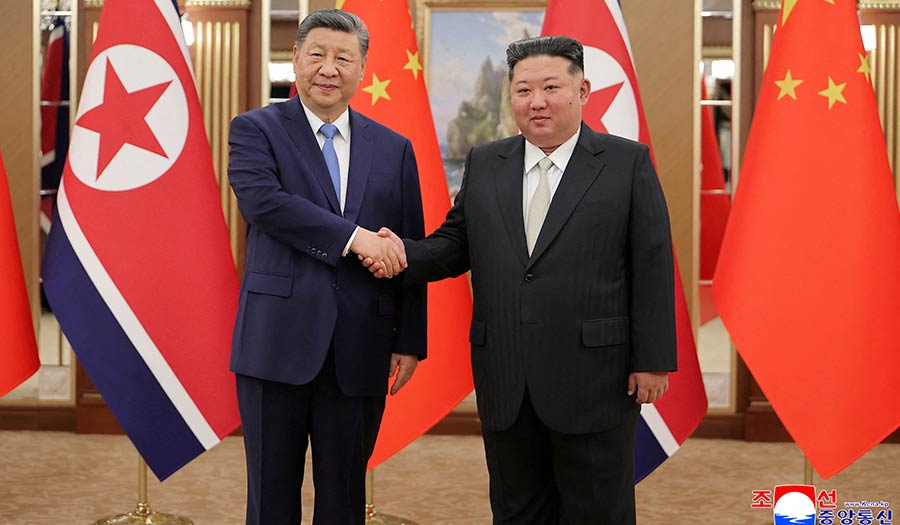
 KCNA via REUTERS
Article
Learn the why behind the headlines.
Subscribe to the Real Truth for FREE news and analysis.
Subscribe NowSEOUL/BEIJING (Reuters) – North Korea and China both walked away claiming major wins from Chinese President Xi Jinping’s visit this week to the isolated state, which helped elevate North Korean leader Kim Jong Un’s global stature and pulled Pyongyang more tightly into China’s orbit.
The two countries each lavished the other with praise and spoke of deeper cooperation during the two-day trip, which saw Mr. Kim greet Mr. Xi with a 21-gun salute as well as a performance of Chinese and North Korean songs and avoided discussion of thornier issues such as denuclearization and the United States.
Mr. Kim “has often talked about how North Korea is now a pivotal player in reshaping the global order, and its partnership with Russia has been a major catalyst in validating that assertion,” said Jenny Town, director of the Korea program at the Washington-based Stimson Center.
“Having Xi now take his first trip out of country this year to visit Pyongyang on an agenda that didn’t include North Korea’s nuclear programme was a big win for Kim.”
The lack of discussion around denuclearization, which had in the past strained China’s relationship with North Korea, is a significant change.
On the eve of Mr. Xi’s visit, Kim Yo Jong, the North Korean leader’s sister, slammed the U.S. as spreading false information, after Washington in May said that Mr. Xi and U.S. President Donald Trump had confirmed a shared goal to denuclearize North Korea during talks in Beijing.
“Beijing has very clearly moved on from that issue and now tacitly accepts North Korea as a nuclear state, which likely puts China on an equal footing with Russia in Pyongyang’s eyes,” said Jeremy Chan, a China & Northeast Asia analyst at Eurasia Group.
“I think China achieved its primary goal of this trip, which was drawing North Korea closer and counterbalancing Russia’s growing influence in North Korea.”
Chinese scholars, however, said the visit was neither directed against nor subject to the influence of any third country.
“The visit is primarily aimed at consolidating the traditional bilateral friendship between China and the DPRK,” said Zhang Yun, an international relations professor at China’s Nanjing University.
Asked whether Mr. Kim and Mr. Xi discussed denuclearization on Tuesday, China’s foreign ministry told a regular briefing that China’s position and policy on the peninsula remained consistent and stable.
To a follow-up request for comment on whether the lack of mention meant an implicit acceptance of North Korea as a nuclear state, the ministry said on Thursday that China had repeatedly stated its position on the matter.
Officially, China opposes North Korea’s nuclear buildup but has increasingly avoided pressing the issue publicly.
Limits to Cooperation
Still, analysts noted there were distinct differences in the two sides’ accounts of the leaders’ talks, with North Korea more focused on the pageantry of the event and positioning itself as an equal to Beijing, while China spoke of hoped-for outcomes around trade, tourism and law enforcement.
Ms. Town said it indicated there were limits to how far North Korea was willing to go to improve the relationship with China, after moving closer to Russia in recent years by sending military support for the Ukraine war and receiving economic help in return.
“It is clear that Kim and Xi do not have the kind of rapport Kim has with Putin; there seems to be little personal affinity between them. But both understand the strategic value of the relationship to push through,” she said.
But Mr. Kim giving explicit support for Beijing’s One China principle, which for Beijing means that both sides of the Taiwan Strait belong to one country, and China’s mention of military cooperation stood out, they added.
“North Korea’s support for Russia has shown that Pyongyang can provide material assistance to a major power in wartime. There is no evidence yet of a comparable commitment to China, but DPRK [North Korea] messaging on Taiwan now matters more than before,” said Chad O’Carroll, founder of North Korea-focused website NK News.
Observers of the visit also said they were closely watching for the presence of Mr. Kim’s daughter as it would have bolstered arguments made by South Korea’s spy agency and others that she was being groomed to succeed her father.
The daughter, who is believed to be around 13 and named Ju Ae, accompanied Mr. Kim on his visit to Beijing last year and is pictured with him regularly. However, she has not been seen in images of the trip released by Chinese and North Korean state media.
Benjamin Ho, China program associate professor at the S. Rajaratnam School of International Studies in Singapore, said her absence was in keeping with China’s style.
“Given Beijing’s penchant for protocol, it would be awkward if a young girl appears among all the senior officials present,” he said.

More on Related Topics:
- U.S. Removes Syria from Terrorism Sponsor List
- U.S. Unveils ‘Economic D-Day’ of Sanctions to Isolate Iran
- Saudi Arabia, Turkey and Pakistan Have Signed a Key Defense Agreement
- Ukraine and 9 Other Countries Announce a Coalition to Protect Europe from Ballistic Missiles
- Europe Faces a Ukrainian Drone Problem as Kyiv Targets Russian Oil Exports
Latest News
-
October 9, 2026
- What Will the Next Leader of the UN Need to Get the Job Done in an Increasingly Complex World? October 8, 2026
- UN Health Agency Wants More Details from Russia on Suspected Pneumonic Plague Case
- Ukraine Claims to Have Taken Out More Than Half of Russia’s Oil Refining Capacity
- Violence Has Displaced Members of More Than Half a Million Mexican Households in Past 5 Years
- As Iran War Smolders, Shunned Eritrea Looks to Come in from the Cold September 15, 2026
- U.S. Acknowledges for the First Time that It Has Deployed Weapons in Space
- Some Russians Are Fleeing Abroad, Citing Draft Fears and a Loss of Freedom September 11, 2026
- Americans Mark 25 Years Since September 11 Attacks amid Enduring Grief, Reflection
- Yemen’s Iranian-Backed Houthis Seize an Island in a Key Strait, Opening a New Front in the Iran War September 10, 2026
- The Push to Remove Lead Pipes Is On. Thousands of Water Systems Still Don’t Know Where Theirs Are September 9, 2026
- Family Interest in Education Falls as Test Scores Drop
- The Poorest in the U.S. Can’t Find Housing Even as Low-Income Units Sit Empty September 1, 2026
- In U.S. West, Drought Pits Farms Against Industry
- Why Christians Must Watch the News
- Teach Your Children to Be Active
- What Comes After America 250? August 31, 2026
- How Brexit Broke British Politics
- How to Keep the Sabbath
- Aliens and the Bible?
- Building Character in a Crooked World