
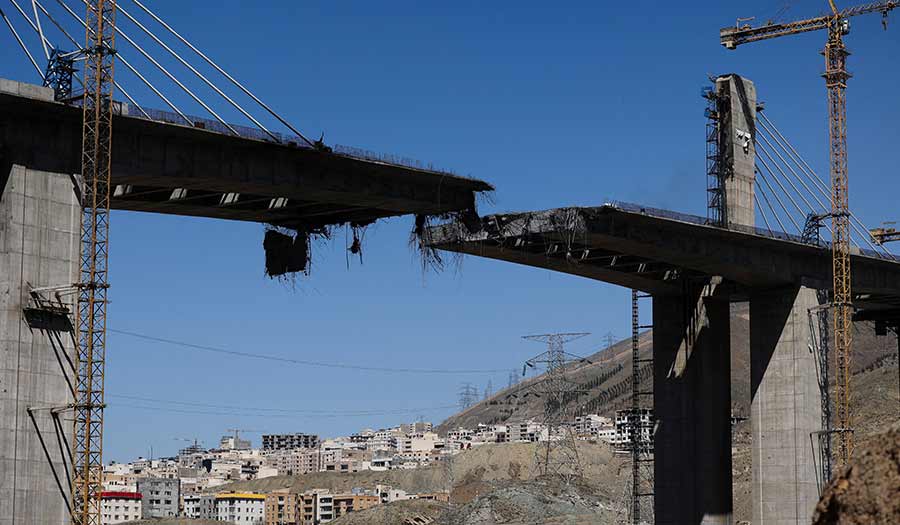
 Majid Asgaripour/WANA (West Asia News Agency) via REUTERS
World News Desk
Learn the why behind the headlines.
Subscribe to the Real Truth for FREE news and analysis.
Subscribe NowWASHINGTON/CAIRO (Reuters) – Iran shot down a U.S. warplane on Friday in the first such known incident of the five-week war, officials from both nations said, with one of the crew members rescued after ejecting and the other still missing, according to a U.S. source.
The incident showed the risks still faced by U.S. and Israeli aircraft over Iran despite assertions by U.S. President Donald Trump and his Defense Secretary Pete Hegseth that their forces had total control of the skies.
Meanwhile, a second U.S. Air Force combat plane crashed in the Gulf region on Friday, the New York Times reported, citing two U.S. officials. Its only pilot was then rescued, the Times said.
Iranian media said residents were shooting at U.S. helicopters on a search-and-rescue mission after the downing of what U.S. sources said was a two-seat F-15E jet.
Iran’s Revolutionary Guard Corps said it was combing an area near where the plane came down in southwestern Iran and the regional governor promised a commendation for anyone who captured or killed “forces of the hostile enemy.”
The Pentagon and U.S. Central Command did not immediately respond to requests for comment.
William Goodhind, a forensic imagery analyst with Contested Ground, said images of the plane’s tail fin seen in photos posted on social media are consistent with that of an F-15E Strike Eagle, which carries two crew.
No Sign of End to War
The prospect of a U.S. service person being alive and on the run inside Iran raises the stakes for Washington in a conflict with low public support and no sign of an imminent end.
Iran has officially told mediators it is not prepared to meet with U.S. officials in Islamabad in coming days and that efforts to produce a ceasefire, led by Pakistan, have reached a dead-end, the Wall Street Journal reported on Friday.
The U.S. and Israel opened the campaign with a wave of strikes that killed Supreme Leader Ayatollah Ali Khamenei on February 28. The war has killed thousands and threatened lasting damage to the global economy.
So far, 13 U.S. military service members have been killed in the conflict and more than 300 have been wounded, according to the U.S. Central Command.
Iran has rained drones and missiles down on Israel. It has also taken aim at Gulf countries allied to the U.S., which have so far held back from joining the war directly for fear of further escalation.
In a security alert on Friday, the U.S. embassy in Beirut said Iran and its aligned armed groups may target universities in Lebanon, urging U.S. citizens in the country to leave while commercial flights are still available.
Israel has been waging a parallel campaign against Iran-backed Hezbollah in Lebanon after the militant group fired at Israel in support of Iran.
President Threatens to Strike Bridges, Power Plants
On Friday, as Mr. Trump threatened to hit its bridges and power plants, Iran struck a power and water plant in Kuwait, underlining the vulnerability of Gulf states that rely heavily on desalination plants for drinking water.
On Thursday, Mr. Trump posted footage on social media showing dust and smoke billowing up as U.S. strikes hit the newly constructed B1 bridge between Tehran and nearby Karaj, which was due to open this year, and said more attacks would follow.
“Our Military, the greatest and most powerful (by far!) anywhere in the World, hasn’t even started destroying what’s left in Iran. Bridges next, then Electric Power Plants!” he wrote in a subsequent post.
On Friday, a drone hit a Red Crescent relief warehouse in the Choghadak area of Iran’s southern Bushehr province.
Kuwait Petroleum Corporation said its Mina al-Ahmadi refinery had been hit by drones. Other attacks were also reported to have been intercepted in Saudi Arabia and Abu Dhabi. Missile debris landed near the Israeli port of Haifa, site of a major oil refinery.
Oil markets were closed after benchmark U.S. crude prices gained 11 percent on Thursday following a speech by Mr. Trump that offered no clear sign of an imminent end to the war.
- Personals
- PROPHECY
 America and Britain in Bible Prophecy
All nations are now rushing toward the conclusion foretold to occur in the “last days.” Humanity plunges ahead—blind, pleasure-crazed and largely detached from important world events occurring daily.
More on Related Topics:
- Explainer: What Are Iran’s Options to Escalate Further in Face of U.S. Economic Threats?
- Afghanistan Marks 5 Years Under the Taliban
- Israel Is Building a Miles-Long Earthen Barrier Inside Gaza, Entrenching Its Division
- Iran’s Forces Attack Bahrain and Kuwait After U.S. Hits Iranian Ports and Cities
- In Iran’s Capital, Weapons Demonstrations Send a Signal at Home and Abroad as Threat of War Remains
Latest News
-
October 8, 2026
- UN Health Agency Wants More Details from Russia on Suspected Pneumonic Plague Case
- Ukraine Claims to Have Taken Out More Than Half of Russia’s Oil Refining Capacity
- Violence Has Displaced Members of More Than Half a Million Mexican Households in Past 5 Years
- As Iran War Smolders, Shunned Eritrea Looks to Come in from the Cold September 15, 2026
- U.S. Acknowledges for the First Time that It Has Deployed Weapons in Space
- Some Russians Are Fleeing Abroad, Citing Draft Fears and a Loss of Freedom September 11, 2026
- Americans Mark 25 Years Since September 11 Attacks amid Enduring Grief, Reflection
- Yemen’s Iranian-Backed Houthis Seize an Island in a Key Strait, Opening a New Front in the Iran War September 10, 2026
- The Push to Remove Lead Pipes Is On. Thousands of Water Systems Still Don’t Know Where Theirs Are September 9, 2026
- Family Interest in Education Falls as Test Scores Drop
- The Poorest in the U.S. Can’t Find Housing Even as Low-Income Units Sit Empty September 1, 2026
- In U.S. West, Drought Pits Farms Against Industry
- Why Christians Must Watch the News
- Teach Your Children to Be Active
- What Comes After America 250? August 31, 2026
- How Brexit Broke British Politics
- How to Keep the Sabbath
- Aliens and the Bible?
- Building Character in a Crooked World August 28, 2026
- U.S. Declares Drought Disaster for Parts of Puerto Rico as Dry Conditions Persist