 Image from stock.adobe.com and Nano Banana.
Article
Learn the why behind the headlines.
Subscribe to the Real Truth for FREE news and analysis.
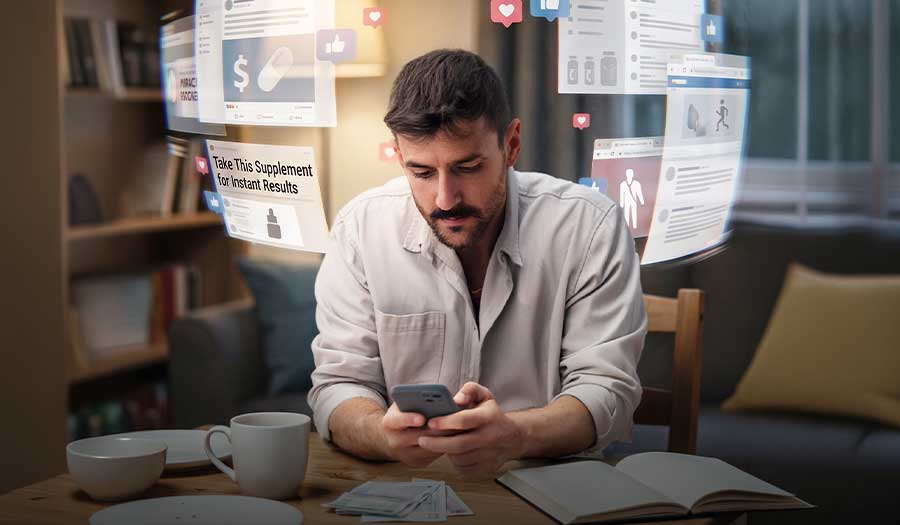
Subscribe NowHealth and wellness advice is available in abundance on social media—from trendy to informative to straight-up disinformation—and you are far from alone in seeing it.
A new survey by the Pew Research Center found that about 4 in 10 U.S. adults—and around half of those under 50—get health information from social media or podcasts.
Researchers also looked at the social media profiles of 6,828 health and wellness influencers with at least 100,000 followers. Only about 4 in 10 list a background as a health professional. About one-third called themselves coaches, about 3 in 10 described themselves as entrepreneurs and about 1 in 10 cited their own life experience, like being a parent.
Despite the wide range of expertise, about half of people who get health and wellness information from influencers said the influencers help them better understand their own health, while about one-third said it has not made much difference. About 1 in 10 said it made them more confused.
Experts say a bit of skepticism is key to interacting with posts about fitness, mental health and personal health. Here are some tips on how to avoid health disinformation online.
How to Vet Credentials
Experts said the biggest green flag is when an influencer’s credentials are easy to find on their profile. Beware the fill-in-the-blank “coach” who cannot prove their training.
Courtney Babilya, a certified medical exercise specialist and personal trainer who has more than 430,000 followers on Instagram, has seen this with maternity content: “Someone has a baby and suddenly they’re a pregnancy coach.”
“We have to be careful with people who have an experience in one thing and suddenly become a ‘coach’ on that,” she said.
“You do have an obligation to make sure that you are not giving someone a false idea or spreading a message that isn’t going to be applicable to everyone,” she said.
Do Not Fall for Viral Shock Factor
If it brings up big emotions, pause. For people who cannot access care or feel unheard by their doctors, an offbeat opinion could feel like a long-sought answer. The Pew survey found 53 percent of uninsured people got health information from social media, compared to 38 percent of those who were insured.
But people who are trying to share good medical information online are not trying to incite fear or surprise, said Dr. Fatima Daoud Yilmaz, an OB-GYN at Stony Brook Medicine in New York.
Even if the person has expertise, ask yourself: Are they speaking outside the scope of their knowledge? Is what they are saying in line with scientific consensus?
“All opinions are not created equal when it comes to something such as health or medicine or science,” said Ms. Daoud.
Look out for exaggerated or definitive claims, especially in the first few seconds of the video when influencers are trying hard to grab your attention, added Ms. Babilya.
Follow the Influencer Money
People on social media are making money—for some, it is their livelihood.
“It doesn’t mean that all of the information that they put out is biased, but it should tell consumers of that information to take it with a grain of salt because they do have financial incentive to be pushing information like this,” Ms. Daoud said.
Ms. Babilya’s platform is now a full-time job, and it is how she supports her family. She is upfront with her audience and makes sure her ads are transparently labeled.
Stop Being a Passive Scroller
Experts also recommend pausing to check the video’s sources. Some posts are not well fact-checked, Ms. Babilya warned, citing studies that have nothing to do with what the influencer says it does.
Use the same standard as when you are vetting a purchase online. Look at the larger conversation around the advice as you would reading product reviews, Ms. Tawwab said.
Two-thirds of users said they just happen to come across the content rather than seeking it out, according to the Pew survey.
If you want to control your feed, it will take time and ongoing effort, said Ash Milton of the University of Minnesota, who studies how users navigate online mental health information.
“You have to work for it because the algorithm is designed to be passive consumption,” Ms. Milton said.
You can use “Hidden Words” on Instagram or “Not Interested” on TikTok to filter out certain content. Use your reaction as a barometer to limit content by asking yourself: Is the health information actually applicable and helpful to your life, or just relatable?
Find a Doctor You Trust
Confirm with a trusted health professional before acting on anything you see online.
Influencers can say anything while medical professionals are ethically and legally liable for your care, and “may face professional and personal consequences for the advice that they give you,” Ms. Daoud said. “Ultimately, talk to the medical provider who knows you.”
A good provider should be willing to answer questions, explain risks and benefits in plain language and take your concerns seriously—especially if something you saw online has left you worried.
Bring the post, clip or claim with you to an appointment. Ask: Does this apply to me? Is there solid evidence behind it? What are the risks of trying it? A trusted provider can put broad advice into context and help you make decisions based on the reality of your health—not the algorithm’s idea of what will keep you watching.
This article contains information from The Associated Press.

More on Related Topics:
- U.S. Acknowledges for the First Time that It Has Deployed Weapons in Space
- UN and Red Cross Step Up Call for International Rules on ‘Killer Robot’ Weapons Systems
- Brazil Uses Forensic Science to Trace Gold’s Origin and Tackle Illegal Mining in the Amazon
- U.S. Bans Foreign-made Humanoid Robots, Targeting China Over National Security
- Why Artemis II United Us
Suggested Reading
More on Related Topics
Latest News
-
October 16, 2026
- Fundraising to Protect Oceans, Forests and Other Key Nature Sites Falling Short Ahead of UN Summit
- Drone Strikes in the Black Sea Raise Fears of Russian Escalation to Test NATO’s Response
- Nepal’s Devastating Flood Exposes the Risks of Resettling Disaster Survivors October 15, 2026
- Sudan’s Famine Risk Worsened by Conflict, Drought and Funding Shortages
- How the Houthis Are Helping Iran Turn Saudi Arabia into a Pressure Point October 9, 2026
- What Will the Next Leader of the UN Need to Get the Job Done in an Increasingly Complex World? October 8, 2026
- UN Health Agency Wants More Details from Russia on Suspected Pneumonic Plague Case
- Ukraine Claims to Have Taken Out More Than Half of Russia’s Oil Refining Capacity
- Violence Has Displaced Members of More Than Half a Million Mexican Households in Past 5 Years
- As Iran War Smolders, Shunned Eritrea Looks to Come in from the Cold September 15, 2026
- U.S. Acknowledges for the First Time that It Has Deployed Weapons in Space
- Some Russians Are Fleeing Abroad, Citing Draft Fears and a Loss of Freedom September 11, 2026
- Americans Mark 25 Years Since September 11 Attacks amid Enduring Grief, Reflection
- Yemen’s Iranian-Backed Houthis Seize an Island in a Key Strait, Opening a New Front in the Iran War September 10, 2026
- The Push to Remove Lead Pipes Is On. Thousands of Water Systems Still Don’t Know Where Theirs Are September 9, 2026
- Family Interest in Education Falls as Test Scores Drop
- The Poorest in the U.S. Can’t Find Housing Even as Low-Income Units Sit Empty September 1, 2026
- In U.S. West, Drought Pits Farms Against Industry
- Why Christians Must Watch the News
- Teach Your Children to Be Active