The country of Greece has long been viewed as the ultimate Mediterranean hotspot. The sun, the sea, the baklava…These are only a few of the outstanding aspects of this beautiful country.
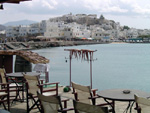
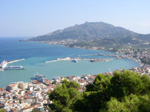
Located in southern Europe, Greece is surrounded by the Mediterranean Sea in almost all directions; the entire country is roughly the size of Alabama, yet it has one of the longest national coastlines in the world—almost 8,500 miles! In contrast, Greece has only about 730 miles of land borders, shared with Albania, Macedonia, Bulgaria and Turkey, all located roughly to its north. The lengthy coastline is partly due to its approximately 2,000 islands, scattered throughout the Mediterranean, Ionian and Aegean seas. Of these islands, only around 200 are inhabited.
Greece’s climate is characterized by hot, sunny summers and temperate, but moist, winters. This mild weather is due to the nation’s location near the Mediterranean Sea. Its landscape is largely rugged and mountainous.
In ancient times, rocky terrain made transport over land difficult. Since the hills and mountains furnished few areas ideal for farming, the ancient Greeks sailed for their supper, so to speak. With most of the country having access to the coast, and with so many islands, natural ports and harbors, the ocean was the most logical transportation route. Greece’s central location, within easy sailing distance of Europe, the Middle East, Africa and Asia, made it a highly advantageous home base for merchants. Whether fishing or trading, the ocean was an integral part of Greek life in times past, and it continues to be today.
Greece’s capital city, Athens, is situated on the Southern coast. Through the centuries, it became one of the world’s great commercial cities. The capital and the surrounding area is now home to approximately one-third of the nation’s 11 million citizens. Many of Greece’s other major cities also lie on the coastline, a reminder of the country’s past as a shipping center for the ancient world.
A great deal of information about ancient Greece comes to us through the remnants of these past ocean journeys—shipwrecks, hidden deep below the clear blue waters that surround the country. These underwater archeological sites have produced many instructive artifacts.
One of the most intriguing ever discovered is the famed Antikythera mechanism, which has been described as a sort of ancient computer. Recently, using the latest technology, scientists have been able to reconstruct the gear mechanisms it contained and have validated many theories that have been put forth through the years—the ancient Greeks were well-versed in the sciences and technologically advanced. At about the size of a shoebox, this mechanism appears to have calculated various astronomical occurrences, and contained more than 30 gears. It is believed to be more complex than medieval cathedral clocks, which were developed more than 1,000 years later!
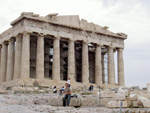
Greek culture and history is of particular pride to its people. Ancient monuments and artifacts dot the landscape, making it impossible to escape Greece’s past. The mythology and pagan religion that confronted the first century Church is still evident in many of the ruined temples devoted to pagan gods and goddesses. However, today, an overwhelming majority of citizens (approximately 98%) claim allegiance to the Greek Orthodox Church.
Another piece of history is the Greek language itself, which is one of the world’s oldest languages, enduring for close to three millennia. While different dialects and variations have occurred over the years, the language itself remains relatively unchanged from that of ancient Greece. Few people are able to say that they could sit down with their ancestors of several thousand years ago and carry on an intelligible conversation!
With its stunning natural beauty and its fascinating history, Greece is a country with something for everyone. Although this article only brushes the surface, you can learn much more about Greece by investigating on your own!
Sources: cia.gov; nationalgeographic.com; britannica.com