Madagascar, also called the Great Red Island because of its red soil, is the fourth largest island after Greenland, New Guinea and Borneo. Although an island, it is larger than countries such as Kenya or France, and nearly twice the size of Arizona. Many even consider Madagascar the unofficial “eighth continent” due to its size and ecological diversity.
Because of Madagascar’s isolation from mainland Africa, it has many unique animal and plant varieties. For example, there are about 40 different species of lemur on the island, which are found nowhere else in the world. Part of the primate family, they live in diverse environments across Madagascar, such as the dry, desert southwest and the lush rainforests of the east.
Even within the different species of lemur there is much diversity. The largest, the indri and the diademed, usually weigh around 15 pounds and can stand 4 feet tall. However, the smallest lemur, actually the smallest primate in the world, is the pygmy mouse lemur. The pygmy mouse lemur averages only about 2.5 inches tall and weighs only 1 ounce!
Madagascar is also home to around 800 butterfly species—not to mention many moth varieties as well. It is estimated that approximately three-quarters of the catalogued plants and animals on Madagascar are entirely unique to the island.
Source: Woophy.com
The only dangerous animal that inhabits the island is the crocodile. A snake called the Do also makes its home here. It can reach up to 10 to 13 feet in size, but is harmless to humans.
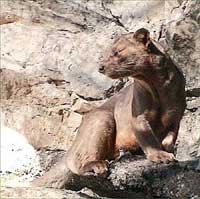
In addition, while not usually dangerous to humans, there is an animal in Madagascar that rates among the most ferocious on earth, pound-for-pound. It is the fossa. Formerly classified in the cat family, it looks to be part cat and part dog, but was finally classified as being related to the mongoose. This land carnivore, the largest in Madagascar, commonly preys on lemur and birds, and many exaggerated legends circulate in regard to its ferocity.
Although Madagascar is considered part of Africa, its history and people are much more closely related to Indonesia and France (as its past colonial ruler), than African peoples. Its official languages are Malagasy, which is written in the Latin alphabet and is considered to have Malayo-Polynesian origins, and French, which is still widely spoken and often used in higher education.
Madagascar gained its independence from France in 1960 and is now a republic led by a president as head of state and a prime minister as head of government. Further, the country is divided into six autonomous provinces, with additional governmental subdivisions in each one.
Of course, this is only a very brief description of a fascinating country. To fully appreciate the many interesting aspects of Madagascar, use this as a starting point for more study and research!
Source: www.britannica.com