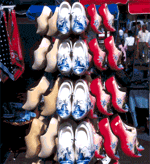
Windmills, tulips, Gouda cheese, wooden shoes… These items will generate a picture of the Netherlands in the minds of most—and for good cause, since all are closely associated with Dutch tradition. But there is more to this country and people than you might think! Let’s take a brief look at what makes this country and its people unique.
While the official name is the Netherlands, many commonly refer to the country as Holland. However, that name technically refers to the two western provinces of the country: North and South Holland. Interestingly, the name “Netherlands” is derived from the Dutch word neder, meaning “low.”
But, to truly understand the name of the country, along with the high profile of windmills and dikes, one must understand the nature of the Dutch landscape. There is a famous saying in the Netherlands: “God created the Earth, but the Dutch created the Netherlands.” This is said because almost half of the country is below sea level; without the use of dikes keeping the North Sea at bay, about 65 percent of the country would be flooded daily by the rising tides.
The utilization of dikes and windmills in the Netherlands began hundreds of years ago and has continually grown and advanced since then. In fact, just over 150 years ago, there were more than 10,000 windmills in the Netherlands! These have increased the size of the country by creating polders—large areas of land that have been reclaimed from the sea through drainage. Currently, more than 1,500 miles of dikes protect these polders and the country itself from the North Sea.
This reclaimed land is crucial to the Netherlands because the country is also the most densely populated in Europe, despite that 60 percent of its land is farmed—and by only 2 percent of the workforce! Remarkably, even with its relatively small size, the Netherlands is actually the third largest agricultural exporter in the world, behind only the United States and France.
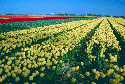
Another common Dutch item is the tulip—and deservedly so, as the Netherlands produces about nine billion flower bulbs per year! This tulip phenomenon began at the end of the 16th century when they were introduced from eastern Mediterranean regions. This was a period when the Netherlands was thriving, and these exotic imports became highly sought after as status symbols. As a result, an artificial demand was created that, for some varieties, hiked prices into the several thousand guilders (more than $1,000) range for a single bulb! Eventually, statutes were passed to suppress the artificial demand and pricing. Now tulips are simply a beautiful and widespread symbol of the Netherlands.
There is much more that could be mentioned about the interesting and unique country of the Netherlands—colonial history, monarchy, government, people, culture and traditions. Challenge yourself to see what else you can learn!
Sources: www.nationalgeographic.com; www.lonelyplanet.com
Source: ArtToday, Inc.
Source: ArtToday, Inc.