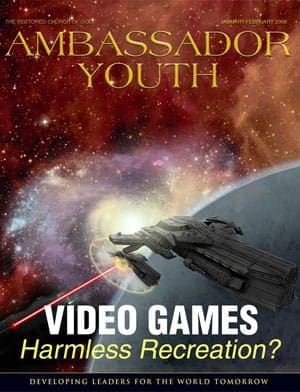
Imagine an unending universe where new worlds are constantly being discovered. In it are thousands of worlds with varied landscapes—rugged mountains, coastal beaches, deep forests and strange new planets ready for exploration.
Now imagine the excitement of visiting such environments. You are free to uncover these areas, yet there is a deadly flaw…
Within this universe, there is absolutely no law. Individuals are free to do whatever they wish. Since decisions are not connected to repercussions, no one is accountable. Actions, whether good or evil, are not tied to consequences, and as a result, only chaos ensues. Violence and strife is rampant. With everyone performing what seems right in his own eyes, the fruit of human nature is ugly.
This universe pictures the realm of video games.
Cutting Edge of Entertainment
Consider the following video games:
- World in Conflict – Set in 1980s America, the player reenacts a would-be scenario of nuclear conflict resulting from the Cold War.
- Manhunt 2 – Set in an urban landscape, the player is an insane asylum escapee who goes on a series of thrill killings.
- Vivisector: Beast Within – The player journeys through a tropical island, hunting and being hunted by crossbreeds of human and animal mutations.
- Gears of War – Set on a fictional planet, the player is an AWOL super-soldier warring against hordes of invading aliens.
- Hitman 2: Silent Assassin – The player travels the world as a genetically-engineered contract killer hired to murder a variety of criminals and innocents alike.
- Hellgate – Set in post-apocalyptic London, the player engages in a hack-and-slash fight against a “demonic” invasion.
With billions of dollars in sales each year, why are these games so popular?
Video games are an escape—a reconstructed view of reality—where the player can be completely removed from real life. Gamers are placed in a surreal world, charged with accomplishing a thrilling mission without any regard to how they complete it—without rules, repercussions or laws.
Most game platforms have made great advances in the last few years. With newly developed technology, one can actually act out the game as he plays.
Consider the Manhunt series, a game in which motions are acted out. The player eviscerates opponents by thrusting, stabbing and gouging with a motion sensor controller.
A game’s “engine” renders 3-D graphics and is the invisible structure of a video game’s digital world. These engines are now able to seamlessly create larger and more detailed landscapes, offering a heightened sense of engagement in the game.
Furthermore, game consoles now have the ability to show what developers call “Area Specific Damage” on virtual images. This ensures that digital player models don’t just disappear when destroyed; specific body parts can be targeted and mutilated with gory realism.
Reality Without Repercussions
The worlds created in these titles can suddenly transport one from everyday reality into the armor of a marine on a far-flung planet, defending against an invading horde of alien attackers. The sole purpose becomes to accomplish your mission, through targeting and destroying as many enemies as possible in the shortest amount of time.
The player is placed in the boots of a marine, making the decision to “pull the trigger” on as many “living” targets as possible.
This alternate reality is completely divorced from the real world, where laws of cause and effect apply. Violent and fatal decisions are easily overturned with the click of a button. Players are encouraged to take foolish risks without fear of having to “live” with their decisions.
While developers understand this, they appeal to larger audiences by promoting “universe threatening” scenarios that encourage players to ruthlessly take action. Once the hero is established in such a dramatic scene, the player can now justify the violence perpetrated in the game since, after all, the universe is in danger. The more sensational the scenario, the easier it is to become lost in the game.
“Virtual Actuality”
Becoming a hero in a pitched battle can be more appealing than having to deal with issues of everyday life. Homework, parents, chores and after-school jobs all pale in comparison to slipping into the shoes of a hired hitman about to take on the next big job. In fact, enough time spent in the shoes of that persona will actually change the way a player perceives real life. It can become difficult to distinguish between reality and fantasy.

Source: ArtToday, Inc.

Source: ArtToday, Inc.

Source: ArtToday, Inc.
By focusing so much effort on your virtual life, you ultimately give up quality time spent in your real life. Priorities shift, and one soon finds himself drawn back to the virtual world that offers things the real world cannot.
Most game designers seek to offer a virtual world, boasting that anything is possible. In order to electrify their audience, they design games to exemplify the elements that appeal most to human nature. In other words, anything illegal is possible, with titles such as Grand Theft Auto designed to allow the player to act like a criminal.
The Alter Ego
“Embrace your alter ego” is a slogan touted in the gaming world. A player is encouraged to forget who he is and take on the persona of the game’s character. In other words, leave your life behind and escape to a realm where you do not need to be concerned about balancing your life, developing human relationships or planning for the future.
Sadly, many gamers take their alter egos to the extreme. Non-essentials become difficult to separate from priorities. Instead of focusing on expanding their knowledge, they become obsessed with advancing the characters or storylines in games. This misplaced focus can impede one from achieving his or her potential.
But just what is the purpose of our lives? What should we be focusing on?
We are to increase our knowledge and expand our horizons. We are to develop ourselves in our youth so we can handle difficult tasks later in life. These include planning for the future, receiving an education, choosing a career and beginning a family.
Your teenage years are one of the most valuable and profitable times. You will severely hinder yourself if you do not use that time wisely.
This is not to say that all games perpetrate violence and a total escape from the world. There have been titles that encourage learning new skills.
Additionally, software packages exist that are useful in creating and compiling digital art, composing music or editing video. Much of this software can be found online for free and can be used for more productive purposes.
It is Not Actually War…
A question to ask when thinking of purchasing or playing the next new video game is, “Would I play this game in the presence of Christ or one of His ministers?”
It can be easy to justify your actions, perhaps thinking that, since there is not “too much” bloodshed in a game, it is still acceptable to play.
Perhaps you are blasting aliens, not humans. Does this mean you are not killing?
In seemingly every game released today, there is violence on an epic scale. Sometimes these titles are overtly violent; other times they appear to be a harmless mix of good and evil. When you are in the game, think: Does it force you to decide between virtual life and death? If so, what would Christ choose? (See Matthew 5:39.) Are we given the authority to choose between the life and death of others?
Despite that the enemies you are destroying are only virtual, the decision to commit violence starts in the mind. Whether you are a hardened hitman pulling the trigger on one of his victims, a space marine “mowing down” an onslaught of alien hordes, or a general commanding his armies to wipe out entire cities, this virtual destruction is present in the mind.
When slipping into the persona presented in a game, ask yourself, “Does this project an image that I am trying to follow Christ?” or “Does it present an image that I am a cold-blooded killer, willing to do anything to accomplish the mission?”
We are told to dwell on whatsoever things are good and just (Phil. 4:8). Do violent games allow us to dwell on these thoughts? Do they present the fruits of the Spirit, found in Galatians 5:22-23? Or do they reflect human nature—the works of the flesh (vs. 19-21)?
The apostle Paul stated, “Whatsoever a man sows, that shall he also reap” (Gal. 6:7). Is filling our minds with fictional worlds brimming with violence sowing “good seeds”?
A Far Greater Mission
As ambassadors representing a soon-coming government, we have a much more fascinating and difficult mission. While video game developers strive to create title after title of fantasy, war-absorbed scenarios, the truth of God’s Plan is infinitely more dramatic and exciting than what any video game could offer. We are training to be leaders in the World Tomorrow. Eventually we will be responsible for designing thousands of solar systems, planning immense cities and creating new worlds, where all will live in peace and safety.
Jesus Christ commands those following Him not to kill or destroy (Ex. 20:13). Yet Christians are to use weapons—spiritual weapons—to control what enters their minds (II Cor. 10:4-5). Consider this when choosing how to spend your time.
While you may not be baptized, it is imperative to grow and train yourself for the awesome mission offered to you. Through the Church and your parents, you have the opportunity to accept this most crucial objective.
At best, virtual worlds are a cheap substitute for your awesome potential. At worst, they are a platform that encourages and rewards those who act out brutality and violence through their actions, without repercussion, in a digital fantasyland.
Time is short! A mission lies in front of us: train to become leaders in an amazing new world coming soon to restore peace, develop new worlds and create happiness for all throughout the universe. This is a reality that requires dedication now—to fight against the pulls of your mind and remove the negative, violent and surreal influences in your life. Even though the odds may look grim, God has assured nothing but victory.
The question is, are you up to the mission?