In today’s society, the aged are routinely ignored, overlooked, patronized and abused. They remain, for the most part, an untapped source of experience and wisdom. They are seen as an inconvenience and an impediment. Although this stage of life is generally referred to as “the golden years,” society has relegated those who attain it to the status of “old-fashioned, outdated, obsolete and irrelevant.”
How do you view your parents? Your grandparents? When they offer advice or correct you in some way, hearkening back to events or circumstances from their youth—perhaps even telling you a story, beginning, “When I was your age…”—do you find yourself thinking, “Here we go again…”? Or do you look forward to what they are about to tell you, appreciating the wisdom of their advanced years and the lesson that is forthcoming?
Hidden Treasure
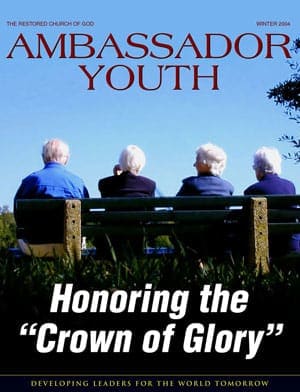
Ultimately, as a young person learning God’s Way, the basis for how you live your life should be God’s Word, the Bible. And one of the lessons it reveals is to show proper respect and consideration for those in positions of authority. This begins with our parents, and includes, by extension, grandparents and all those who are older, more experienced and, therefore, wiser—those whom the Bible refers to as “the hoary head.”
Unfortunately, most young people do not take this approach, but rather prove the truth of the adage, “Youth is wasted on the young.” The following anecdotal timeline demonstrates the “evolution” of one’s thinking in regard to his parents. While the focus is on the father, the principle applies to both parents, and even to grandparents:
4 years:“My daddy can do any-thing.”
7 years: “My dad knows a lot, a whole lot.”
8 years: “My father doesn’t know quite everything.”
12 years: “Oh, well, naturally Father doesn’t know that, either.”
14 years: “Father? Hopelessly old-fashioned.”
21 years: “Oh, that man is out-of-date. What did you expect?”
25 years: “He knows a little bit about it, but not much.”
30 years: “Maybe we ought to find out what Dad thinks.”
35 years: “A little patience. Let’s get Dad’s assessment before we do anything.”
50 years: “I wonder what Dad would have thought about that. He was pretty smart.”
60 years: “My dad knew absolutely everything!”
65 years: “I’d give anything if Dad were here so I could talk this over with him. I really miss that man.”
(The above is from “Wake Up and Smell the Coffee!”, which appeared in an Ann Landers column.)
A Crown of Glory
The Bible offers valuable instruction regarding the proper way to behave toward those who, by reason of age, have inherited “a crown of glory.” Notice the following verses:
Leviticus 19:32: “You shall rise up before the hoary [gray] head, and honor the face of the old man, and fear your God: I am the Lord.”
Proverbs 16:31: “The hoary head is a crown of glory, if it be found in the way of righteousness.”
An extensive account in the book of I Kings demonstrates the folly of rejecting the wisdom and counsel of those who are older and wiser. It is found in chapter 12, verses 6 to 16, and you may wish to take the time to read the entire account.
To summarize: King Solomon had died, and his son Rehoboam assumed the throne over the nation of Israel. Desiring to begin his reign “on the right foot,” he summoned his court advisors (a group of older men who had served Solomon) for counsel. Having seen the disastrous effects of Solomon’s many domestic policies (including heavy taxation), these men recommended the reversal of those policies, so as to lighten the burdens on the citizenry.
However, desiring a “second opinion,” Rehoboam consulted a team of his peers, who basically told him to ignore the advice of the elders and to raise taxes. He followed their advice, which resulted in the splitting of the nation of Israel.
Another account showing the seriousness God places on giving proper respect to those who are older or in positions of authority is found in II Kings, involving the prophet Elisha. Notice: “And he [Elisha] went up from there unto Bethel: and as he was going up by the way, there came forth little children out of the city, and mocked him, and said unto him, Go up, you bald head; go up, you bald head. And he turned back, and looked on them, and cursed them in the name of the Lord. And there came forth two she bears out of the wood, and tore forty and two children of them” (2:23-24).
Here, blatant disrespect for one of God’s servants resulted in the violent deaths of 42 children. Are you beginning to see how important it is to God that you respect your elders?
Application for Today
Many would view the above account as extreme and harsh. Although God does not send wild bears to punish those who are disrespectful to their elders or those in positions of authority today, He inspired the recounting of that episode in the history of ancient Israel for our example (I Cor. 10:11). How can you apply these lessons in your life?
Consider: When one of your parents or another adult asks you to do something, do you immediately do it (as long as it does not break God’s laws), or do you ask, “Why?” When talking to adults, do you address them by first name or as “Mr.”, “Mrs.,” or other appropriate title? When an adult enters a room, do you acknowledge him/her? (For example, do you rise from your chair, if seated?)
The question naturally arises, “When is one an adult?” The Bible shows that God considers those who are age 20 and above to be adults (Ex. 30:14; 38:26; Lev. 27:3; 27:5; Num. 1 (entire chapter); 32:11; I Chron. 23:24). These scriptures show that responsibility was given to—and accountability required of—those who had reached the age of 20.
Like precious nuggets of gold, the elderly can be an invaluable resource just waiting to be tapped. As a young person, you should respect those who are older or in positions of authority, realizing that they have much to offer, in experience, history and wisdom. Although you may not always see the wisdom in what they tell you, recognize that God will reward you for showing them proper respect and following their instructions. Remember, you yourself will one day wear that “crown of glory,” so show appreciation for its value by respecting those who wear it today.